The holiday season is usually marketed as a time of “connection.” But let’s be real: for most of us, that “connection” happens through a 6-inch glass screen. We’re snapping photos of the turkey instead of eating it, and scrolling through other people’s family reunions while sitting in the middle of our own.
By the time late December rolls around, many of us aren’t just physically tired—we are digitally exhausted. Our attention spans are shorter than a goldfish’s, our sleep is wrecked by blue light, and our “dopamine receptors” are fried from too many notifications.
Recent studies show that the average American worker spends 23% of their day just managing email, and 31% of US adults are online “almost constantly.” This isn’t just a habit; it’s a biological overload that leads to “mental fog” and increased cortisol.
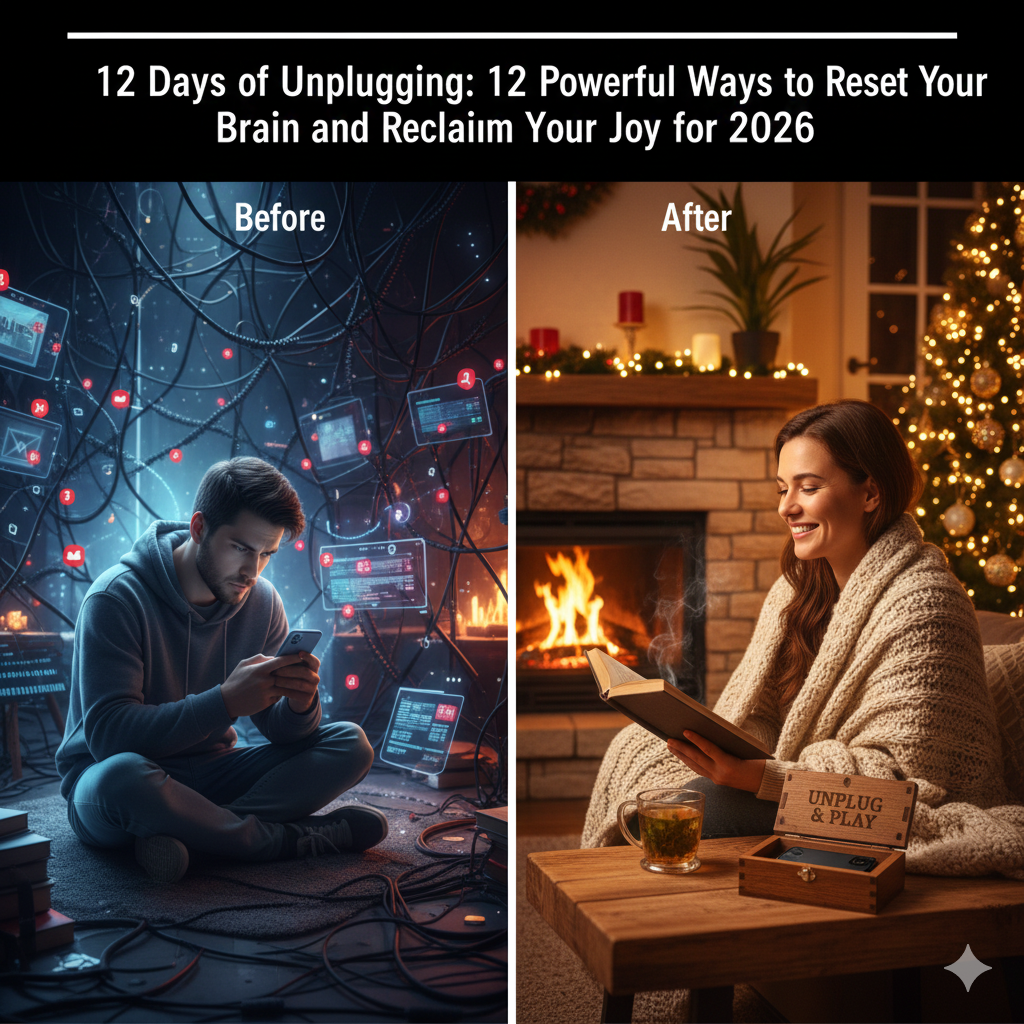
That is why we created the 12 Days of Unplugging challenge. At Unplugged Routine, we believe that the best way to start a new year isn’t with a complicated resolution, but with a clean slate. This 12-day framework is designed to help you slowly “de-pixelate” your life, moving from digital chaos to analog clarity just in time for 2026.
Day 1: The “Notification Lockdown”
The Science: Every “ping” triggers a micro-stress response. Research from the University of California shows it takes an average of 23 minutes and 15 seconds to get back to deep focus after a single interruption.
The Action: Go into your settings and turn off every single non-human notification. Silence the shopping apps, the news alerts, and the social media “likes.” Keep only the “vitals”—calls from family and direct texts. You’ll be amazed at how much “phantom vibration” anxiety disappears when your phone finally stops screaming for your attention.
Day 2: The 30-Minute Morning Sanctuary
The Hook: Most Americans check their phones within five minutes of waking up. This forces your brain to react to the world’s problems before you’ve even addressed your own needs.
The Action: Keep your phone in another room for the first 30 minutes of the day. Use this time for “Human Inputs”: stretch, drink water, or look out the window. By owning your first half-hour, you set the emotional tone for the next sixteen.
Day 3: The “Paper over Pixels” Swap
The Science: Reading on paper improves comprehension and retention compared to screens. Furthermore, physical books don’t have “blue light,” which suppresses melatonin production.
The Action: Swap your evening scroll for a physical book or magazine. The tactile sensation of turning a page sends a signal to your nervous system that the “work day” is officially over.
Day 4: The Digital Sunset
The Hook: Blue light mimics high-noon sunlight. When you scroll at 11 PM, you are biologically telling your brain to stay awake.
The Action: Set a “hard stop” for all screens one hour before bed. Dim the lights, put the laptop in a drawer, and let your internal clock reset. This is the secret to waking up on Day 5 without that “hangover” feeling.
Day 5: The “Phone Jail” Dinner
The Hook: “Phubbing” (phone-snubbing) is a leading cause of relationship dissatisfaction.
The Action: Create a “Phone Jail”—a simple basket or box. Every person at dinner must check their device at the door. The first person to reach for their phone does the dishes. Watch how the quality of conversation triples when eyes meet eyes instead of screens.
Day 6: The “Analog Journey” (No GPS!)
The Science: Spatial navigation is handled by the hippocampus. When we rely 100% on GPS, we actually weaken the parts of our brain responsible for memory and direction.
The Action: Go for a walk or drive to a familiar spot without using your phone. Notice the landmarks—the blue house on the corner, the oak tree by the park. Reclaim your sense of place in the physical world.
Day 7: The “Dopamine Fast” – Social Media Blackout
The Science: Social media apps are “variable reward” machines, similar to slot machines. A 24-hour break allows your dopamine receptors to “downregulate” and recover.
The Action: For 24 hours, delete or ignore all social media. No Instagram, no TikTok, no LinkedIn. You will likely feel a “twitch” to check your phone—this is a sign of your brain healing. Embrace the boredom; it’s where your best ideas are hiding.
Day 8: The “Manual Creative” Session
The Hook: We have become a society of “consumers.” Today, we become “creators.”
The Action: Spend 30 minutes on a hobby that requires your hands: sketching, knitting, gardening, or trying a recipe from a printed book. There is a profound psychological link between hand movements and mental well-being.
Day 9: The “No-Camera” Memory
The Hook: When we take a photo, we often “outsource” the memory to the device, making us less likely to remember the details ourselves.
The Action: Find a beautiful moment today—a sunset or a quiet cup of tea—and intentionally decide not to photograph it. Close your eyes and “save” the image in your mind instead. It stays more vivid when it’s for you, not for an audience.
Day 10: The “Single-Task” Challenge
The Science: The brain cannot multitask; it can only “switch-task,” which lowers IQ by up to 10 points (similar to losing a night’s sleep).
The Action: Do one thing at a time today. If you are eating, just eat. If you are listening to a podcast, don’t scroll your phone simultaneously. Train your “focus muscles” to do the deep work.
Day 11: The “App Purge”
The Action: Open your phone and look at every app. Ask: “Does this serve me, or do I serve it?” If an app makes you feel anxious, angry, or just wastes your time, delete it. Your home screen should be a curated garden, not a cluttered junkyard.
Day 12: The Full 24-Hour Digital Sabbath
The Grand Finale: You’ve built the stamina for this. From sunrise to sunset, turn your phone completely off. No “quick checks.”
Spend this day in nature, with family, or in deep rest. This is your “hard reset” for 2026. You’ll return to the digital world on Day 13 not as a slave to the algorithm, but as its master.
Conclusion: Your Unplugged Routine Starts Now
The 12 Days of Unplugging isn’t about becoming a hermit. It’s about taking back the remote control of your own life. As we move into 2026, the world is only going to get louder. By practicing these twelve steps, you’ve built the “digital resilience” needed to stay sane, focused, and happy.
Are you ready to reclaim your joy? We’re starting a community-wide challenge this week! Leave a comment below with the word “IN” to join, and tell us: Which of these 12 days will be your biggest challenge? Let’s support each other!