Hey there, awesome students! Are you feeling the post-holiday slump, or maybe just a little overwhelmed by the constant digital buzz? You’re not alone. In today’s hyper-connected world, it’s easy to get sucked into endless scrolling, notifications, and the pressure to be “always on.” But what if I told you that by strategically unplugging, you could actually boost your grades, reduce stress, and genuinely enjoy your student life more? Sounds pretty good, right?
Welcome to the 30-Day Unplugging Routine Challenge designed specifically for YOU! This isn’t about ditching technology entirely (let’s be real, that’s not practical for students!). Instead, it’s about creating a healthier, more intentional relationship with your devices. It’s about taking back control, one mindful step at a time.
Think of this as your secret weapon for a more focused, productive, and ultimately happier new year. Ready to dive in and transform your habits? Let’s get started!
The Digital Overload Epidemic: Why Students Need to Unplug
Before we jump into the “how,” let’s chat about the “why.” You’re probably juggling classes, homework, social life, part-time jobs, and maybe even family commitments. Add to that the constant stream of social media, news alerts, and streaming services, and it’s a recipe for burnout.
Here’s what digital overload can look like for students:
- Decreased Focus & Productivity: Constantly checking your phone breaks your concentration, making it harder to study effectively or complete assignments efficiently.
- Increased Stress & Anxiety: The fear of missing out (FOMO) and the pressure to present a perfect online persona can take a serious toll on your mental well-being.
- Sleep Deprivation: Scrolling late into the night disrupts your natural sleep cycle, leaving you tired and groggy for classes.
- Eye Strain & Headaches: Hours spent staring at screens can lead to physical discomfort.
- Reduced Real-World Connections: When you’re constantly glued to your screen, you might miss out on genuine interactions with friends and family right in front of you.
Does any of that sound familiar? The good news is, you have the power to change it!
Your Unplugging Routine Toolkit: Essential Tips Before You Begin
Before we kick off the 30-day challenge, let’s arm you with some fundamental strategies that will make this journey smoother and more effective. These aren’t rules; they’re guidelines to help you build a sustainable unplugging routine.
- Understand Your “Why”: What do you hope to gain from this challenge? Better grades? More sleep? Less stress? A clearer mind? Write it down and keep it somewhere visible. Your “why” will be your biggest motivator.
- Start Small, Be Consistent: Don’t try to go from 10 hours of screen time to 1 hour overnight. This is about gradual, sustainable change. Small, consistent steps lead to big results.
- Identify Your Digital Triggers: What makes you reach for your phone? Is it boredom, stress, a notification, or habit? Recognizing your triggers is the first step to managing them.
- Create Physical Boundaries: Your phone doesn’t need to be your constant companion. Designate “no-phone zones” in your home, like your bed or the dinner table.
- Find Offline Replacements: What will you do instead of scrolling? Brainstorm activities like reading, journaling, exercising, spending time in nature, or connecting with friends in person.
- Communicate Your Intentions: Let your friends and family know you’re taking on this challenge. They can offer support and understand if your response times are a little slower.
- Be Kind to Yourself: There will be days when you slip up, and that’s perfectly okay! Don’t let one misstep derail your entire effort. Acknowledge it, learn from it, and get back on track.
The 30-Day Unplugging Routine Challenge: Your Daily Blueprint
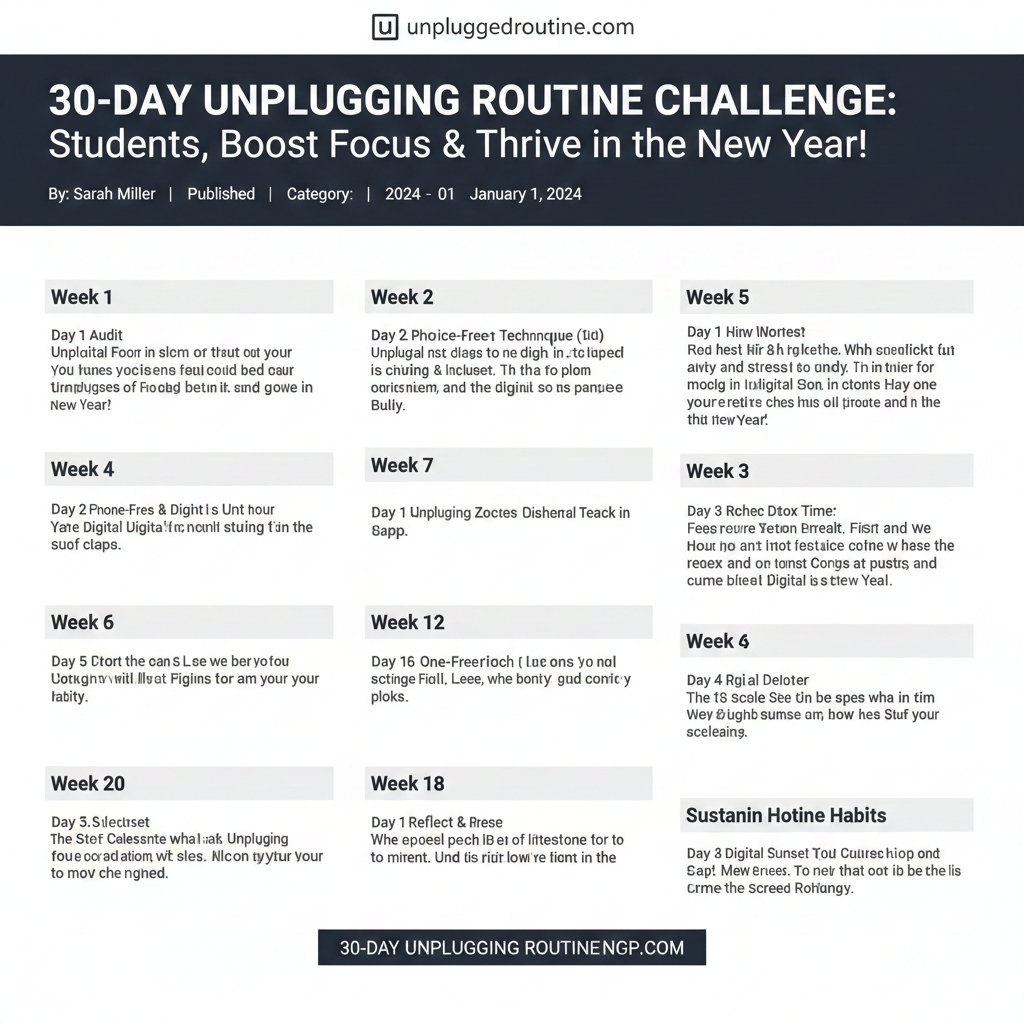
This challenge is structured to build on itself, gradually integrating new habits into your life. Each week introduces a new focus, helping you progressively reduce your reliance on digital devices and establish a powerful unplugging routine.
Week 1: Digital Awareness & Mindful Mornings
This week is all about understanding your current digital habits and starting your day with intention, free from immediate screen interaction.
Day 1: Digital Audit
- Challenge: Track your screen time honestly. Most smartphones have built-in features for this (Settings > Screen Time on iOS, Digital Wellbeing on Android).
- Goal: Simply observe without judgment. How much time are you spending, and on which apps?
Day 2: Phone-Free First Hour
- Challenge: For the first hour after waking up, do not touch your phone. No checking social media, emails, or news.
- Goal: Start your day with a calm mind. Try reading a book, stretching, or making breakfast.
Day 3: Notifications Lockdown
- Challenge: Turn off all non-essential notifications for social media apps. Keep only calls and essential messages.
- Goal: Reduce constant interruptions and reclaim your attention.
Day 4: Email & Social Media Check-in Times
- Challenge: Designate specific times of day to check emails and social media (e.g., once in the morning, once in the afternoon, once in the evening). Avoid impulsive checks.
- Goal: Be intentional about when you engage with these platforms, rather than letting them dictate your time.
Day 5: Mindful Meals
- Challenge: Make at least one meal a day completely phone-free. Put your device away and focus on your food and any company.
- Goal: Practice presence and enjoy your meals without digital distraction.
Day 6: Digital Detox Hour
- Challenge: Find one hour today where you completely unplug. Put your phone on silent, away from reach, and engage in an offline activity.
- Goal: Experience the freedom of being truly present.
Day 7: Reflect & Plan
- Challenge: Review your screen time from the week. What did you notice? How did you feel during your unplugged moments? Plan for Week 2.
- Goal: Cement your learnings and prepare for the next steps in your unplugging routine.
Week 2: Focused Work & Study Blocks
This week focuses on integrating your unplugging routine into your academic life, enhancing your concentration and productivity.
Day 8: Pomodoro Power-Up (Unplugged Edition)
- Challenge: Use the Pomodoro Technique (25 minutes of focused work, 5-minute break) but keep your phone out of sight during the 25-minute sprints.
- Goal: Improve deep work sessions and reduce study distractions.
Day 9: Device-Free Study Zone
- Challenge: Designate a specific study area (e.g., your desk, a library cubicle) where your phone is either turned off, on silent, or in another room during study sessions.
- Goal: Create an environment conducive to concentration.
Day 10: One Tab Rule (or App)
- Challenge: When working on a computer, try to only have the tabs or applications open that are essential for your current task. Close all others.
- Goal: Minimize digital clutter and reduce the temptation to multitask.
Day 11: Scheduled Breaks, Not Distraction Breaks
- Challenge: During your scheduled breaks, actively choose an offline activity (stretch, walk, grab a snack) instead of immediately grabbing your phone.
- Goal: Make your breaks truly restorative, rather than just shifting digital gears.
Day 12: Digital “Do Not Disturb” (for Studying)
- Challenge: Utilize your phone’s “Do Not Disturb” feature during all study blocks, ensuring only urgent calls get through.
- Goal: Protect your focus from incoming interruptions.
Day 13: Offline Brainstorming
- Challenge: For an upcoming assignment or project, try to brainstorm ideas using pen and paper before turning to digital tools.
- Goal: Engage your creativity without the immediate influence of search engines.
Day 14: Reflect & Refine
- Challenge: How did your focus improve this week? What challenges did you face? Adjust your plan for Week 3.
- Goal: Continuously improve your personalized unplugging routine.
Week 3: Social Connections & Leisure Time
This week shifts focus to enriching your social interactions and leisure activities by intentionally reducing digital interference.
Day 15: In-Person Connection Challenge
- Challenge: Initiate an in-person conversation with a friend, classmate, or family member without checking your phone during the interaction.
- Goal: Prioritize real-time connections over digital ones.
Day 16: Analog Entertainment
- Challenge: Choose an analog form of entertainment for at least 30 minutes (e.g., reading a physical book, listening to a record, playing a board game, drawing).
- Goal: Rediscover the joy of non-screen-based leisure.
Day 17: Walk & Observe
- Challenge: Go for a walk (even a short one) without your phone. Pay attention to your surroundings, the sounds, and the sights.
- Goal: Practice mindfulness and appreciate the world around you.
Day 18: Phone-Free Social Gathering
- Challenge: When you’re with friends or family, keep your phone in your bag or pocket. Be present in the conversation.
- Goal: Enhance the quality of your social interactions.
Day 19: Creative Unplugging
- Challenge: Engage in a creative activity that doesn’t involve a screen (e.g., cooking, baking, painting, playing an instrument, writing in a journal).
- Goal: Tap into different parts of your brain and reduce screen fatigue.
Day 20: Digital Sunset
- Challenge: Set a “digital sunset” time. For example, no screens after 9 PM. Wind down with a book or conversation instead.
- Goal: Improve your sleep quality and prepare your mind for rest.

Day 21: Reflect & Celebrate
- Challenge: What new hobbies or connections did you discover this week? What felt surprisingly easy or difficult?
- Goal: Acknowledge your progress and look forward to the final push in your unplugging routine.
Week 4: Sustaining Habits & Future-Proofing
This final week is about solidifying your new habits and planning how to maintain your healthy unplugging routine long-term.
Day 22: Technology-Free Zone Expansion
- Challenge: Identify another area or time in your daily life where you can implement a “no-phone” rule (e.g., gym, waiting in line, commute).
- Goal: Broaden the scope of your intentional unplugging.
Day 23: Digital Declutter
- Challenge: Delete apps you rarely use, unfollow accounts that don’t inspire you, and unsubscribe from unnecessary email newsletters.
- Goal: Reduce digital noise and make your online experience more intentional.
Day 24: Scheduled Digital Breaks (Not Just Unplugging)
- Challenge: Intentionally schedule short periods during the day where you do allow yourself to engage with social media or other non-essential digital content. This makes your engagement more conscious.
- Goal: Integrate digital use into your routine rather than letting it take over.
Day 25: The “Why” Revisited
- Challenge: Revisit your initial “why” for taking this challenge. How has your relationship with technology changed? Have you achieved any of your initial goals?
- Goal: Reaffirm your motivations and see how far you’ve come.
Day 26: Teach Someone Else
- Challenge: Share one tip or strategy from your unplugging routine challenge with a friend or family member.
- Goal: Reinforce your own learning by explaining it to someone else.
Day 27: Plan Your Weekend Unplug
- Challenge: Plan an activity for the upcoming weekend that is completely screen-free or significantly minimizes screen use.
- Goal: Extend your unplugging routine into your downtime, making weekends truly restorative.
Day 28: Design Your Ideal Digital Day
- Challenge: On paper, sketch out what your ideal daily schedule looks like, incorporating intentional unplugged times, focused work, and balanced digital use.
- Goal: Create a personalized roadmap for your long-term digital well-being.
Day 29: Problem-Solving & Adaptability
- Challenge: Identify potential roadblocks to maintaining your unplugging routine in the future. Brainstorm strategies to overcome them.
- Goal: Develop resilience and adaptability to sustain your habits.
Day 30: Celebrate & Commit
- Challenge: Reflect on your entire 30-day journey. Celebrate your successes! Write down 3-5 key habits you want to continue.
- Goal: Solidify your commitment to a healthier, more balanced digital life moving forward. You’ve built a powerful unplugging routine!
Beyond the 30 Days: Making Unplugging a Lifestyle
Congratulations! You’ve completed the 30-Day Unplugging Routine Challenge! You’ve taken significant steps toward a healthier, more balanced relationship with technology. This isn’t just a challenge; it’s the beginning of a new, empowering lifestyle.
Remember, the goal isn’t to be perfectly unplugged all the time. It’s about being intentional with your digital use. It’s about choosing when and how you engage with screens, rather than letting them choose for you.
Here are some final tips for maintaining your unplugging routine:
- Regular Check-ins: Periodically review your screen time and digital habits. Are you slipping back into old patterns?
- Be Flexible: Life happens! If you have a busy week, be realistic about your goals, but don’t give up entirely.
- Keep Exploring Offline Hobbies: The more engaging offline activities you have, the less you’ll rely on screens for entertainment or stress relief.
- Advocate for Yourself: Don’t feel pressured to respond to messages immediately. It’s okay to set boundaries with friends and family.
- Embrace Boredom: Sometimes, letting yourself be a little bored can spark creativity and encourage you to find new, enriching activities.
Conclusion: Reclaim Your Time, Reclaim Your Life!
You’ve just invested 30 days into yourself – your focus, your well-being, and your future. By embracing this unplugging routine, you’re not just reducing screen time; you’re gaining valuable time for deeper learning, genuine connections, restful sleep, and self-discovery. This new year, make a commitment to being present, productive, and truly thriving.
Ready to continue your journey towards a more balanced and focused life?
Share your biggest takeaway from this challenge in the comments below! What’s one habit you’ll definitely keep? Let’s inspire each other to stay unplugged and engaged!