Let’s be honest. It’s 11:30 PM. You know you should be asleep. Your pillow looks inviting, your body is tired, and your alarm is set for 6:00 AM. But there you are, phone in hand, mindlessly scrolling.
One quick peek at Instagram turns into an hour-long odyssey through your friend’s cousin’s vacation photos. You click over to TikTok, and suddenly it’s 1:00 AM, your eyes are burning, and your mind is buzzing with everything from DIY crafts to existential commentary.
You’re caught in the late-night scrolling trap.
This cycle isn’t a sign of weak willpower; it’s a symptom of a powerful digital habit, deliberately designed to keep you hooked. If you’ve felt the frustration of losing hours of precious sleep to a glowing screen, you are absolutely not alone.
The good news? The solution isn’t a dramatic, painful digital detox. It’s a strategic, step-by-step process of unplugging before bed. It’s about building a better routine, not relying on sheer willpower.
This comprehensive, guide from UnpluggedRoutine.com will give you a 7-step blueprint—anchored in a practical 21-Day Challenge—to fundamentally rewire your evenings, ditch the scroll, and reclaim the deep, restorative sleep you deserve.
Ready to say goodbye to “doom scrolling” and hello to serenity? Let’s dive in.
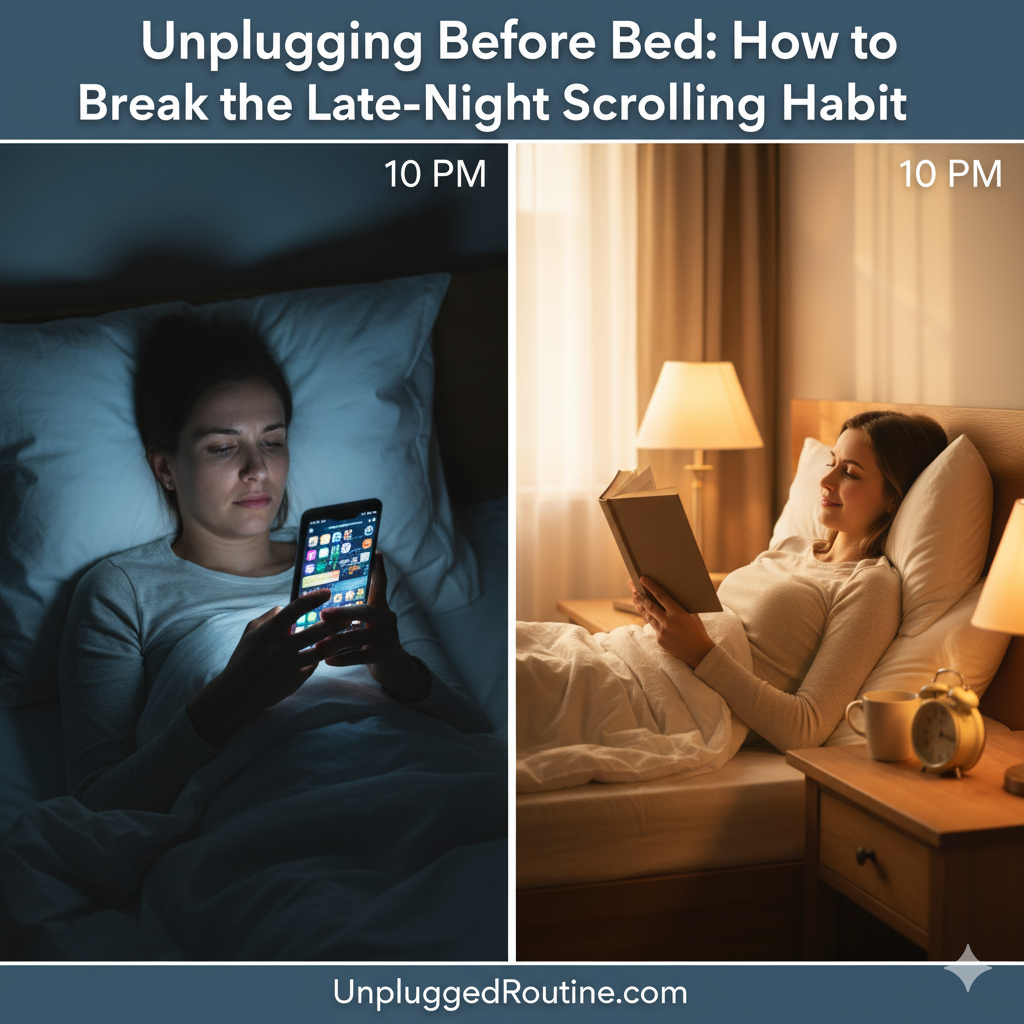
Part 1: The Astonishing Truth: What Late-Night Scrolling Does to Your Body
The late-night scroll feels harmless—a way to “wind down.” But the science is crystal clear: this habit is actively sabotaging your sleep quality, mood, and long-term health. We have to understand the why before we can fix the how.
The Silent Saboteur: Blue Light vs. Melatonin
The number one culprit in the unplugging before bed battle is blue light.
Every electronic screen—your phone, tablet, and laptop—emits a high concentration of blue wavelength light. During the day, this blue light is helpful; it signals alertness, boosts attention, and regulates your body’s clock.
But here’s the crucial part: as daylight fades, your brain needs to start producing melatonin, the hormone that tells your body, “Okay, it’s time to sleep now.” Darkness is the signal.
When you stare at a blue-light-emitting screen late at night, your brain receives a powerful, confusing message: It’s still daytime! Stay awake!
This exposure drastically suppresses melatonin production, delaying your sleep onset and shifting your entire circadian rhythm. You feel less drowsy, it takes you longer to fall asleep, and the sleep you do get is often lighter and less restorative.
The Brain’s Rollercoaster: The Dopamine Loop of Doom
Beyond the light, there’s the content itself. Scrolling is an addictive behavior, driven by a dopamine reward loop.
Dopamine is the neurotransmitter responsible for motivation, pleasure, and—crucially—addiction. Every time you get a new notification, see a funny meme, or read breaking news, your brain gets a small, satisfying hit of dopamine.
You keep scrolling because your brain is constantly chasing that next hit.
Lying in bed, where you are physically inactive and your mind is seeking stimulation, the phone becomes the easiest source of cheap, immediate reward. This cycle keeps your mind in a state of high-alert engagement, which is the exact opposite of what you need for peaceful sleep.
The Hidden Costs: Anxiety, Brain Fog, and Physical Strain
The physical and mental toll goes beyond just missing out on an hour of sleep.
- Increased Anxiety: Late-night consumption of emotionally charged content—news, politics, social drama—spikes your cortisol levels (the stress hormone). You go to bed stressed, making relaxation impossible.
- Cognitive Decline: Waking up after fragmented, poor-quality sleep leads to sleep inertia or brain fog. Your focus, memory, and reaction time are all diminished the next day.
- Physical Aches: Scrolling often involves lying in awkward positions, leading to “tech neck,” eye strain, and headaches. You’re trading restful sleep for physical discomfort.
The mission of unplugging before bed is not just about logging off; it’s about safeguarding your mental health, physical well-being, and daytime performance.
Part 2: 5 Non-Negotiable Pillars to Reclaim Your Nights
If you want to break a habit, you must replace it with a routine. These five foundational pillars are the essential rules for a successful Unplugged Routine.
Pillar 1: The Hour of Power (The 60-Minute Rule)
This is the golden rule: Implement a 60-minute window of screen-free time before your head hits the pillow.
Think of it as the Digital Sunset. When the sun goes down (or when your pre-bed alarm goes off), the high-intensity light and high-stimulus digital content must stop.
This hour allows your brain to naturally ramp up melatonin production and transition from “doing” mode to “being” mode. It is the single most effective barrier against the late-night scroll.
Pillar 2: The Bedroom as a Sanctuary (Screen-Free Zone)
Your brain is a masterful associator. If you use your bed for working, watching TV, arguing online, or scrolling, your brain learns to associate your mattress with wakeful activity, not sleep.
The Bed is for Two Things: Sleep and Intimacy. That’s it.
Make your bedroom a definitive screen-free zone. The simple act of leaving your tablet in the living room or your laptop on the kitchen counter creates a physical and psychological barrier against the urge to scroll.
Pillar 3: Notifications: The Silent Sleep Killer
Notifications are tiny, psychological landmines designed to make you pick up your phone. A single beep, buzz, or glowing red badge is enough to yank your attention back into the digital world.
Action Step: Turn off all non-essential notifications permanently. For the remaining essential apps (like calls or texts from family), use your phone’s “Do Not Disturb” feature, making sure to select only approved contacts who can break through.
This ensures that when you commit to unplugging before bed, your phone isn’t actively trying to tempt you back.
Pillar 4: Charging Station Exile (Across the Room)
If your phone is charging right next to your head, you will grab it. It is a fundamental law of human behavior.
To solve this, designate a charging station outside of arm’s reach. The dresser across the room is good. The hall table outside your door is even better.
This forces you to make a conscious, effortful choice—you have to physically get out of your cozy bed—to check your phone. Most of the time, that moment of resistance is enough to stop the impulsive scroll.
Bonus Tip: Invest in a simple, non-ticking analog alarm clock to replace your phone alarm.
Pillar 5: The Greyscale Strategy (Make it Boring)
Social media apps, news sites, and games use vibrant, contrasting colors (red, blue, yellow) to make content pop and grab your attention. This visual stimulation is highly engaging.
By switching your phone display to greyscale (or black and white) in the hours leading up to bed, you drastically reduce its visual appeal. The glowing screen becomes instantly less exciting.
Check your phone’s accessibility settings (usually under “Digital Wellbeing” or “Screen Time”) to set up a nightly schedule where the screen automatically switches to monochrome. It’s a psychological hack that works wonders for unplugging before bed.
Part 3: The 21-Day Digital Sunset Challenge: A Step-by-Step System
Changing a deeply ingrained habit takes consistency, not intensity. Experts agree that it takes around 21 days to form a new routine. We’re going to use this timeline to systematically dismantle the late-night scrolling habit.
Week 1: Awareness and Separation (The Breakup)
The goal this week is to understand the extent of the problem and create physical distance.
Days 1-3: Data Collection and Shock
- The Mission: Use your phone’s built-in Screen Time or Digital Wellbeing feature to track exactly how much time you spend on social media and news apps after 9:00 PM.
- The Hook: Seeing the hard numbers can be a shocking, powerful motivator. Note your mood when you finally put the phone down—are you stressed, tired, or buzzing?
Days 4-7: Setting the First Hard Boundary
- The Mission: Implement Pillars 2 and 4. Move your phone charging station out of your bedroom and set up your analog alarm clock.
- The Hook: The first few nights will feel weird. Lean into the boredom! When you feel the urge to check your phone, remind yourself of the journey you’re on. Congratulate yourself every morning when you wake up and your phone is still across the room.
Week 2: Substitution and Redefinition (The Replacement)
The goal this week is to swap out the scrolling habit with something healthy and relaxing.
Days 8-10: The Placeholder Activity
- The Mission: Introduce a single, low-stimulus activity to fill the gap left by scrolling. This is your “placeholder.” Choose one: a physical book (not an e-reader), journaling, or light stretching.
- The Hook: Do this activity in the bed where you usually scroll. Your mind will try to pull you back to the phone, so consciously pick up the book or pen instead. This is called Habit Stacking: Scroll time is now Read time.
Days 11-14: The Sensory Shift and Routine Anchor
- The Mission: Build out a more robust, enjoyable wind-down routine using low-light, comforting sensory cues.
- The Hook: Incorporate a hot bath or shower, use a calming aromatherapy scent (lavender, chamomile), or listen to a soft, sleep-focused podcast on a separate, designated device (like a small Bluetooth speaker, not the phone). Use warm, low-wattage lighting (red or amber is best) instead of bright overhead lights.
Week 3: Mastery and Automation (The New Normal)
The goal this week is to make the routine automatic, requiring minimal willpower.
Days 15-17: The Time Limit Automation
- The Mission: Use your phone’s app-limit settings (Digital Wellbeing/Screen Time) to enforce Pillar 1. Set a “Hard Stop” limit on all social media and news apps that kicks in 75 minutes before your intended bedtime.
- The Hook: This is your final fail-safe. Even if you pick up the phone out of habit, the app lock will pop up and ask if you really want to overrule it. That forced pause is often all it takes to trigger the conscious thought: “No, I don’t.”
Days 18-21: Lock-In and Celebration
Part 4: Ditch the Scroll: 10 Engaging Activities for Your Wind-Down
If the scrolling itch strikes, you need an instant alternative ready to go. Remember, the substitute must be low-stimulus and screen-free. Here are ten powerful ways to embrace unplugging before bed.
1. The Power of Print Reading
There’s a massive difference between reading a physical book and reading an illuminated screen. Reading a physical book engages your mind just enough to distract from the day’s worries without activating the light-sensitive parts of your brain. Choose a fiction book—it’s less stimulating than non-fiction or work-related reading.
2. Stream-of-Consciousness Journaling
Keep a dedicated notebook and pen near your bed. Spend 5-10 minutes performing a “brain dump.” Get everything that’s buzzing in your head—the worries, the to-do list, the awkward conversation—out onto the paper. This clears your mental cache for sleep.
3. The 4-7-8 Breathing Technique
Lying in bed, use this simple technique to calm your nervous system. Inhale deeply through your nose for a count of 4. Hold your breath for a count of 7. Exhale completely through your mouth with a whoosh sound for a count of 8. Repeat for five cycles. It’s a powerful physiological reset.
4. Gentle Stretching or Yin Yoga
A quick, restorative 10-minute stretching session can release muscle tension accumulated during the day. Focus on hips, shoulders, and neck. Do this outside the bedroom, and only use soft, dim lighting.
5. Listen to an Audiobook or Podcast
If your brain requires some auditory stimulation to settle down, use a speaker to listen to an audiobook or a calming, narrative podcast. Crucially, set a sleep timer (most apps have one) so it automatically shuts off after 15 or 20 minutes, preventing it from keeping you awake all night.
6. Connect with Your Partner or Family
If you share your home or bed, use the unplugging before bed time to truly connect. Talk about your day without the phone present. Share three things you are grateful for, or simply enjoy a period of quiet, shared presence.
7. The Next-Day Prep Ritual
A prepared mind is a relaxed mind. Spend 10 minutes performing small, comforting tasks that set you up for success tomorrow. This could be packing your lunch, laying out your workout clothes, or setting the coffee maker. It gives you a sense of control and reduces morning anxiety.
8. Puzzles or Low-Stakes Games
If you crave a little bit of distraction, try a physical, low-light puzzle like a jigsaw puzzle, Sudoku, or a crossword book. These activities engage your logic centers without the intense blue light or dopamine-chasing feedback loop of a phone game.
9. Mindfulness or Meditation
Many people mistakenly think they can’t meditate, but at night, it can be as simple as lying still and focusing on the sensation of your breathing. Guided sleep meditations are excellent, and again, use a dedicated speaker and a sleep timer.
10. Write a “Win of the Day”
Instead of focusing on things you didn’t accomplish (which often happens when scrolling), keep a small notepad and write down three specific, small or large, “wins” from your day. This rewires your brain to end the day on a note of positivity and achievement.
Reclaim Your Peace, One Night at a Time
You now know the science: late-night scrolling doesn’t help you relax—it actively disrupts the complex biological processes required for sleep. You have the toolkit: the 5 Non-Negotiable Pillars to set boundaries and the 21-Day Digital Sunset Challenge to build resilience.
Unplugging before bed isn’t a sacrifice; it’s an investment in your peace, your performance, and your health. Every night you successfully choose the book over the blue light, you are giving your body the gift of deep, healing rest.
The power to change this habit is not hidden in an app or a setting; it is in your routine. Start tonight.
The time to start your Digital Sunset Challenge is right now. Before you lie down, take your phone and move it to its new charging spot outside your bedroom. Today marks Day 1 of your new, restful life.
For more actionable guides, sleep hacks, and the full 21-Day printable tracking sheet, head over to the Unplugged Toolkit section of our website right now!