Listen up. We all know the feeling.
It’s 3 PM, and you’re staring blankly at your screen. You have 10 tabs open, a dozen unread messages, and a buzzing sound in your head. That’s not just fatigue; that’s digital brain fog.
We live in a state of constant mental overload. Our brains are processing more information in a single day than people saw in an entire lifetime just a century ago.
The result? Racing thoughts, anxiety, and the inability to simply switch off when the day is done.
But what if the simple act of putting a pen to paper could offer a powerful, scientifically proven antidote to this digital chaos?
Journaling isn’t just a quirky habit for daydreamers. It’s an ancient, effective tool for mental clarity, validated by modern neuroscience. It’s the ultimate brain hack to help you unplug your mind.
Here is the real science behind why writing works, and how this simple act can literally rewire your brain for peace and focus.
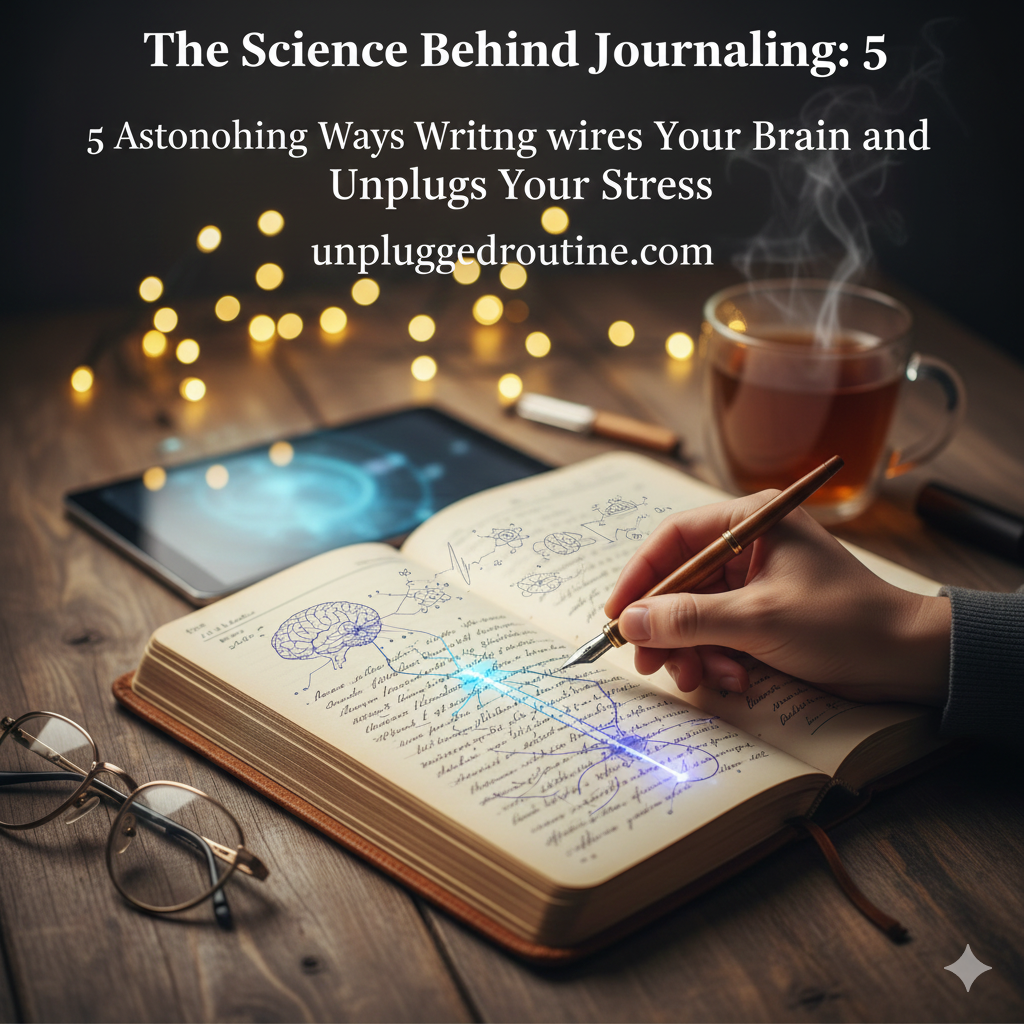
1. Cognitive Offloading: Freeing Up Mental RAM
Let’s start with the most immediate benefit. It’s called Cognitive Offloading, and it’s about giving your brain a break.
Think of your brain like a computer. Specifically, think of your Working Memory. This is the mental space where you actively hold and process information—the things you need to remember right now.
For most of us, this memory is extremely limited. Psychologists famously call it “The Magic Number Seven, Plus or Minus Two.” Our working memory can generally hold about four to seven pieces of information at once.
The Problem of Open Tabs
When you lie awake thinking about tomorrow—the dry cleaning, the email you forgot to send, the presentation you need to prep—you are using up all those precious slots in your working memory.
These are “open tabs.” Your brain has to dedicate energy just to hold them in the queue so you don’t forget them. This is what causes that feeling of internal pressure and anxiety.
The Journal as an External Hard Drive
When you write down your to-do list, your worries, or even just random thoughts, you are performing cognitive offloading. You are moving those “open tabs” from your limited internal RAM onto an external hard drive—the paper.
The moment the brain sees the information recorded safely, it can relax. It knows it doesn’t have to keep struggling to hold onto those thoughts.
The result? Instant mental space. You feel less anxious because you literally have more mental capacity available. You’ve closed the loops.
2. The Stress Hormone Solution: Taming the Amygdala
Journaling doesn’t just clear mental space; it changes the chemistry of your body. Specifically, it tackles the notorious stress hormone, Cortisol.
When you experience stress—whether it’s a near-miss traffic accident or a stressful email—your Amygdala (the brain’s alarm bell) rings. This triggers the “fight or flight” response, flooding your system with Cortisol.
In the modern world, the Amygdala rings all day long because of digital pings, deadlines, and social media comparisons. Your body stays in a low-grade state of alert.
Expressive Writing and Cortisol
Studies on “expressive writing” (writing about emotional topics) show a direct correlation between journaling and lower Cortisol levels.
The physical act of writing slows down your heart rate and forces you to process the stressor in a calm, focused way, rather than letting it spiral emotionally.
Creating Distance
When you write down, “I am furious that my coworker took credit for my idea,” you are taking that huge, overwhelming emotion and giving it boundaries.
You move from being in the emotion to being an observer of the emotion. This distance—this shift in perspective—is key to calming the Amygdala. The emotional event no longer feels like a fresh threat; it feels like data you are processing.
3. The Brain Rewire: Linking Logic and Emotion
The brain is divided into hemispheres. The Right Hemisphere is generally associated with intuition, emotion, and holistic thinking. The Left Hemisphere is associated with logic, language, and analysis.
When you are stressed or emotionally overwhelmed, the right brain often takes over, leading to irrational thinking or panicked reactions.
The Language Bridge
Journaling requires you to take a messy, non-linear emotion (right brain activity) and translate it into coherent words, sentences, and structure (left brain activity).
This is the crucial step.
By forcing the emotional center (right brain) to communicate with the language center (left brain), you create a neurological bridge.
You are essentially forcing the emotional data to go through the logic filter.
The “Aha!” Moment
This is why people often have “Aha!” moments while journaling. You see the problem written out, and the logical, left side of your brain says, “Wait, that’s actually not that big of a deal,” or “Here is the three-step solution to this.”
You don’t just feel better; you literally process your emotions better, making you more emotionally resilient the next time stress hits.
4. Training Your Attention Span: The Analog Focus
One of the biggest struggles with digital overload is Attention Residue.
When you switch between tasks quickly (e.g., checking email while writing a report), your brain leaves a “residue” of attention on the previous task, reducing your focus on the new one. This residue is how the digital world keeps your mind tethered.
The Deep Focus Workout
Journaling is a form of deep focus training.
When you commit to writing for 10 or 15 minutes, you are dedicating 100% of your linguistic and cognitive focus to the physical act of writing. There are no pings, no links to click, and no distracting notifications.
You are forcing your prefrontal cortex (the part of your brain responsible for focus, decision-making, and impulse control) to engage in a single, sustained activity.
Dopamine Management
Digital scrolling provides quick, low-quality hits of dopamine. This trains your brain to expect instant gratification.
Journaling provides a slower, higher-quality reward: clarity. By replacing the screen-reaching impulse with the pen-reaching impulse, you are actively managing your dopamine pathways and training your brain to find satisfaction in focus rather than distraction.
This practice is the fundamental building block of an effective “unplugged routine.”
5. Journaling Styles: Applying Science to Your Pages
Knowing the science is great, but applying it is where the magic happens. Different journaling techniques target different neurological benefits.
To harness the power of writing and rewire your mind, try these three scientifically-backed styles:
A. The Gratitude Loop (The Serotonin Boost)
The Science: Writing about positive events increases activity in the ventral striatum, the area of the brain associated with rewards and pleasure, boosting feel-good neurotransmitters like Serotonin.
How to Apply: Write down three specific things that happened in the last 24 hours that you are genuinely thankful for. The more specific, the better. (e.g., “The sun hitting my face during my walk” instead of “The nice weather”).
B. The Future Self Letter (The Frontal Cortex Activator)
The Science: Writing from the perspective of your future self (e.g., you 6 months from now) activates the frontal cortex—the part of the brain responsible for planning, goal-setting, and complex thought. This is powerful for behavior change.
How to Apply: Write a letter to your current self, signed by the “Future You.” What goals did you achieve? What problems did you overcome? What advice does your future, successful self have for you today?
C. Timed Stream of Consciousness (Maximum Cognitive Offloading)
The Science: This technique is pure cognitive offloading. By writing non-stop, you bypass the “inner editor” and force your thoughts onto the page before your working memory can filter or judge them.
How to Apply: Set a timer for 7 minutes. Write non-stop until the timer goes off. Do not lift the pen. If you run out of thoughts, just write, “I don’t know what to write next,” until a new thought appears.
Your Unplugged Routine Starts Now
The brain is capable of incredible change. It’s not a fixed machine; it’s constantly rewiring itself based on how you use it.
Every time you choose the pen over the screen, you are sending a powerful signal to your Amygdala, your Working Memory, and your Prefrontal Cortex: “We are in control. We choose peace over panic.”
The science is clear: journaling isn’t just self-help—it’s neurobiology in action. It’s the highest-ROI, lowest-cost tool you have for managing stress and achieving mental clarity in a chaotic world.
Stop letting your digital devices dictate your mental state. Start actively rewiring your mind for focus and calm.
Ready to apply the science and unplug your mind?
You don’t need to know every scientific term to benefit. You just need a pen and a guide.
We’ve created a 5-Day “Clarity Journal” Blueprint that uses these exact scientific principles to calm your brain. It provides the prompts and structure so you can start clearing your mental clutter immediately.
Disclaimer: This article provides information for educational purposes only and is not a substitute for professional mental health care.