The alarm blares. You reach for your phone to hit snooze. And then… you’re caught.
Suddenly, you’re scrolling through emails, checking social media, and before your feet even hit the floor, your mind is already racing. You’re plugged in before your day has even begun.
Or maybe it’s the other end of the day.
You promised yourself no screens before bed. But as soon as you settle down, the urge to check “just one more thing” becomes irresistible. You spend an hour staring at a blue light, buzzing with anxiety, when you should be drifting off to sleep.
Sound familiar?
We are all trying to find ways to “unplug.” To get some mental space. To escape the constant digital noise that fills our lives from morning to night.
Journaling has emerged as a powerful, low-tech solution. It’s a simple act of putting pen to paper that can profoundly impact your mental clarity, stress levels, and overall well-being.
But here’s the big question: When should you journal to get the most “unplugging” benefits?
Is it better to clear your head first thing in the morning, or unwind with reflection at night?
Let’s dive into the fascinating differences between Morning vs. Evening Journaling and help you discover which one will help you unplug more effectively, based on what you need most.
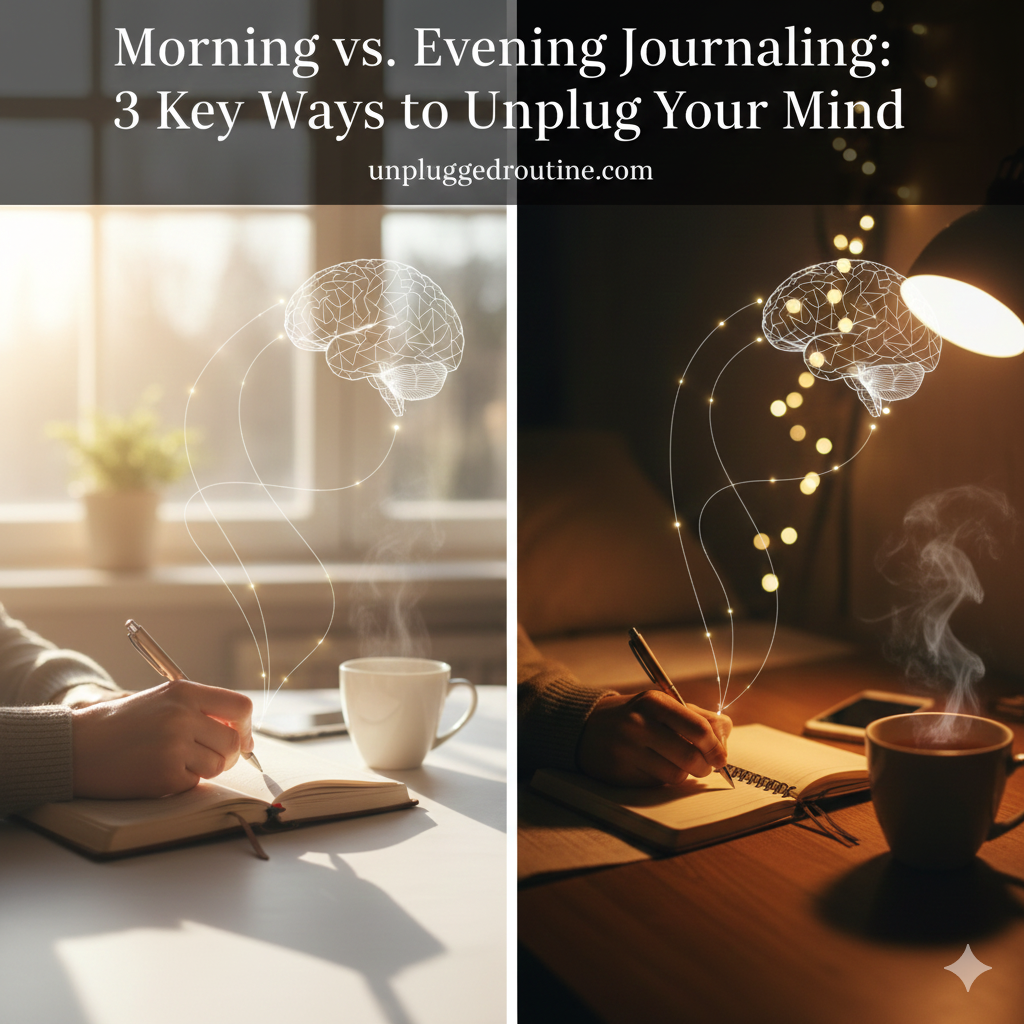
The Core Goal: What Does “Unplugging” Really Mean for Your Brain?
Before we pit morning against evening, let’s clarify what we’re trying to achieve when we “unplug” our minds. It’s not just about putting down your phone. It’s about:
- Reducing Mental Clutter: Clearing the endless to-do lists and worries that bounce around your head.
- Lowering Stress Hormones: Calming your nervous system to escape that constant “fight or flight” feeling.
- Regaining Focus: Training your brain to concentrate on one thing at a time, away from digital distractions.
Both morning and evening journaling can achieve these goals, but they do it in different ways and at different times.
Morning Journaling: Hacking Your Day Before It Hacks You
Imagine starting your day with clarity, intention, and a sense of calm. That’s the promise of morning journaling. It’s about being proactive
Benefit 1: Setting Intentions (Your Mental GPS)
When you wake up and immediately check your phone, you’re letting the world dictate your day. You’re reactive.
Morning journaling allows you to set your own agenda. By writing down your intentions, your goals, or simply how you want to feel that day, you are giving your brain a GPS. You are programming it for purpose, not just reaction.
- How it unplugs: Instead of letting external pings pull your attention in 20 directions, you’ve created a central focus point for your day. This helps your brain filter out irrelevant noise.
Benefit 2: Clearing the Mental Inbox (Pre-emptive De-clutter)
Did you ever wake up with a jumbled mess of thoughts from yesterday, or even from dreams?
Morning pages (a popular term for free-flowing morning journaling) act like a mental inbox clear-out. You dump all the residual thoughts, anxieties, and half-formed ideas onto the page before they can consume your precious morning focus.
- How it unplugs: This is classic “cognitive offloading” (as we talked about previously). You’re freeing up your mental RAM before the day even begins to fill it up. This leaves you with more mental capacity for important tasks.
Benefit 3: Cultivating Presence (Mindful Start)
Modern life rushes you from the moment you wake. Morning journaling forces you to slow down, even if just for 5-10 minutes.
This quiet, analog time creates a buffer between sleep and the digital demands of the day. You are present with your thoughts, your feelings, and the physical act of writing.
- How it unplugs: It actively combats the rush. You’re grounding yourself, which makes you less susceptible to the immediate pull of your phone and the frantic energy of the internet.
Who is Morning Journaling Best For?
- People who feel overwhelmed or scattered before their day even properly starts.
- Those who struggle with morning anxiety or decision fatigue.
- Anyone who wants to be more intentional and proactive with their time and energy.
Evening Journaling: Winding Down, Letting Go, and Resting Better
If morning journaling is about preparing for the day, evening journaling is about processing and releasing it. It’s about being reactive to your experiences, then letting them go.
Benefit 1: Digital Disconnection (The Ultimate Screen Barrier)
This is arguably the most direct way evening journaling helps you unplug. It creates a physical, analog buffer zone between your last digital interaction and your bed.
Instead of scrolling Instagram, you’re writing in a notebook. This simple swap has profound effects on your brain chemistry and sleep hygiene.
- How it unplugs: It removes blue light exposure (which disrupts melatonin production) and replaces it with a calm, focused activity that signals to your brain: “Day is done. Time to relax.”
Benefit 2: Stress Processing & Release (Closing Loops)
The day throws a lot at us: frustrations, arguments, unanswered emails, missed deadlines. If you don’t process these, they turn into “open tabs” in your brain that keep you awake.
Evening journaling gives you a dedicated space to review your day. You can vent frustrations, reflect on what happened, and consciously decide what you need to “let go” of before sleep.
- How it unplugs: It lowers cortisol levels (your stress hormone) by allowing you to process emotional events. By writing down worries, you perform cognitive offloading, signaling to your brain that it’s safe to stop holding onto them.
Benefit 3: Gratitude & Positive Reframing (Sleep-Inducing Mindset)
It’s easy to focus on what went wrong in a day. Evening journaling is a powerful tool for shifting that perspective before bed.
By writing down things you’re grateful for, or even positive lessons learned from difficult situations, you can end your day on a high note.
- How it unplugs: Ending the day with gratitude changes your emotional state. It floods your brain with feel-good chemicals, reduces anxiety, and sets the stage for a more peaceful, restorative sleep.
Who is Evening Journaling Best For?
- People who struggle with shutting off their minds at night.
- Anyone who easily gets sucked into “doomscrolling” before bed.
- Those who carry the day’s stress and worries into their sleep.
- Individuals seeking better, deeper sleep.
Morning vs. Evening Journaling: Which Helps YOU Unplug More? (The Verdict)
The truth is, both morning and evening journaling offer incredible benefits for unplugging your mind. There isn’t a single “best” time for everyone.
It truly depends on your biggest struggle:
- If you wake up feeling immediately overwhelmed, scattered, or reactive to your phone: Morning journaling might be your savior. It helps you set the tone and protect your mental space before the digital world invades.
- If you struggle to unwind at night, find yourself doomscrolling, or lie awake with racing thoughts: Evening journaling is likely your key to better sleep and a true digital detox. It helps you process, release, and calm your mind before bed.
Can You Do Both? (The Power Combo!)
Absolutely! Many people find immense benefits from a quick 5-minute journal in the morning to set intentions and a more reflective 10-15 minute session in the evening to wind down.
Think of it as bookending your day with intention and reflection, creating two powerful “unplugged zones” that protect your mental well-being.
3 Quick-Start Prompts for Your Chosen Time
To help you jump right in, here are some quick prompts for both morning and evening sessions:
Morning Quick-Start:
- 3 Things I Want to Accomplish Today: (Focuses your energy)
- How I Want to Feel Today: (Sets your emotional intention)
- One Thing I’m Grateful for Right Now: (Starts the day with positivity)
Evening Quick-Start:
- 3 Things That Went Well Today: (Reflects on positives)
- What’s weighing on my mind? / What do I need to let go of? (Releases stress)
- How I feel right now: (Checks in with emotions, no judgment)
Conclusion: Choose Your Unplugging Moment
In a world that constantly pushes us to be “on,” choosing to intentionally disconnect is an act of self-care and mental resilience. Journaling, whether done in the quiet dawn or the peaceful dusk, is your secret weapon against digital fatigue and mental overload.
It’s not about perfection; it’s about consistency. Start small. Experiment. Find the rhythm that helps you unplug most effectively. Your brain will thank you for the space, the calm, and the clarity.
Don’t let your screens define your state of mind. Take back control, one written page at a time.
Ready to find your perfect unplugging routine?
Still unsure which journaling time is best for you? We’ve created a FREE “Morning vs. Evening Quiz + Starter Prompts” guide to help you identify your primary need and kickstart your ideal journaling habit today.
Note: This article is for informational purposes and does not substitute professional advice for chronic sleep issues or mental health conditions.