🧠 The Science-Backed Power of Journaling
Journaling isn’t just about venting; it’s a powerful form of self-directed therapy. It shifts your mental state from reacting in panic to calmly observing your thoughts. This simple act has profound neurological benefits that help actively reduce anxiety.
The CBT Connection: Reframing Negative Thoughts
One of the greatest benefits of journaling stems from its similarity to Cognitive Behavioral Therapy (CBT).
When anxiety hits due to a social media comparison (e.g., “Everyone is more successful than me”), that thought feels like an objective fact.
Journaling forces you to take that blurry, panicked thought out of your head and see it in black and white on the page.
Once externalized, you can question it: Is this 100% true? What evidence do I have? This process allows you to reframe negative beliefs, neutralizing their power to cause stress.
Emotional Regulation and the Amygdala
When you feel overwhelmed, your amygdala—the brain’s fear center—is in overdrive. Writing about your feelings, especially the stressful ones, engages your prefrontal cortex.
The prefrontal cortex is the rational, thinking part of your brain. When it takes over, it essentially sends a calming signal to the amygdala, helping you regulate intense emotions.
This explains why even just five minutes of writing about a stressful event can make you feel immediately calmer. You are literally engaging your brain’s natural chill-out mechanism.
Mindfulness and Presence
Social media anxiety thrives in the past (regret) and the future (worry). Journaling anchors you firmly in the present moment.
The physical act of writing—the sound of the pen, the feel of the paper—is a powerful grounding exercise. It pulls your focus away from the screen’s frantic pace and brings you into the reality of your body and your immediate environment.
This foundational practice of mindfulness is key to helping you reduce anxiety consistently.
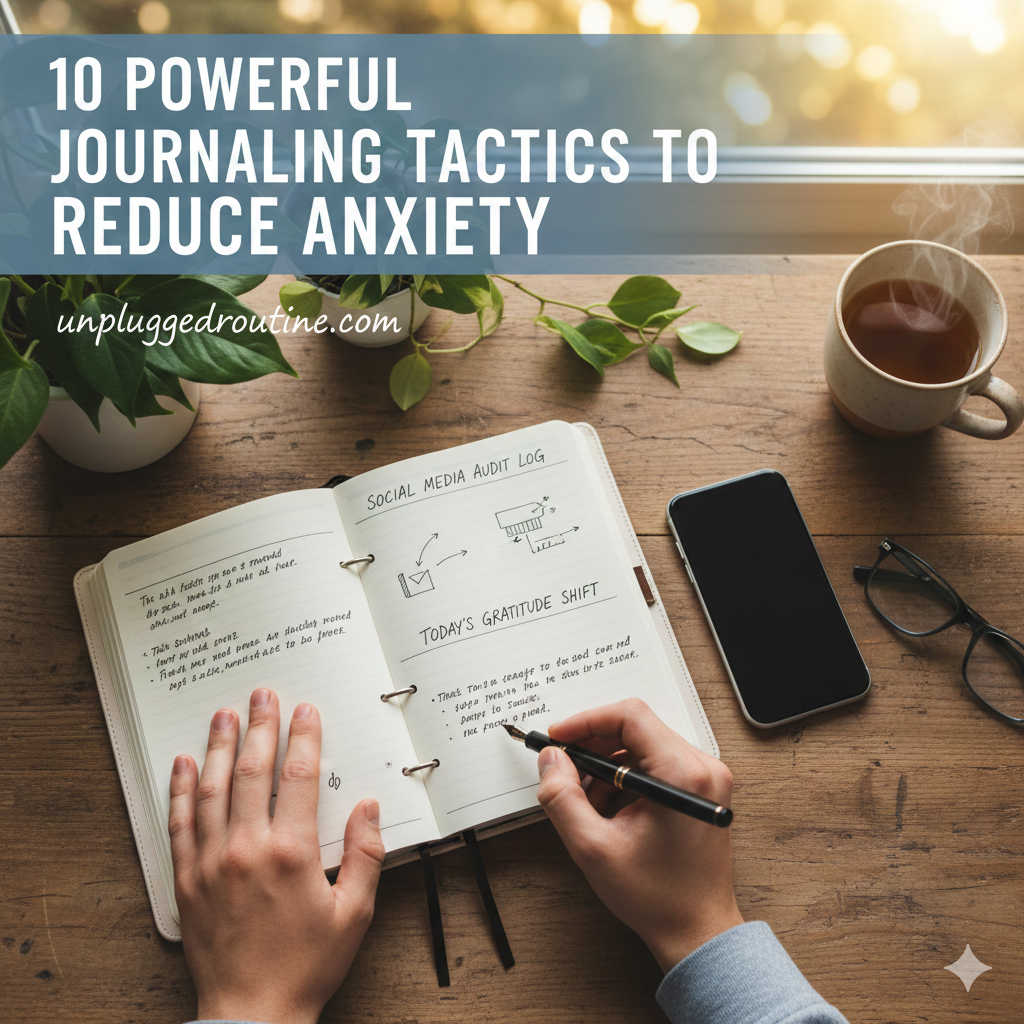
🛡️ 10 Powerful Journaling Tactics to Reduce Anxiety
Now that we know why it works, let’s get into the specifics. These 10 tactics are designed to directly counter the emotional traps set by social media overload.
Tactic 1: The “Social Media Audit” Log
This tactic is about awareness, not judgment. You can’t change what you don’t measure.
Keep a simple log for a few days, focusing only on the feelings associated with your scrolling.
The Prompt: Write down the app you used, the time spent, and the primary emotion you felt upon closing the app (e.g., “Facebook, 15 min, Defeated,” or “Instagram, 10 min, Inspired“).
The Benefit: You quickly identify the platforms and content streams that are consistently poisoning your mood. This knowledge is your power to curate a healthier feed or simply delete the worst offenders.
Tactic 2: The Comparison Cure (Gratitude Shift)
Comparison anxiety is the silent killer of contentment. We need a tactical way to shift focus from what others have to what we already possess.
The Prompt: Immediately after you notice a comparison thought (e.g., “I wish I had their career/house/body…”), write down three specific, detailed things you are currently grateful for that cannot be captured in a photo.
Example: Instead of “I wish I had their perfect travel life,” write: 1. The smell of coffee brewing this morning. 2. The support of my friend Sarah yesterday. 3. The quiet feeling of finishing a complex task.
The Benefit: This instantly rewires your brain from external lack to internal abundance, helping to swiftly reduce anxiety tied to social comparison.
Tactic 3: The “Digital Detox Dream” (Future Visioning)
Sometimes, the weight of being “on” all the time makes it hard to remember why you want to unplug. You need a compelling vision of your calmer future self.
The Prompt: Describe a perfect, ideal weekend where digital interruptions are minimized. What are you doing? Who are you with? How do you feel? Use sensory details.
Example: “I feel light, like my shoulders are dropped. I can smell the fresh air outside. I spend two hours reading a physical book and talking deeply with my partner, without the blue light distraction.”
The Benefit: This exercise creates a clear, motivational goal, making the immediate sacrifice of reducing screen time feel worthwhile and exciting.
Tactic 4: The FOMO Fighter (Present Moment Log)
To fight the Fear of Missing Out, we must appreciate the Joy of Missing Out (JOMO). This tactic celebrates your current reality.
The Prompt: Write down what you are currently doing in great detail. Include one sensory observation (sight, sound, touch, smell) and one feeling.
Example: “I am sitting at my desk. I can hear the rain tapping softly against the window (sound). I feel a deep sense of calm focus (feeling) because I’m not checking my phone.”
The Benefit: It grounds you, validating that your present moment—however ordinary—is more valuable than the imagined excitement happening elsewhere.
Tactic 5: Anxiety Thought Mapping (Tracing the Source)
Social media anxiety often feels like a vague, overwhelming cloud. This exercise is an emotional detective mission.
The Prompt: Start with your general anxious feeling and use arrows to trace it back to the specific social media post, comment, or interaction that triggered it.
Example: Overwhelmed $\rightarrow$ Saw political fight on Twitter $\rightarrow$ Felt angry and helpless $\rightarrow$ Realized I was arguing with a stranger I don’t know.
The Benefit: You realize your anxiety is often about external noise, not your life. Identifying the source makes the anxiety feel contained and addressable, dramatically helping to reduce anxiety.
Tactic 6: The “Reality Check” Table (Expectation vs. Reality)
This structured exercise is perfect for combating the cognitive dissonance created by the curated world of social media. It forces you to compare the glossy online expectation with the messy, complex, and true reality.
The Prompt: Draw a simple two-column table.
- Column 1: The Expectation (What the post implied): E.g., “Success is instantaneous and effortless.”
- Column 2: The Reality (What I know is true): E.g., “Success takes years of failure, editing, and hidden struggles.”
The Benefit: By systematically dismantling the illusion, you weaken the grip social media has on your self-worth. It’s an intellectual exercise that calms the emotional system, effectively working to reduce anxiety stemming from unrealistic standards.
Tactic 7: Brain Dump & Boundary Setting
Social media overload often makes us feel frantic and out of control. A simple brain dump can empty the mental clutter, which then allows you to set firm, helpful boundaries.
The Prompt: Write down everything that is worrying you about your digital life without stopping or censoring for five minutes. Then, review the list and circle one simple, non-negotiable boundary you can set today.
Example Boundary: “No phone in the bedroom after 9 PM.” or “I will only check LinkedIn once during my workday.”
The Benefit: The dump clears the chaos, and the boundary gives you a tangible action plan. Control over your boundaries is control over your mental peace.
Tactic 8: The “Positive Scroll” Tracker
It’s easy to focus only on the negative parts of social media, but sometimes these platforms do offer genuine value. This tactic helps you intentionally seek out and internalize the good.
The Prompt: After you scroll, note one account or piece of content that genuinely informed, inspired, or entertained you without triggering negative self-talk. Write down why it was a positive interaction.
Example: “Watched a five-minute video on basic home repair. Felt motivated and learned a skill.”
The Benefit: You train your brain to actively look for beneficial content, shifting your perception and making your digital time feel less like a mental punishment and more like intentional learning.
Tactic 9: Sensory Awareness Journaling (Grounding)
When digital stress makes you feel disconnected from your physical reality, grounding techniques are essential. This is pure, mindful presence.
The Prompt: Put your phone down and dedicate two minutes to noticing your current, physical environment. Write down:
- Five things you see.
- Four things you feel (texture, temperature).
- Three things you hear.
- Two things you smell.
- One thing you taste (even if it’s just your breath).
The Benefit: This snaps you out of the abstract, virtual world and back into the concrete safety of your physical body and space, a rapid-fire way to reduce anxiety and panic attacks.
Tactic 10: The “Actionable Insight” List
The goal of journaling isn’t just to complain; it’s to create change. This tactic transforms emotional processing into practical, real-world steps.
The Prompt: Review what you wrote today. Identify the central theme (e.g., I’m worried about comparing my productivity to others). Then, list three non-digital actions you can take to address the anxiety.
Example Action Plan: 1. Schedule a 30-minute deep work session. 2. Call a friend instead of texting. 3. Go for a 15-minute walk.
The Benefit: You move from the passive state of worry to the active state of solving, which builds self-efficacy and resilience against digital stressors.
🗓️ Making It a Routine: Practical Tips for Unplugging
Knowing the tactics is one thing; implementing them is another. Here’s how you can seamlessly weave journaling into your day to maximize its power to reduce anxiety.
Find Your Golden Hour
The best time to journal is the time when you are most susceptible to digital distraction. For most people, this is one of two times:
- The Start: Right after waking up, replacing your immediate phone check with the journal. This sets a focused, intentional tone for the day.
- The End: Right before bed, to process the day’s noise (including social media scrolling) and clear your mind for better sleep. This is crucial for digital hygiene.
Physical vs. Digital Journaling
While the irony is not lost, writing your thoughts on a laptop is okay. However, studies show that the physical act of writing by hand is more deeply connected to cognitive processing and memory consolidation.
Invest in a comfortable pen and a notebook you love. The sensory experience of physical writing further grounds you, making it far more effective in combating digital overload.
Start Small: The 5-Minute Rule
Don’t aim for a novel every day. That pressure guarantees failure.
Commit to the 5-Minute Rule. Set a timer and write without judgment until the timer goes off. If you feel like continuing, great. If not, you’ve still won because you completed your routine. Consistency, even in small doses, is what truly helps you reduce anxiety over time.
Conclusion: Reclaim Your Peace, One Page at a Time
We live in a world where being constantly available is the default, and digital anxiety is the unfortunate price we pay.
But remember this: Your peace is more valuable than any notification.
Journaling is your low-tech, high-impact defense system. It’s the safe, private space where you can sort through the overwhelming noise of the internet, dismantle toxic comparisons, and ground yourself back in the reality of your valuable life. It is the single most powerful tool for you to take back control and consistently reduce anxiety caused by social media overload.
You don’t need to quit social media entirely; you just need a better relationship with it. And that relationship starts on the page.
Are you ready to stop scrolling and start living?
Don’t wait until tomorrow. Grab a notebook and a pen right now. Start with Tactic 1 (The “Social Media Audit” Log) or Tactic 7 (Brain Dump & Boundary Setting). Dedicate just five minutes tonight to processing your digital world.
Visit unpluggedroutine.com to join our community and download our Free Quick-Start Journaling Prompts for Digital Wellness.
Start your unplugged routine today—your calmer, more focused self is waiting.