Deep Dive: The Power of Journaling (Recap)
Imagine a private, judgment-free space where you can dump every thought, every worry, every fleeting idea that’s cluttering your mind. That’s journaling. It’s an active engagement with your inner chaos, giving it structure, clarity, and an emotional release.
Journaling excels when you need to process specific events or troubleshoot a problem. It provides a tangible record of your mental and emotional journey.
🧘 Deep Dive: The Power of Meditation
Where journaling is active, meditation is passive observation. It’s the practice of intentionally paying attention to the present moment without judgment. It’s not about emptying your mind, but about retraining your mind to observe its contents without attaching to them.
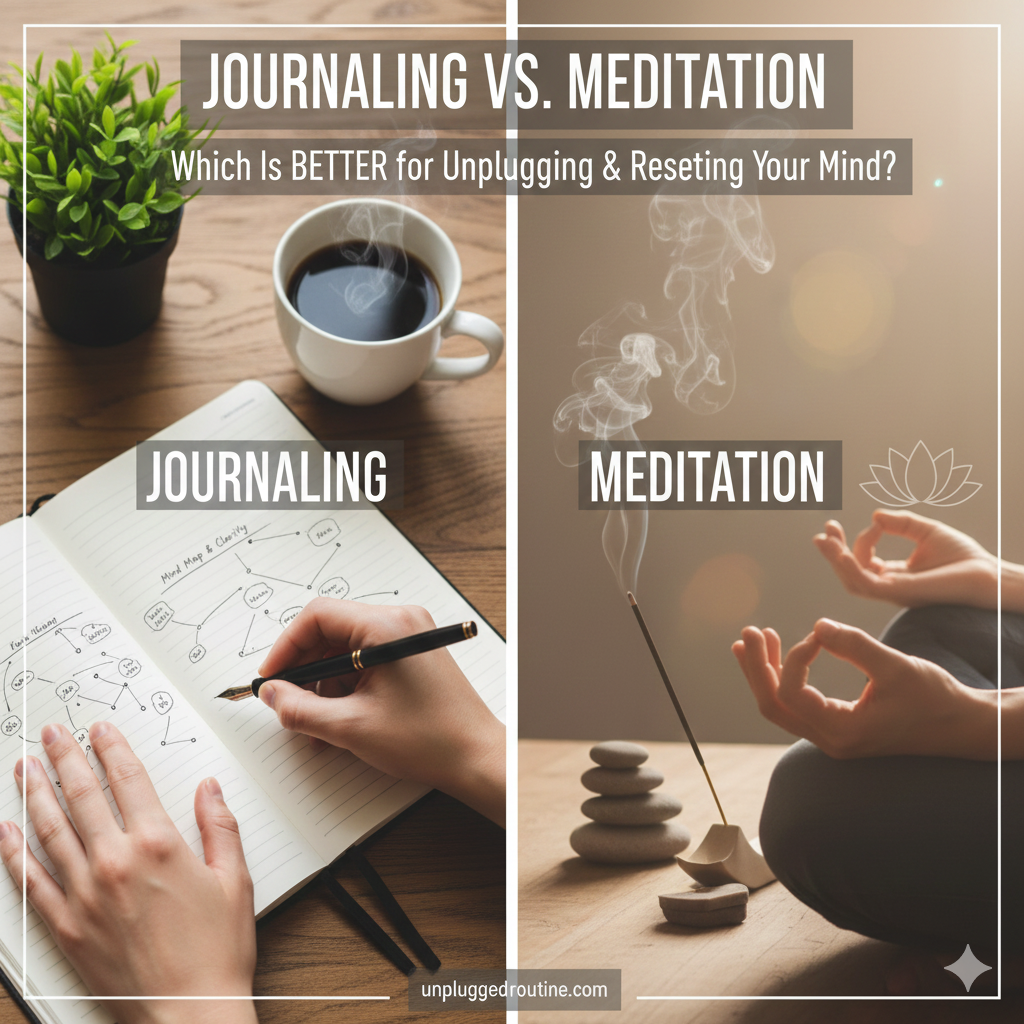
What is it? (Mindfulness, Concentration, Transcendence)
Meditation encompasses many forms, but the most common for modern wellness is mindfulness meditation. This involves focusing your attention—usually on your breath, a body sensation, or a sound—and gently redirecting your focus whenever your mind inevitably wanders.
It is an exercise in mental discipline that aims to foster inner tranquility and clarity.
How it works (Brainwave Changes, Stress Reduction, Emotional Distance)
- Stress Hormone Reduction: Science shows that regular meditation lowers the levels of the stress hormone cortisol. This shifts your nervous system from “fight-or-flight” (sympathetic) to “rest-and-digest” (parasympathetic), physically inducing a state of calm.
- Emotional Distance: Meditation helps you create a healthy distance from your thoughts and feelings. Instead of saying, “I am anxious,” you learn to observe, “I am having the thought that I am anxious.” This detachment is key to preventing digital stressors from overwhelming you.
- Amygdala Regulation: Consistent practice can actually reduce the density of gray matter in the amygdala—the brain’s fear center—while increasing it in areas related to attention and self-awareness. It literally rewires your brain for less reactivity and more calm.
- Sensory Reset: By focusing only on the present (e.g., your breath), meditation gives your senses a break from the constant information overload of the digital world, providing a deep, immediate reset.
Pros & Cons for Unplugging/Resetting
Pros:
- Immediate Calm: Provides an immediate physiological drop in stress levels.
- Non-Verbal Release: Excellent for when emotions are too big or messy to articulate.
- Focus Training: Drastically improves concentration and attention span (essential after constant digital distraction).
- Deep Presence: Anchors you firmly in the present moment, counteracting FOMO.
- Low Barrier to Entry: Can be done anywhere, anytime, with no tools required.
Cons:
- Can Feel Boring/Difficult: For beginners, the quiet can feel restless, or the mind can race.
- Lack of Tangible Output: No record to look back on for analysis or goal setting.
- Passive Approach: Not ideal for problem-solving or creating action plans.
- Requires Patience: The long-term benefits require consistent, dedicated practice.
Best for (Specific scenarios)
Meditation excels when you need to:
- Reduce immediate stress or panic.
- Regulate intense emotional reactions.
- Improve focus and concentration.
- Increase your emotional resilience to digital noise.
- Achieve a rapid, deep mental reset.
⚖️ Direct Comparison: Journaling vs. Meditation
To truly answer which is “better” for your unplugging and resetting journey, we must look at how their core mechanisms differ.
| Feature | Journaling | Meditation |
| Primary Goal | Clarity, Processing, Problem-Solving | Stillness, Awareness, Emotional Regulation |
| Approach | Active Expression (Doing) | Passive Observation (Being) |
| Output | Tangible Record, Action Plan | Internal State Shift, Mental Space |
| Brain Activity | Left Brain (Logic, Language, Analysis) | Right Brain (Intuition, Emotion, Sensory) |
| Digital Stress Fix | Names the trigger; outlines the boundary. | Cultivates distance from the trigger. |
| Best for | The Why and How | The Here and Now |
Active Expression vs. Passive Observation
This is the most crucial difference.
Journaling is like a cognitive behavioral therapist. It forces you to actively engage the thinking, verbal part of your brain to challenge and restructure the messy, digital thoughts that lead to anxiety. It seeks to understand and solve the noise.
Meditation is like a mental windshield wiper. It simply allows the thoughts to pass without interaction. It seeks to quiet and observe the noise without judging it. It teaches non-reactivity, which is the ultimate defense against digital triggers.
Tangible Record vs. Internal State Shift
If you are goal-oriented or struggling with a complex digital problem (like setting a new work-life boundary), journaling is essential. You need that tangible record to map your progress.
If you are dealing with general overwhelm, chronic stress, or the inability to concentrate, meditation offers a powerful, immediate internal state shift. You walk away feeling lighter and calmer right now.
🎯 When to Choose Which (or Both!)
So, which is the winner? The answer, like most things in digital wellness, is: It depends on your current need.
Choose Journaling When…
- You feel confusion or indecision: You need to work through multiple ideas or thoughts related to your work, finances, or relationships, which digital noise has cluttered.
- You need emotional release: You’ve just witnessed a stressful online argument or received a triggering email and need to vent the emotion before you react.
- You need an action plan: You’re ready to set clear digital boundaries, define your goals, or analyze a recurring behavior (like checking social media first thing).
Choose Meditation When…
- You feel physical symptoms of stress: Your heart is racing, your jaw is clenched, or you feel panic setting in (an immediate, physiological reset is needed).
- You are overly reactive: You want to reduce the knee-jerk emotional responses to digital notifications and commentary.
- You struggle with focus: You need to strengthen your attention muscle to concentrate on real-life tasks without the digital urge pulling you away.
Why You Should Do BOTH: The Holistic Synergy
For the ultimate mental reset, the true winner is the combination. Journaling vs. Meditation is actually a misnomer; they are powerful allies.
- Journal First, Meditate Second: A “brain dump” before meditation clears the immediate mental clutter. By getting the noisy thoughts onto the page, you make it much easier for your mind to settle and concentrate during meditation.
- Meditate First, Journal Second: Meditating first quiets the mind and shifts you into a non-judgmental, insightful state. Journaling immediately afterward allows you to capture the deep insights and realizations that emerged from the stillness.
Combining them creates a powerful cycle: Clarity (Journaling) $\rightarrow$ Calm (Meditation) $\rightarrow$ Insight (Journaling). This dual approach tackles both the chaos and the reaction to the chaos, making it the fastest route to consistently unplugging and resetting your mind.
** practical tips for Incorporating Both**
Making these practices stick requires intention, especially when fighting the addictive pull of your phone.
Create Your “Reset” Sanctuary
Designate one spot in your home that is completely digital-free. This could be a specific chair, a corner cushion, or a spot by the window. Keep your journal, pen, and a comfortable blanket there.
The moment you sit there, your brain immediately shifts into “unplugged” mode, making it easier to start either journaling or meditating.
The “Morning Clarity” Combo
Replace your phone’s alarm with a physical one. As soon as you wake up:
- Journal (5 Minutes): A quick brain-dump to offload the night’s residual stress or the first impulse to check your phone.
- Meditate (5–10 Minutes): Center yourself using a breath focus. This combination ensures you start the day grounded and intentional, not reactive and overwhelmed.
The “Evening Wind-Down” Duo
About 30 minutes before bed:
- Journal (5 Minutes): Use a structured prompt, like a gratitude list or the “FOMO Fighter” tactic, to process the day’s digital exposure.
- Meditate (5 Minutes): A short body scan or loving-kindness practice to relax your nervous system and prepare for deep sleep.
This two-step process effectively cleanses your mind of the day’s digital residue.
Conclusion: The Power of Intentional Rest
In the constant, high-volume hum of the digital world, the ability to unplug and reset your mind is the ultimate superpower.
Journaling vs. Meditation isn’t a competition; it’s a spectrum of self-care. Journaling is your tool for active self-reflection, clarity, and problem-solving. Meditation is your tool for passive self-regulation, deep calm, and non-reactivity.
By understanding what each practice offers, you gain the wisdom to choose the right tool for the right moment—or, better yet, the strength to combine them into a powerful, holistic routine.
Your mind is your most valuable asset, and it deserves intentional rest.
🚀 Your Call to Action (CTA)
Ready to stop wishing for mental peace and start creating it?
Today, choose one practice: Either sit in silence for five minutes with your breath (Meditation) OR write down the three things making you anxious right now (Journaling). Just five minutes is all it takes to begin your reset.
Visit unpluggedroutine.com to explore our library of guided meditation scripts and free journaling templates designed specifically to combat digital overload.
Start your unplugged journey now and master the art of the mental reset!