Welcome to unpluggedroutine.com! We are dedicated to helping you find simple, sustainable ways to inject peace and presence back into your busy life.
If you’ve decided to use journaling as your secret weapon against mental clutter and digital overwhelm—smart choice! As we discussed before, it is one of the most powerful tools for a true mental reset.
But then the inevitable question pops up: When should I do it?
Should you tackle your to-do list and anxieties first thing in the morning? Or should you save the process for the evening, using it to wipe the slate clean before bed?
The truth is, both morning and evening journaling offer incredible benefits, but they serve two fundamentally different functions for your brain. One is a launchpad, and the other is a landing strip.
Today, we’re diving deep into the science and psychology of both routines, revealing the 5 key differences and helping you decide which style of journaling will best help you unplug your mind and build the life you want.
⏰ The Time Trap: Why Timing Your Journaling Matters
In the world of creating new habits, consistency is key, but timing is the turbocharger.
The benefits of journaling—stress reduction, clarity, self-awareness—are amplified when you align the practice with your brain’s natural state at that specific time of day.
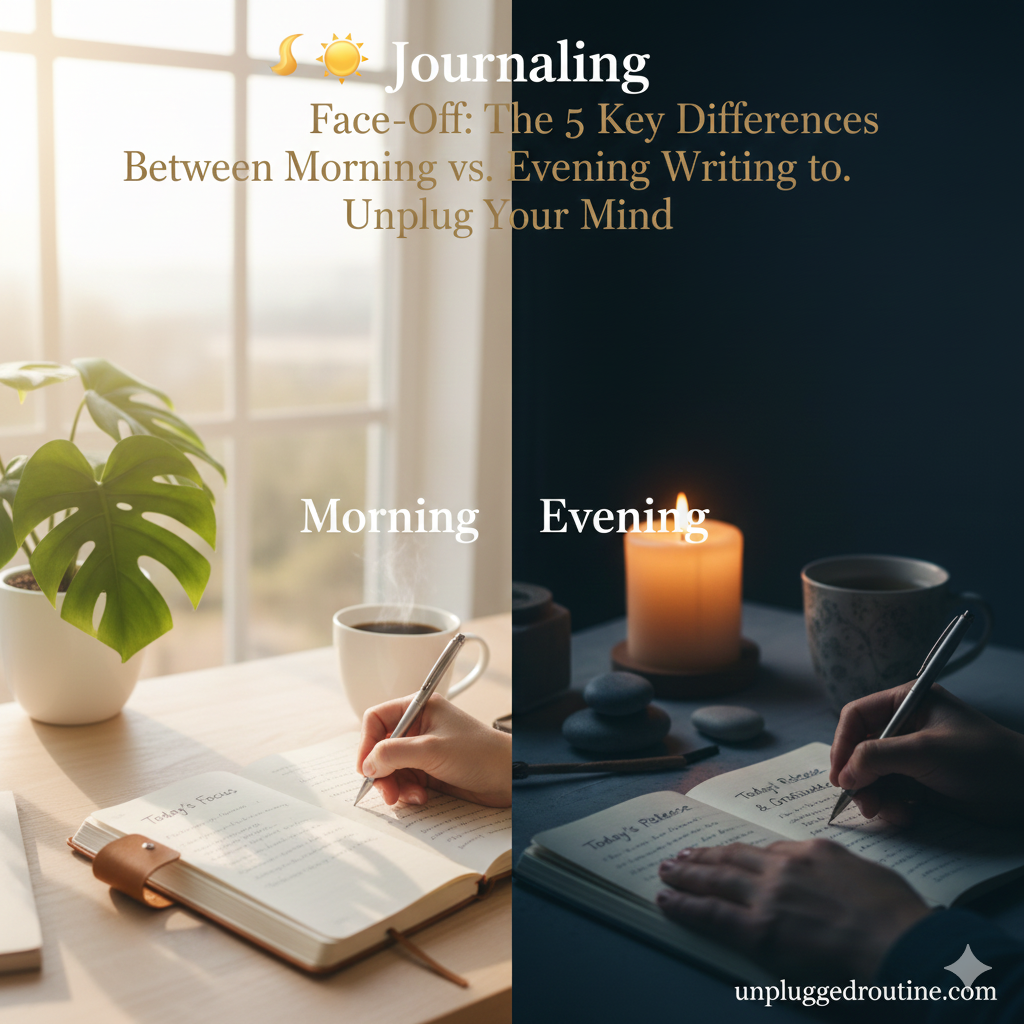
If you journal in the morning, you’re accessing a fresh, slightly unstructured mind, perfect for creative thought. If you journal in the evening, you’re working with a saturated mind, perfect for processing and release.
Knowing this difference is crucial for a successful unplugged routine. Let’s break down the two contenders.
🌅 Morning Journaling: The Launchpad for Your Day
Morning journaling, often associated with the concept of “Morning Pages” (stream-of-consciousness writing), is an incredibly powerful tool for setting the stage for a productive, intentional, and calm day before the digital world crashes in.
The Psychology: Clearing the Cache
When you wake up, your brain is still transitioning from sleep cycles. You are often in an alpha or theta brainwave state, which is fertile ground for creative, unstructured thought.
Morning journaling essentially acts as a “clear cache” button for your mind.
1. Function: Mental De-Clutter and Intentionality
The primary function of morning writing is to dump all the residual thoughts, anxieties, and scattered plans that woke up with you. By moving these things from your head to the page, you free up immediate mental bandwidth.
- It’s a Brain Dump: You get out all the little worries, the “I can’t forget to…” thoughts, and the random anxieties that otherwise occupy valuable working memory space.
- It Sets Intention: Once the clutter is gone, you can shift to writing about your priorities, goals, and the feeling you want to have that day. This proactive approach helps you run your day, rather than letting the day run you.
2. The Science: Priming the Prefrontal Cortex
Writing in the morning activates your prefrontal cortex—the part of the brain responsible for executive functions like planning, decision-making, and goal-setting.
- The Benefit: By engaging this area intentionally early on, you are essentially strengthening your mental muscles for the decisions you’ll face later. You are making your willpower stronger before you are faced with digital temptations.
- The Result: You are less likely to fall into reactive habits (like doomscrolling) because you have already consciously chosen your focus. This is essential for a successful digital detox that lasts all day.
3. The Best Format: Stream of Consciousness (Morning Pages)
- Goal: Quantity over quality. Fill 1-3 pages without stopping, editing, or judgment.
- What to Write: Anything. Complaints, fears, dreams, to-do lists, observations. The goal is flow.
- The Unplugging Power: It clears the immediate, ambient noise, giving you a quiet, focused start, minimizing the need to immediately turn to a screen for stimulation.
Action Hook for Morning Journaling: Try writing the answer to this prompt the moment you wake up, before looking at your phone: “What is the one thing I must accomplish today to feel successful, and why?”
🌙 Evening Journaling: The Landing Strip for Your Mind
Evening journaling is less about planning and more about processing, releasing, and reflecting. It’s the ritual that signals to your brain that the workday is officially over.
The Psychology: Closing Open Loops
Throughout the day, your mind encounters countless events, interactions, and tasks. Many of these get stored as “open loops”—mental fragments demanding resolution. This is a primary cause of that “racing mind” that keeps you awake at night.
Evening journaling helps you systematically close those loops.
4. Function: Emotional Processing and Stress Release
The primary function of evening writing is to offload the emotional baggage and cognitive strain of the day.
- It’s Cathartic: You can write about conflicts, disappointments, or frustrations. This expressive writing is linked to reducing activity in the amygdala (your fear center), moving those feelings from your emotional brain to your logical brain.
- It Promotes Gratitude: Evening is the perfect time to review the day and anchor yourself in positive experiences. A Gratitude Journal at night helps cement positive emotions and counter the brain’s natural negativity bias.
5. The Science: Preparing for Deep Sleep
One of the most effective ways to unplug your mind is to ensure quality rest. Evening journaling is a scientifically proven tool for improved sleep hygiene.
- The Benefit: A study published in the Journal of Experimental Psychology found that participants who spent five minutes writing a to-do list before bed fell asleep significantly faster than those who wrote about events already completed. Why? It offloads future-oriented worry.
- The Result: By systematically processing the day and offloading tomorrow’s tasks, you reduce mental rumination—the chief culprit of insomnia.
6. The Best Format: Structured Reflection
- Goal: Clarity and resolution. Focus on specific events and feelings.
- What to Write: The Three G’s (Gratitude, Goodness, Growth): Three things you are grateful for, three things that went well, and one thing you learned (growth).
- The Unplugging Power: It creates a clear boundary between the active day and the restive night, reducing stress hormones and making your mind quiet for sleep.
Action Hook for Evening Journaling: Try this prompt tonight, before turning off the light: “What is the one major lesson I learned today, and what can I let go of before I fall asleep?”
⚖️ Morning vs. Evening Journaling: Which Helps You More?
The best time for journaling is ultimately the time you will stick to, but you can choose based on your specific mental needs.
| Feature | If You Choose Morning Journaling | If You Choose Evening Journaling |
| Primary Goal | To Set Intention & Focus | To Process & Release Stress |
| Your Biggest Problem | Feeling scattered, distracted, or lacking clarity during the day. | Experiencing racing thoughts, anxiety, or insomnia at night. |
| Psychological Function | Activates the planning/executive function. | Deactivates the emotional/alarm system (amygdala). |
| The Habit Hook | Do it before you check your phone. | Do it as the last thing before getting into bed. |
| Best Result | Increased productivity and intentionality. | Deeper relaxation and improved sleep quality. |
The Unplugged Routine Recommendation: The Combo Approach
If you really want to supercharge your ability to unplug your mind, consider a micro-dose of both!
- Morning (5 Minutes): A quick brain dump and one clear intention for the day. (The Launchpad)
- Evening (5 Minutes): Three things you are grateful for and one thing you are letting go of. (The Landing Strip)
This dual approach covers both mental preparation and emotional closure, making it incredibly effective for combatting digital fatigue.
4 Friendly Tips for Sticking to Your Journaling Routine
No matter when you choose to write, these tips will help make starting a journaling habit a lasting part of your unplugged routine.
- Remove the Digital Barrier: Keep your journal and pen physically away from your phone, laptop, or tablet. Ideally, store them together in a basket or on a table away from your bedside. When you sit down to journal, put your phone in another room (or at least on silent, face down).
- Make it a Ritual, Not a Task: Dim the lights, light a candle, or make a warm beverage (coffee in the morning, herbal tea in the evening). Engage your senses to make the experience feel special and calming, not like another chore on your list.
- Use a Simple Prompt System: If you struggle with the blank page, use a structured system. For example: Morning: 1. What’s on my mind? 2. What’s my one goal? Evening: 1. What went well? 2. What am I releasing?
- Forgive the Breaks: Missed a day? Missed a week? Don’t stress or quit. The most important thing is to simply pick up the pen and start again. Your journal is a non-judgmental friend waiting for you.
✅ Conclusion: Take Control of Your Cognitive Schedule
Whether you decide on the goal-setting clarity of Morning Journaling or the stress-releasing calm of Evening Journaling, the ultimate decision should align with your biggest need right now.
If you struggle to start your day without chaos, go with the morning routine. If you struggle to end your day with peace, choose the evening routine. By intentionally scheduling your journaling practice, you are actively choosing when and how to process the world, and that is the true power of learning how to unplug your mind.
Take control of your cognitive schedule, and you take control of your peace.
Ready to build a journaling routine that finally sticks?
Decide right now: Will you try the Morning or the Evening method for the next seven days? Commit to that time slot! To get specific prompts tailored for your chosen time, download our free Quick-Start Journaling Guide and subscribe to the Unplugged Routine Newsletter for more hacks to create intentional space in your busy life!