Ever feel like the world is constantly shouting at you through your screens? Notifications, emails, endless feeds, the pressure to “be available” 24/7 – it’s an exhausting symphony of digital demands. In this hyper-connected world, it often feels like taking a break, slowing down, or simply disconnecting is an act of rebellion. And in many ways, it is.
Welcome to unpluggedroutine.com, your sanctuary in the digital storm. Today, we’re diving deep into a truth that’s becoming more critical by the day: unplugging in a hyper-connected world isn’t just a good idea, it’s a radical act of self-care (and self-love). It’s about consciously choosing your well-being over the relentless pull of the digital tide.
The Myth of Constant Connection
We’ve been sold a powerful myth: that constant connection equals constant productivity, constant happiness, and constant belonging. But for many, the reality is far from it. Instead, constant connection often leads to:
- Digital Exhaustion: A pervasive mental fatigue from continuous information processing.
- Comparison Culture: The insidious belief that everyone else’s highlight reel is their everyday life, leading to feelings of inadequacy.
- Fragmented Attention: The inability to focus deeply on any one thing, making true learning or creativity a struggle.
- Erosion of Presence: Always half-here, half-there, missing out on the richness of real-life moments.
In this context, choosing to step away – even for a short while – isn’t avoidance; it’s a deliberate choice to protect your most valuable resources: your time, energy, and mental peace.
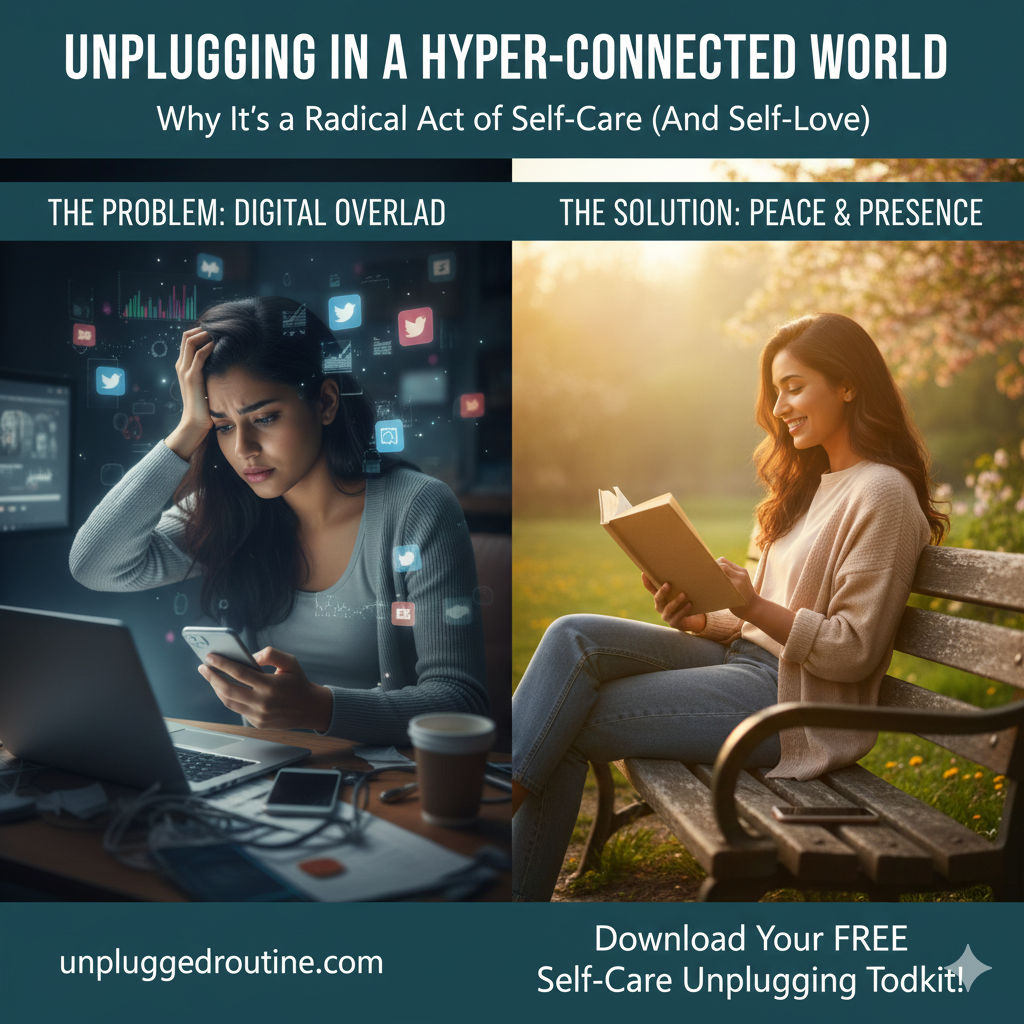
Why “Radical” Self-Care?
The word “radical” might seem strong, but consider this:
- It goes against the dominant culture: Society often rewards being “always on,” quick responses, and a packed digital presence.
- It challenges ingrained habits: Our digital habits are deeply wired, creating powerful neural pathways. Breaking them requires conscious effort.
- It demands intentionality: Unplugging isn’t passive; it’s an active decision to prioritize your inner world over external demands.
When you choose to unplug in a hyper-connected world, you’re not just taking a break; you’re making a profound statement that your well-being matters more than digital obligation. That, my friends, is a radical act.
Unplugging: The Ultimate Act of Self-Care & Self-Love
Let’s break down exactly why unplugging is such a powerful expression of caring for yourself:
1. Reclaiming Your Precious Attention
Your attention is your most valuable asset. It determines what you learn, what you experience, and what you create. In a hyper-connected world, your attention is constantly being commodified and sold to advertisers, content creators, and apps.
The Self-Care Angle: When you unplug, you’re literally taking your attention back. You’re saying, “My focus is too valuable to be scattered across endless feeds and notifications.” This allows you to direct your attention intentionally towards things that truly nourish you – a good book, a meaningful conversation, a creative project. This is a profound act of self-respect.
2. Protecting Your Mental Energy from Digital Overload
Our brains are constantly working to process information, make decisions, and regulate emotions. Digital environments, with their constant streams of new content, notifications, and emotional triggers, can rapidly deplete our mental reserves. This leads to decision fatigue, irritability, and a feeling of being perpetually overwhelmed.
The Self-Care Angle: Unplugging is like hitting the “reset” button for your brain. It reduces the constant input, allowing your mind to rest, recover, and consolidate information. This conserves mental energy, making you more resilient, focused, and present when you do need to engage with the digital world or tackle real-life challenges.
3. Nurturing Authentic Connection (With Yourself & Others)
While social media offers a form of connection, it often lacks the depth and authenticity of real-world interactions. Furthermore, the constant “performing” for an online audience can create a disconnect from your true self.
The Self-Care Angle: By unplugging, you create space for genuine, unfiltered connection. This means truly listening to a friend without the urge to check your phone, having a heartfelt conversation with family, or simply sitting in quiet contemplation with your own thoughts and feelings. This allows for deeper intimacy, stronger bonds, and a more profound understanding of yourself – the real you, not the online avatar.
4. Cultivating Inner Peace and Reducing Anxiety
The hyper-connected world thrives on urgency, comparison, and the fear of missing out (FOMO). This constant state of low-grade anxiety can be incredibly damaging to your mental well-being, leading to chronic stress, poor sleep, and a diminished sense of contentment.
The Self-Care Angle: Unplugging is an intentional step away from these anxiety triggers. It allows you to break free from the comparison trap, silence the constant demands, and find moments of genuine peace. When you’re not constantly reacting to external stimuli, you can reconnect with your inner calm, practice mindfulness, and reduce the overall stress load on your mind and body. This is crucial for long-term emotional regulation.
5. Reconnecting with Your Body and the Natural World
Sitting glued to screens for hours on end is detrimental to physical health. It contributes to sedentary lifestyles, poor posture, eye strain, and disrupted sleep. We are biological beings, designed to move, interact with nature, and experience the world through all our senses.
The Self-Care Angle: Unplugging encourages you to move your body, step outside, feel the sun on your skin, and breathe fresh air. It motivates you to engage in physical activity that nourishes your body and releases endorphins. This is a fundamental act of self-love, recognizing that your physical health is inextricably linked to your mental well-being, and both thrive when disconnected from screens.
6. Fostering Creativity and Problem-Solving
When your brain is constantly inundated with external information, it has less opportunity for internal processing, wandering, and making novel connections. The “default mode network” – the part of your brain responsible for introspection, imagination, and creative thought – thrives on downtime.
The Self-Care Angle: Giving yourself the gift of unplugged time is like giving your brain a sandbox to play in. It allows for mind-wandering, daydreaming, and the subconscious linking of ideas. This isn’t wasted time; it’s essential for innovative thinking, breaking through creative blocks, and finding solutions to complex problems. It’s an act of self-investment in your intellectual and creative capacity.
7. Defining Your Own Worth Beyond Digital Validation
In a hyper-connected world, it’s easy to fall into the trap of seeking external validation through likes, comments, and follower counts. Your self-worth can become dangerously tied to your online presence and perceived popularity.
The Self-Care Angle: Unplugging is a powerful statement that your worth is inherent, not dependent on digital metrics. It forces you to look inward, to appreciate your own strengths, passions, and presence without the need for external affirmation. This builds true self-esteem and fosters a deep sense of self-love, reminding you that you are valuable simply for being you, independent of your digital footprint.
Embracing the Radical Act: Your First Steps
Ready to embrace this radical act of self-care? You don’t need to disappear off-grid. Start small, start intentionally.
- Designate Screen-Free Zones: Pick one room or one activity (e.g., the dinner table, your bedroom after 9 PM) where screens are absolutely banned.
- Schedule Digital Downtime: Treat your unplugged time like an important appointment. Block out 30 minutes or an hour each day where your phone is on airplane mode and out of reach.
- Find an “Analog Anchor”: Discover a non-digital activity that genuinely brings you joy or calm – reading, drawing, walking, listening to music without distractions. Make time for it daily.
Conclusion: Unplug to Flourish
In a world that constantly pushes for more connection, more speed, and more digital presence, choosing to slow down and disconnect is an act of profound courage and wisdom. Unplugging in a hyper-connected world isn’t a luxury; it’s a necessity for your well-being.
It is a radical act of self-care because it challenges societal norms, reclaims your agency, and prioritizes your mental, emotional, and physical health. It is an act of self-love because it affirms your inherent worth, nurtures your inner peace, and allows you to experience the richness of life beyond the screen.
When you unplug, you’re not missing out. You’re choosing to lean into what truly nourishes you, allowing yourself to flourish in a way that constant digital noise simply can’t.
Are you ready to give yourself the gift of presence and reconnect with the incredible world (and person) that exists beyond your screen?
Call to Action (CTA)
Ready to start your journey of radical self-care through unplugging?
Download our FREE “Radical Self-Care Unplugging Toolkit” now! This toolkit includes a self-assessment to identify your digital stressors, mindful disconnection exercises, and a guide to discovering deeply fulfilling offline activities. Click here to begin your transformation and embrace the power of unplugging today!