In a world where we can “connect” with thousands of people through a glass screen, why do we feel more isolated than ever? The paradox of 2025 is that while our digital networks are expanding, our biological need for real-world community is hitting a breaking point.
The solution isn’t found in a new app or a faster internet connection. It’s found in the rhythmic crunch of gravel underfoot and the shared breath of a group climbing a hill together.
Welcome to the era of the Social Nature Walking Club.
This isn’t your grandmother’s walking group. Across the United States and Europe, “walking crews” are becoming the new social hubs for Gen Z and Millennials who are burnt out on bars, dating apps, and the “always-on” culture of the city.
At unpluggedroutine.com, we are documenting how these communities are transforming mental health by turning “green exercise” into a social revolution. Here are five reasons why you need to find your tribe on the trail this year.
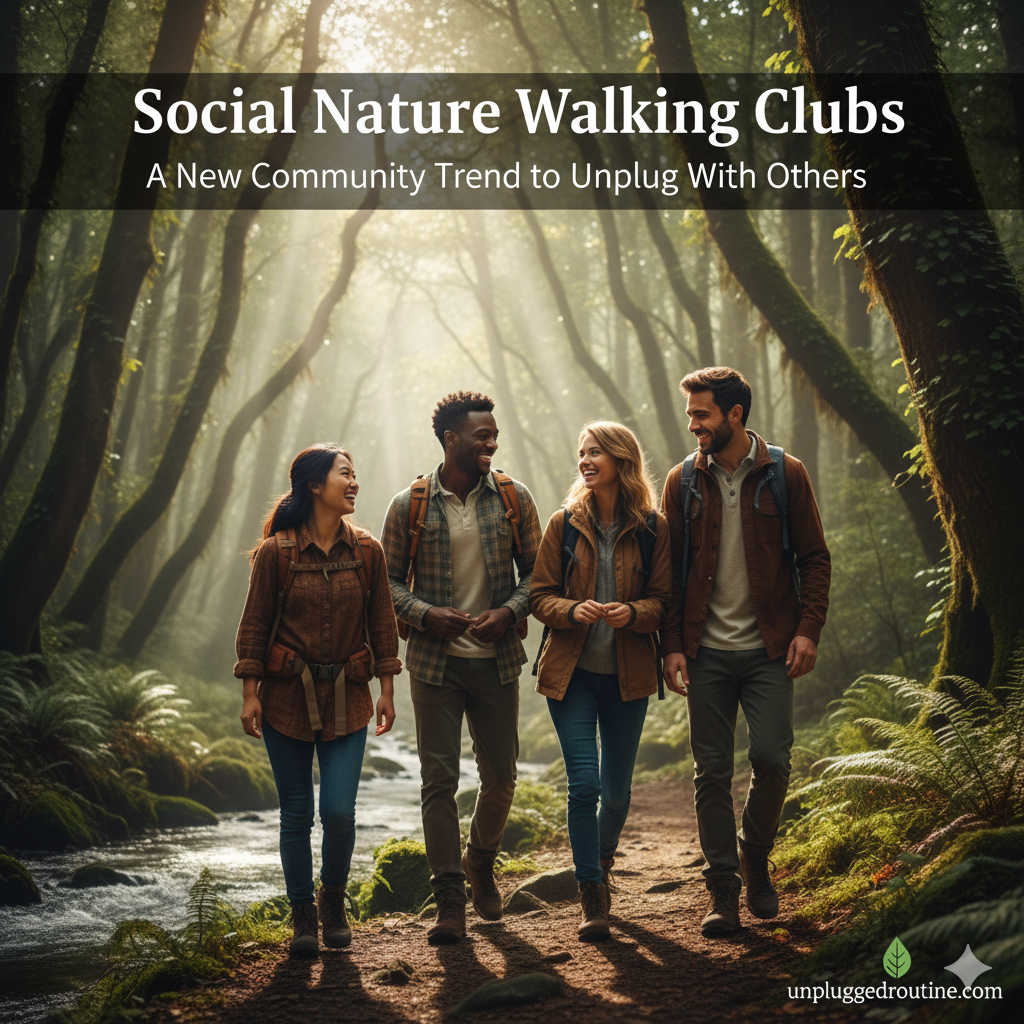
1. The “Synergy” Effect: Nature + Connection = Super-Wellness
Separately, nature and social interaction are powerful. Together, they create a physiological “super-pill.”
A groundbreaking 2025 study from the University of York showed that nature-based social activities can improve mood and anxiety levels in as little as 12 weeks—with results comparable to short-term Cognitive Behavioral Therapy (CBT).1
When you walk in a group, you aren’t just lowering your cortisol; you are releasing oxytocin (the bonding hormone). This combination acts as a biological shield against the “fight or flight” response triggered by modern work life.
2. Parallel Interaction: The End of Social Anxiety
One of the biggest hurdles to making new friends is the “interview” vibe of sitting across from a stranger at a table. It’s high-pressure, high-eye-contact, and often leads to social burnout.
Nature walking utilizes Parallel Interaction. Because everyone is moving forward and looking at the path, the pressure of direct eye contact is removed.
This makes it easier for people to open up. In these groups, conversations flow more naturally. You can have a 20-minute discussion about a deep life topic, then lapse into a comfortable 5-minute silence while looking at a waterfall, without it feeling “awkward.
3. The Power of “Collective Effervescence”
Have you ever felt a surge of energy when walking in a crowd at a festival? Sociologists call this Collective Effervescence. It’s the sense of harmony that occurs when a group of people performs the same rhythmic action together.
In a walking club, this rhythm creates a “group hum.” This synchrony has been shown to:
- Lower Perceived Effort: You can walk five miles with a group and feel less tired than if you walked two miles alone.
- Boost Confidence: Being part of a “pack” increases your sense of personal agency and safety.
- Synchronize Heart Rates: Some studies suggest that group members’ physiological states begin to mirror one another over long walks.
How to Find (or Start) Your Unplugged Crew: 3 Hook Steps
Ready to stop scrolling and start strolling? Use these steps to bridge the gap from digital to physical:
- Step 1: Scour the “Offline” Boards. Don’t just check Facebook. Look at the physical bulletin boards in local coffee shops, libraries, and REI stores. The best clubs often started as a simple “Meet at 8 AM Saturday” flyer.
- Step 2: The “Phone in the Bag” Pact. If you’re starting a group, make it a “Blackout Walk.” Everyone puts their phone at the bottom of their backpack. This immediately elevates the quality of the conversation.
- Step 3: Host a “Kick-Off” Circle. Don’t just start walking. Spend 5 minutes at the trailhead introducing yourselves and sharing one thing you’re hoping to “unplug” from during the walk.
4. Accountability That Doesn’t Feel Like a Chore
The #1 reason people fail at their wellness goals is lack of accountability. It’s easy to snooze the alarm when it’s just you and your sneakers.
In a Social Nature Walking Club, your presence matters. When you know that Mark and Sarah are waiting at the trailhead with a spare thermos of coffee, you show up.
These clubs turn “exercise” into a “social event.” In 2025, we’re seeing a shift where the “Saturday Morning Walk” is replacing the “Friday Night Drinks.” It’s a sustainable way to build a routine because you’re showing up for the people, not just the steps.
5. Reclaiming the “Third Space”
Sociologists define the “Third Space” as a place that isn’t home (the first space) and isn’t work (the second space). In the digital age, our third spaces (cafes, libraries, parks) have been invaded by laptops and Wi-Fi.
Social Nature Walking Clubs are reclaiming the trail as a pure third space. It is a neutral ground where your job title, your follower count, and your income don’t matter.
On the trail, you are just a person navigating the terrain. This “ego-death” is incredibly refreshing for high-achievers who spend all day being judged by their metrics.
The 2025 Vision: “Green Prescriptions”
This isn’t just a lifestyle choice; it’s becoming a medical one. In parts of Europe and the U.S., doctors are beginning to write “Green Prescriptions”—referring patients with mild depression or loneliness to community walking groups.2
At unpluggedroutine.com, we see this as the future of healthcare. It’s preventative, it’s community-driven, and it’s completely free.
Conclusion: Your Seat (or Step) at the Table
The rise of Social Nature Walking Clubs proves that we are finally waking up to the cost of our digital isolation. We are choosing the rustle of leaves over the ping of a notification. We are choosing the warmth of a real smile over the blue light of a screen.
The trail is long, but it’s much easier to walk when you aren’t walking alone.
Ready to find your path?
Check out our [Unplugged Club Directory] to find a walking group near you, or download our “Social Trailblazer” guide to start your own local chapter. 2025 is the year we take our lives back—one step, and one friend, at a time