Have you ever looked at your phone “one last time” before bed, only to find yourself wide awake an hour later, heart racing over a news headline or a work email? Or maybe you’ve noticed that your ability to concentrate on a single task—even a movie or a book—has dwindled to just a few minutes before you feel the “itch” to check for notifications.
You aren’t imagining it. There is a profound Science of Screen Time at play here, and it’s physically altering the way your brain functions.
In today’s world, our devices are no longer just tools; they are extensions of our nervous systems. While they offer incredible convenience, they also come with a biological cost. At Unplugged Routine, we’re obsessed with understanding how tech impacts our biology so we can help you reclaim your natural state of calm and focus.
Today, we are diving deep into the research. We’ll explore why your brain reacts to screens the way it does and, more importantly, provide a scientific roadmap to help you unplug and heal.
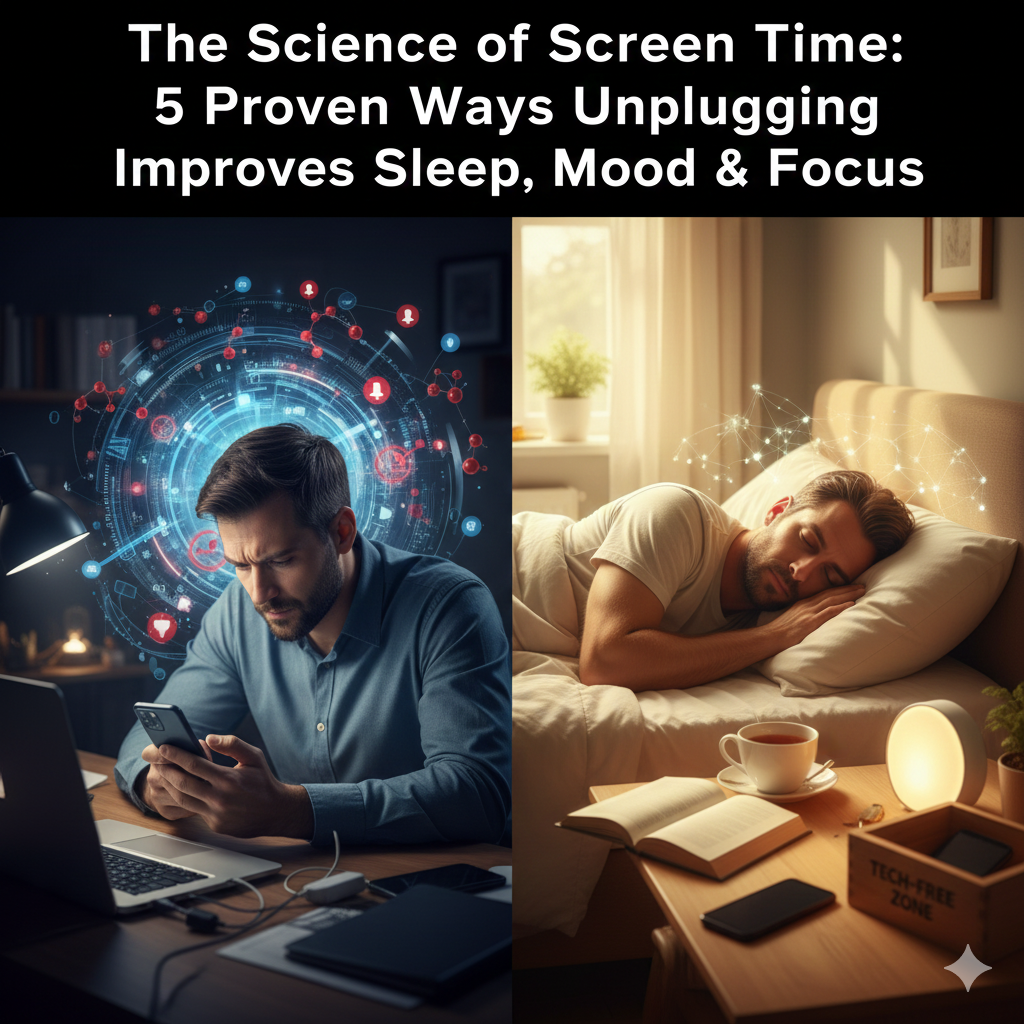
The Biological “Hack”: Why Screens Keep Us Wired
To understand why unplugging is so effective, we first have to look at what happens when we stay plugged in. Your brain is a masterpiece of evolution, but it wasn’t designed for 2025.
Our ancestors relied on the sun to regulate their internal clocks. Today, we carry a miniature sun in our pockets. The blue light emitted by smartphones and laptops mimics daylight, tricking your brain into thinking it’s high noon when it’s actually midnight.
But it’s not just the light. It’s the dopamine loop. Every like, comment, and notification triggers a tiny burst of dopamine—the “reward” chemical. Your brain begins to crave these hits, leading to the compulsive checking we’ve all experienced.
Hook Step 1: Solving the Sleep Equation
If you want to improve your life overnight—literally—you have to address the relationship between screens and sleep.
The Melatonin Suppression: When blue light hits your retinas, it tells your pineal gland to stop producing melatonin, the hormone responsible for sleep. Even 15 minutes of late-night scrolling can delay your sleep cycle by hours.
The “High-Alert” Brain: Beyond the light, the content we consume matters. Checking work emails or scrolling through stressful news puts your brain in a “high-alert” state. Your body produces cortisol (the stress hormone), making deep, restorative REM sleep nearly impossible.
The Fix: Implement a “Digital Sunset.” One hour before bed, turn off all screens. Swap the scrolling for a paper book or a gratitude journal. You’ll find that you fall asleep faster and wake up feeling significantly more refreshed
Hook Step 2: Breaking the Mood-Volatility Cycle
Have you ever felt “hangry,” but for tech? That irritability you feel when you can’t check your phone is a real physiological response.
Social Comparison and Cortisol: The Science of Screen Time shows a direct link between heavy social media use and increased anxiety. We are constantly measuring our “behind-the-scenes” against everyone else’s “highlight reel.” This creates a constant state of low-grade social stress.
The End of Reflection: When we use screens to fill every gap in our day—waiting for coffee, riding the elevator—we lose the ability to process our emotions. We are “numbing out” rather than checking in.
The Fix: Practice “Scheduled Boredom.” For 10 minutes a day, leave your phone in another room. Let your mind wander. This allows your emotional processing centers to “catch up,” leading to a more stable and positive mood.
Hook Step 3: Reclaiming the “Deep Work” Focus
In 2025, our attention is the most valuable commodity on earth. Major tech companies spend billions to ensure you stay distracted.
The Myth of Multitasking: Science is clear: the human brain cannot multitask. It can only “switch-task.” Every time you check a notification while working, it takes an average of 23 minutes to return to your original level of deep focus. This is known as “attention residue.”
Brain Plasticity: Because of our screen habits, we are training our brains to be distracted. We are physically weakening the neural pathways responsible for deep, sustained concentration.
The Fix: Use “Focus Blocks.” Set a timer for 25 minutes (the Pomodoro technique) and put your phone on “Do Not Disturb” in a different room. By practicing this, you are literally rewiring your brain to regain its ability to focus.
Hook Step 4: The Physical Toll – “Text Neck” and Beyond
The impact isn’t just mental; it’s physical. The way we interact with tech changes our posture and our physical health.
Digital Eye Strain: Our eyes weren’t meant to stare at a fixed distance for hours on end. This leads to headaches, blurred vision, and physical fatigue.
The Sedentary Trap: Screens are the ultimate “sit-down” activity. The more time we spend plugged in, the less we move, which further degrades our mood and energy levels.
The Fix: The 20-20-20 Rule. Every 20 minutes, look at something 20 feet away for 20 seconds. This simple habit resets your eye muscles and breaks the digital trance.
Hook Step 5: The “Dopamine Fast” – A Scientific Reset
If you feel completely “burnt out” by your devices, a standard break might not be enough. You might need a biological reset.
Downregulation: When we over-stimulate our brain with digital hits, our dopamine receptors “downregulate.” This means we need more and more stimulation just to feel “normal.” This is why things that used to be fun—like a walk in the park—might feel “boring” now.
The Reset: A 24-hour unplugging period (similar to a Digital Sabbath) allows your dopamine receptors to reset. It’s like a palate cleanser for your brain. After a day away from screens, you’ll find that real-world pleasures feel much more vibrant.
Summary: The Power of a Wired-Down Life
The Science of Screen Time is clear: we aren’t broken; we are just over-stimulated. By understanding the biological mechanisms at play, we can stop blaming ourselves for “lack of willpower” and start using science-backed strategies to reclaim our health.
When you choose to unplug, you aren’t missing out on the world. You are finally showing up for it. You are giving your brain the sleep it needs, your mood the stability it craves, and your focus the power it’s capable of.
Conclusion: Your Scientific Journey to Wellness Starts Now
Understanding the Science of Screen Time is the first step toward a more intentional life. You have the power to rewire your brain, improve your sleep, and skyrocket your productivity—one unplugged moment at a time.
At Unplugged Routine, we are here to guide you through the transition from “digital exhaustion” to “analog excellence.” Don’t let your devices dictate your biology. Take control of your habits today.
Are you ready to see the results for yourself? We challenge you to a 24-hour “Brain Reset” this weekend! Put the phone away and track how your mood and focus change. Leave a comment below telling us: What is the one thing you’re most excited to do with your extra “focus time”?