Creating a consistent workout routine can feel overwhelming, especially when you’re trying to juggle everything life throws your way. But what if I told you the key to lasting fitness success could be found just steps away – right in your own home? This guide will walk you through the simple yet effective steps to design your perfect weekly home workout routine, helping you ditch the gym excuses and embrace a healthier lifestyle from the comfort of your living room.
Table of Contents
1. Define Your Fitness Goals: What Do You Want to Achieve?
Before you even think about exercises or schedules, let’s get clear on your “why.” What do you hope to achieve with your weekly home workout routine? Having well-defined goals will keep you motivated and help you choose the right types of workouts.
- Weight Loss: Are you looking to shed some pounds? Your routine should likely include a good mix of cardio and strength training to burn calories and build muscle.
- Muscle Gain: Want to build strength and tone your muscles? Focus on bodyweight exercises or invest in some basic dumbbells or resistance bands for progressive overload.
- Improved Endurance: Hoping to run a 5k or simply feel less winded during daily activities? Incorporate more cardio-focused workouts.
- Increased Flexibility: Feeling stiff? Dedicate time to yoga or stretching routines.
- Overall Well-being: Maybe you just want to feel healthier and more energized. A balanced routine with a variety of movements will be beneficial.
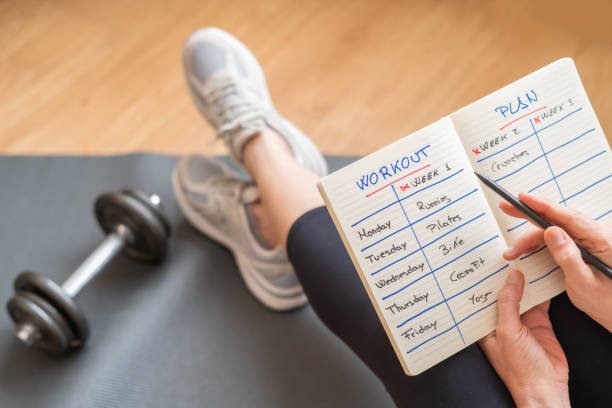
Be specific with your goals. Instead of “lose weight,” aim for “lose 5 pounds in the next month.” Instead of “get stronger,” aim for “be able to do 10 push-ups with good form.” Writing down your goals makes them more tangible and increases your commitment.
2. Assess Your Current Fitness Level: Where Are You Starting From?
It’s crucial to be honest with yourself about your current fitness level. Starting too hard, too fast is a surefire way to get discouraged or even injured.
- Beginner: If you’re new to exercise or haven’t been active in a while, start with shorter workouts (15-20 minutes) and focus on mastering basic movements with proper form.
- Intermediate: If you have some experience with exercise, you can aim for longer workouts (30-45 minutes) and incorporate more challenging variations of exercises.
- Advanced: If you’re already quite fit, you can push yourself with longer, more intense workouts and consider adding more advanced bodyweight exercises or equipment.
Don’t compare yourself to others. Everyone starts somewhere, and the most important thing is to progress at your own pace. Listen to your body and don’t hesitate to modify exercises if needed.
3. Determine Your Workout Frequency: How Many Days Can You Commit?
Consistency is key to seeing results, but it’s also important to be realistic about how much time you can dedicate to your weekly home workout routine.
- 2-3 Workouts Per Week: This is a great starting point for beginners. Focus on full-body workouts to hit all major muscle groups.
- 4-5 Workouts Per Week: If you have more time and are looking to see results faster, spreading out your workouts allows for more focused training (e.g., upper body days, lower body days, cardio days).
- 6-7 Workouts Per Week: This is for more advanced individuals and requires careful planning to avoid overtraining and ensure adequate recovery.
Remember to factor in rest days. Your muscles need time to recover and rebuild. Overtraining can lead to fatigue, injury, and burnout. Aim for at least one full rest day per week.
4. Choose Your Workout Types: What Activities Do You Enjoy?
The best workout routine is one you can stick with, and that often comes down to choosing activities you actually enjoy. When designing your weekly home workout routine, consider incorporating a variety of workout types:
- Cardio: Activities that get your heart pumping, like jogging in place, jumping jacks, high knees, or dancing. Cardio is great for burning calories and improving cardiovascular health.
- Strength Training: Exercises that challenge your muscles, such as bodyweight squats, push-ups, lunges, planks, and using dumbbells or resistance bands. Strength training builds muscle mass, which boosts your metabolism.
- Flexibility and Mobility: Activities like yoga, Pilates, and stretching improve your range of motion, reduce the risk of injury, and can alleviate muscle soreness.
- Balance Training: Exercises that challenge your stability, such as single-leg stands or heel-to-toe walking. Balance training is important for preventing falls and improving coordination.
Mix and match these workout types throughout your week to keep things interesting and ensure you’re working different aspects of your fitness.

5. Select Your Exercises: Building Your At-Home Arsenal
Now comes the fun part: choosing the specific exercises for your weekly home workout routine. Since you’re working out at home, focus on exercises that require minimal or no equipment.
Bodyweight Exercises: These are fantastic for beginners and can be surprisingly challenging.
- Lower Body: Squats, lunges (forward, backward, lateral), glute bridges, calf raises.
- Upper Body: Push-ups (on knees or toes), incline push-ups (using a chair or wall), triceps dips (using a chair), plank.
- Core: Crunches, leg raises, bird-dog, bicycle crunches.
- Cardio: Jumping jacks, high knees, butt kicks, mountain climbers, burpees (can be modified for lower impact).
Optional Equipment: If you have access to some basic equipment, you can add variety and increase the challenge:
- Resistance Bands: Versatile for working all major muscle groups with varying levels of resistance.
- Dumbbells: Great for adding weight to squats, lunges, rows, presses, and more.
- Yoga Mat: Provides cushioning and grip for floor exercises.
When choosing exercises, focus on proper form over the number of repetitions. Watch videos and read instructions carefully to ensure you’re performing each movement correctly to avoid injury.
6. Structure Your Weekly Schedule: Putting It All Together
Now, let’s create a sample weekly home workout routine. Remember, this is just an example, and you can adjust it based on your goals, fitness level, and available time.
Option 1: Beginner (2 Workouts Per Week)
- Monday: Full Body Workout (20 minutes): Bodyweight squats, wall push-ups, glute bridges, plank, marching in place. 2 sets of 10-12 repetitions (or 30 seconds for plank/marching).
- Thursday: Full Body Workout (20 minutes): Lunges, incline push-ups, bird-dog, crunches, arm circles. 2 sets of 10-12 repetitions (or 30 seconds for arm circles).
Option 2: Intermediate (4 Workouts Per Week)
- Monday: Lower Body & Core (30 minutes): Squats, lunges, glute bridges, calf raises, plank, leg raises. 3 sets of 12-15 repetitions (or 45 seconds for plank).
- Tuesday: Active Rest (light walk or stretching).
- Wednesday: Upper Body & Core (30 minutes): Push-ups, triceps dips, Superman lifts, bird-dog, bicycle crunches. 3 sets of 10-12 repetitions.
- Thursday: Active Rest (light walk or stretching).
- Friday: Cardio & Full Body (30 minutes): Jumping jacks, high knees, bodyweight squats, incline push-ups, glute bridges. 3 sets of 1 minute for cardio, 12-15 repetitions for strength.
Option 3: More Frequent Workouts (Adjust Based on Your Preferences)
You can also structure your week with dedicated cardio days, strength training days focusing on different muscle groups (e.g., upper body, lower body, core), and flexibility/mobility sessions.
7. Plan Your Workout Sessions: What Will Each Workout Look Like?
For each workout session in your weekly home workout routine, plan the following:
- Warm-up (5-10 minutes): Prepare your body for exercise with light cardio (e.g., marching in place, jumping jacks at a low intensity) and dynamic stretches (e.g., arm circles, leg swings).
- Workout (as planned): Perform your chosen exercises with proper form and the designated number of sets and repetitions (or duration).
- Cool-down (5-10 minutes): Gradually bring your heart rate down with light cardio and static stretches (holding each stretch for 20-30 seconds), focusing on the muscles you worked.
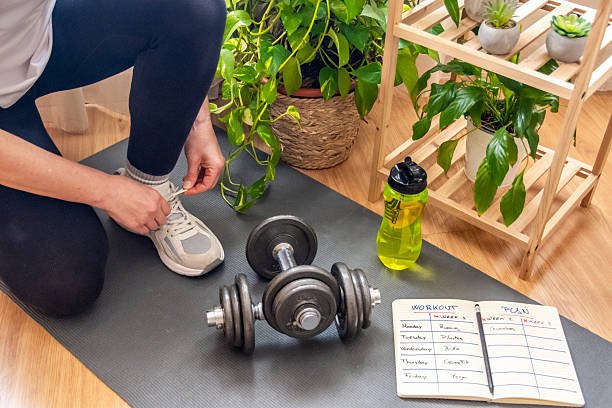
Writing down your workout plan for each session can help you stay organized and focused.
8. Track Your Progress: Celebrate Your Wins!
Monitoring your progress is a powerful motivator and helps you see how far you’ve come with your weekly home workout routine.
- Keep a Workout Journal: Note down the exercises you did, the number of sets and reps, the weight you used (if any), and how you felt.
- Track Your Measurements: If your goal is weight loss or muscle gain, track your weight and body measurements periodically.
- Take Photos: Progress photos can be incredibly motivating as you start to see physical changes.
- Celebrate Milestones: Acknowledge your achievements, no matter how small. Reached a new personal best for push-ups? Completed a week of consistent workouts? Give yourself a pat on the back!
9. Listen to Your Body and Adjust: Flexibility is Key
Life happens, and sometimes your planned weekly home workout routine might need adjustments. Don’t be afraid to modify your schedule if you’re feeling tired, sore, or if unexpected events come up.
- Rest When Needed: If you’re feeling overly fatigued or experiencing pain, take a rest day. Pushing yourself too hard can lead to injury.
- Modify Exercises: If an exercise is too difficult, try a modification (e.g., push-ups on your knees instead of toes). If it’s too easy, look for ways to make it more challenging (e.g., adding more repetitions or sets, trying a harder variation).
- Be Flexible with Your Schedule: If you miss a workout, don’t beat yourself up. Just get back on track with your next scheduled session. Consistency over perfection is the key.
10. Stay Hydrated and Nourish Your Body: Fueling Your Fitness
Remember that exercise is only one part of the fitness equation. To truly see and feel the benefits of your weekly home workout routine, you also need to prioritize hydration and a healthy diet.
- Drink Plenty of Water: Stay hydrated throughout the day, especially before, during, and after your workouts.
- Eat a Balanced Diet: Fuel your body with nutritious foods that provide the energy and nutrients it needs to perform and recover. Focus on whole grains, lean protein, fruits, and vegetables.
By combining a consistent at-home workout routine with healthy lifestyle habits, you’ll be well on your way to achieving your fitness goals and feeling your best.
Frequently Asked Questions (FAQ)
1. How long should my home workouts be?
There’s no magic number, and it really depends on your fitness level and schedule! If you’re a beginner, a consistent 20-30 minutes of focused exercise, 3-4 times a week, is a fantastic goal. Remember, consistency is far more important than duration. Even a powerful 15-minute workout is incredibly beneficial and much better than doing nothing at all!
2. Do I need any equipment to get results with a home workout routine?
Absolutely not! One of the biggest advantages of at-home fitness is that you can get an amazing workout using just your own body weight. Exercises like squats, push-ups, lunges, and planks are incredibly effective for building strength and endurance. As you progress, you can choose to incorporate simple, inexpensive tools like resistance bands or dumbbells, but they are definitely not required to start seeing results.
3. How do I stay motivated when working out alone?
Staying motivated is often the biggest challenge, but you can do it! Treat your workouts like important appointments and schedule them in your calendar. Find a killer playlist that gets you energized, and focus on how great you feel after the workout is done. It also helps to track your progress in a journal so you can look back and see how far you’ve come.
4. Is it okay to do the same workout every day?
It’s best to avoid doing the exact same routine every single day. Your muscles need time to rest and repair themselves to grow stronger—that’s when the real magic happens! Doing the same exercises daily can lead to burnout or injury. Try to alternate your focus, just like in the sample schedules above. For example, you could focus on your lower body one day and your upper body the next, or alternate between strength training and cardio or flexibility.
5. What should I eat before and after my workout?
Fueling your body is key! Before a workout, about 30-60 minutes beforehand, try having a light snack with easily digestible carbohydrates for energy. A banana or a small bowl of oatmeal is a great choice. After your workout, focus on replenishing your energy and helping your muscles recover with a mix of protein and carbohydrates. Something like Greek yogurt with berries, a glass of milk, or a balanced meal with lean protein (like chicken or beans) are excellent options.
6. Is it okay to work out if my muscles are sore?
This is a great question! It’s very normal to feel some muscle soreness a day or two after a new or intense workout. This is called Delayed Onset Muscle Soreness (DOMS), and it’s a sign your muscles are adapting. If it’s just mild soreness, doing some light activity like walking, stretching, or a gentle yoga session can actually help. However, if you’re in sharp pain or the soreness is severe, it’s best to take a rest day and let your body fully recover.
7. How do I know when it’s time to make my workouts harder?
You’ll know it’s time to increase the challenge when your current routine starts to feel less difficult. A good sign is when you can easily complete all of your sets and reps with perfect form and feel like you could do more. To progress, you can try a few things: add a few more repetitions to each set, add one more set to each exercise, reduce your rest time between sets, or try a more challenging variation of an exercise (like moving from wall push-ups to knee push-ups).
8. What should I do if I miss a workout?
First of all, don’t worry about it! Life happens, and missing a planned workout is completely normal. The most important thing is to avoid the “all-or-nothing” mindset where one missed day makes you feel like you’ve failed and should give up. Don’t try to punish yourself with a super long or intense workout the next day to “make up for it.” Simply be kind to yourself and get right back on track with your next scheduled workout. Long-term consistency is always more important than short-term perfection.
Your Journey to a Fitter You Starts Now
Creating your own powerful weekly home workout routine is a fantastic way to take control of your fitness journey. By defining your goals, understanding your current level, choosing activities you enjoy, and staying consistent, you can achieve remarkable results without ever stepping foot in a gym. Remember to listen to your body, track your progress, and celebrate your achievements along the way.
Now it’s your turn! Take the information and inspiration from this guide and start crafting your personalized plan today. What are your fitness goals, and what’s one simple at-home exercise you’re excited to incorporate into your routine? Share your thoughts in the comments below – we’d love to support you on your unplugged fitness journey!