In the rush of daily life, there’s a deep, quiet desire not just to get through the day, but to feel truly capable of meeting its demands. We want to feel strong—strong enough to effortlessly lift a heavy suitcase into an overhead bin, carry all the groceries in one trip, and move through the world with a sense of grounded confidence. Many believe this kind of strength can only be forged in a gym, surrounded by intimidating racks of iron. That’s a myth. Your body is the only tool you need to build powerful, functional strength. This guide will provide you with the ultimate full-body at-home workout for strength, designed to build muscle, boost your resilience, and empower you from the inside out.
Table of Contents
More Than Muscle: The Real Benefits of Strength Training
Building strength goes far beyond changing your physical appearance. It’s a foundational practice of self-care with profound benefits for your overall well-being.
- Boosts Your Metabolism: Muscle is like a metabolic engine. Unlike fat tissue, muscle requires a significant amount of energy (calories) just to maintain itself. This means the more lean muscle you build, the more calories your body burns around the clock, even while you’re resting.
- Builds Stronger Bones: When you perform strength exercises, your muscles pull on your bones. This stress is a positive signal that tells your body to deposit more minerals and build denser, stronger bones, which is crucial for preventing osteoporosis and fractures as you age.
- Enhances Mental Resilience: Strength training is a practice in overcoming resistance. Each time you push through a difficult set, you are teaching your brain how to persevere. Think of every challenging rep as a vote of confidence for yourself. This builds a powerful sense of self-efficacy that translates directly to handling stress and challenges in your daily life.
- Improves Mood and Reduces Stress: Strength training has been proven to be a powerful mood booster. It releases a cascade of endorphins—your body’s natural feel-good chemicals—that combat stress, ease anxiety, and promote a sense of well-being. It provides a focused, physical outlet for mental tension, leaving you feeling calmer and more centered.
The Key to Bodyweight Strength: Progressive Overload
How do you get stronger without lifting heavier weights? The answer is a crucial fitness principle called progressive overload. In simple terms, it means you must continually challenge your muscles to do more than they are used to. With bodyweight training, you can’t add another plate to the barbell, but you can “increase the challenge” in several other smart ways:
- Increase Reps or Sets: Instead of doing 3 rounds of the circuit, push for 4. Instead of 15 squats, aim for 18.
- Increase Time Under Tension (TUT): This is one of the most effective techniques. Slow down your movements to force your muscles to work harder. For example, try a “3-1-1 tempo” on your squats: take a full three seconds to lower down, pause for one second at the bottom, and take one second to rise back up.
- Decrease Rest Time: If you normally rest for 90 seconds between rounds, try cutting it down to 75, then 60. This increases the metabolic demand of the workout.
- Progress to Harder Variations: Once you can comfortably perform 20 standard squats, it’s time to progress to a more challenging version, like a Jump Squat, to keep challenging your muscles.
Understanding this principle is the key to making continuous progress in your strength training at home.
The Ultimate Full-Body At-Home Workout Routine
This routine is a complete, balanced workout. Perform it 2-3 times per week on non-consecutive days.
Warm-Up (5 minutes)
- Jumping Jacks: 60 seconds
- High Knees: 60 seconds
- Arm Circles: 30 seconds forward, 30 seconds backward
- Leg Swings: 30 seconds per leg (forward/backward and side-to-side)
- Cat-Cow: 60 seconds
The Main Workout (30 minutes)
This is a circuit. Perform each of the 5 exercises back-to-back. After completing all 5 exercises, rest for 60-90 seconds. That’s one round. Complete 3-4 full rounds.
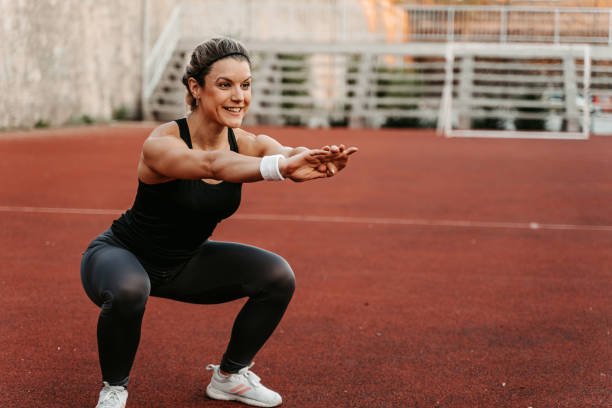
1. Lower Body Push: Bodyweight Squats
- Reps: 15-20
- Focus On: Keeping your spine neutral and chest proud. Imagine you are showing someone the logo on your shirt throughout the entire movement.
- Common Mistake: Letting your knees cave inward. Actively think about pushing your knees out slightly to keep them aligned with your toes.
- Progression (Jump Squats): Perform a regular squat, but on the way up, explode powerfully into a small jump. Land softly with bent knees to absorb the impact and go immediately into the next squat.
2. Upper Body Push: Push-Ups
- Reps: As many as possible with good form (AMRAP).
- Focus On: Bracing your core as if you’re about to be punched in the stomach. This prevents your hips from sagging and protects your lower back.
- Common Mistake: Flaring the elbows out to the sides. Keep your elbows tucked at roughly a 45-degree angle to your body to protect your shoulders.
- Modification (Incline Push-Ups): If a floor push-up is too difficult, place your hands on an elevated surface like the edge of a sturdy couch, table, or wall. The higher the surface, the easier the exercise will be.
3. Lower Body Pull: Glute Bridges
- Reps: 15-20
- Focus On: The powerful squeeze at the top. At the peak of the bridge, consciously squeeze your glutes as hard as you can for a full second before lowering.
- Common Mistake: Using your lower back to lift instead of your glutes. Only lift your hips as high as you can while maintaining a straight line from your knees to your shoulders.
- Progression (Single-Leg Glute Bridges): Perform the exercise as normal, but lift one foot off the floor and extend the leg straight. Complete all reps on one side before switching.
4. Upper Body Pull / Posterior Chain: Superman Lifts
- Reps: 15-20
- Focus On: Lengthening. Imagine you are being gently pulled by your hands and feet in opposite directions. This helps engage the muscles correctly.
- Common Mistake: Cranking your neck up to look forward. Keep your neck in a neutral position by looking down at the floor just in front of you.
- Progression (“Swimmers”): At the top of the lift, perform a fluttering motion by alternating lifting your right arm/left leg and left arm/right leg.
5. Full Body / Core: Plank
- Reps: Hold for 30-60 seconds.
- Focus On: Full-body tension. It’s not just a core exercise. Squeeze your glutes, brace your abs, and push the ground away with your forearms to engage your entire body.
- Common Mistake: Holding your breath. Remember to breathe steadily and deeply throughout the entire hold.
- Progression (Plank with Shoulder Taps): From a high plank (on your hands), try to keep your hips as still as possible as you slowly lift one hand to tap the opposite shoulder.
Cool-Down (5 minutes)
Hold each stretch for 30 seconds. (Internal Link Idea: For a more detailed cool-down, check out our 7 Gentle Yoga Poses for Flexibility.)
- Quad Stretch
- Hamstring Stretch (Seated Forward Bend)
- Pigeon Pose (for hips)
- Child’s Pose (for back)
Frequently Asked Questions (FAQ)
Q1: How many times a week should I do this workout?
A: For best results, aim for 2 to 3 times per week, with at least one day of rest in between. Rest is when your muscles repair and get stronger.
Q2: Can I really build muscle with just bodyweight exercises?
A: Absolutely. Bodyweight strength training is incredibly effective. The key is consistently applying progressive overload—slowing down reps, adding sets, and moving to harder variations.
Q3: Should I be sore after every workout?
A: No. Soreness is common when you start a new routine, but it’s not a required indicator of a good workout. As your body adapts, you’ll experience less soreness.
Q4: What should I eat to support muscle growth?
A: To build muscle, your body needs adequate protein. Aim to include a good source of protein (like chicken, fish, eggs, tofu, beans, or a protein shake) with your meals, especially in the meal you eat an hour or two after your workout to help with muscle repair.
Q5: Do I still need to do cardio on my other days?
A: Yes, it’s an excellent idea to include cardio in your weekly routine. While this workout builds strength and muscle (which is an anaerobic activity), cardio (or aerobic exercise) is specifically focused on strengthening your heart and lungs. A balanced routine includes both. On the days you aren’t doing this strength workout, aim for 20-30 minutes of moderate-intensity cardio like brisk walking, jogging, cycling, or even a fun, high-energy dance session. Our at-home HIIT workouts would also be a perfect complement.
Q6: What if I don’t have enough time for the full 30-minute workout?
A: The “all or nothing” mindset is the biggest enemy of consistency. A shorter workout is infinitely better than no workout at all. If you’re pressed for time, here are two great options:
Do fewer rounds: Complete just one or two full rounds of the circuit. A 10 or 15-minute strength session is still incredibly effective for maintaining muscle and building the habit.
Focus on a couple of key movements: If you only have 5 minutes, pick two exercises (like squats and push-ups) and do as many quality reps as you can. The most important thing is to show up for yourself, even if it’s just for a few minutes.
Q7: When will I actually start to feel stronger?
A: You will likely feel stronger much sooner than you will see visible changes.
In the first 2-4 weeks: You’ll experience “neural adaptations.” This is your brain and nervous system becoming more efficient at communicating with your muscles. Exercises will feel less awkward, and you’ll be able to push harder and do more reps. This is the first sign that you’re getting stronger!
After 6-8 weeks: With consistent training and good nutrition, you may start to notice more visible changes in muscle definition.
Focus on “non-scale victories,” like carrying groceries more easily, having more energy, or finally mastering a full push-up. These are the true indicators of progress.
Conclusion
Building strength is an act of empowerment. It’s the process of showing up for yourself, challenging your limits, and discovering a new level of capability. You don’t need a gym membership to embark on this journey. With this full-body at-home workout for strength, consistency, and the will to progress, you have everything you need to build a stronger body and a more resilient mind. The power to transform is already within you. Start today.
We want to hear about your journey! What does feeling strong mean to you? Share your personal strength goal in the comments below and let’s build a supportive community together!