Hey everyone! Feeling that familiar knot of anxiety tightening in your stomach? Is your brain a scrambled mess of lecture notes, social media updates, and the nagging feeling you should be doing more? If you’re a student or young adult navigating the relentless demands of academics, social life, and future planning, you know the struggle is real. And often, a major player in that struggle is the very device you’re probably holding right now.
Welcome to unpluggedroutine.com, your guide to reclaiming peace and productivity in a hyper-connected world. Today, we’re talking directly to you, students and young adults, about a powerful tool that can dramatically improve your academic performance, mental well-being, and overall success: the digital detox. We’ll show you how to leverage it to not just survive, but truly thrive during exam stress and finally boost that elusive focus.
The Student’s Paradox: Connected, Yet Disconnected
Let’s be honest: for students and young adults, technology is indispensable. It’s how you access lectures, collaborate on projects, research papers, and stay connected with friends and family. It’s a lifeline. But what happens when that lifeline becomes a lead weight, dragging you down?
The paradox is that while technology offers incredible resources, its constant presence can be a huge drain on the very things you need most for academic success: sustained focus, deep learning, effective memory, and emotional resilience.
You’re bombarded by notifications, tempted by endless scrolls, and constantly battling the fear of missing out (FOMO). This isn’t just a minor distraction; it’s a fundamental challenge to your brain’s ability to learn, concentrate, and manage stress – especially during high-pressure times like exam season.
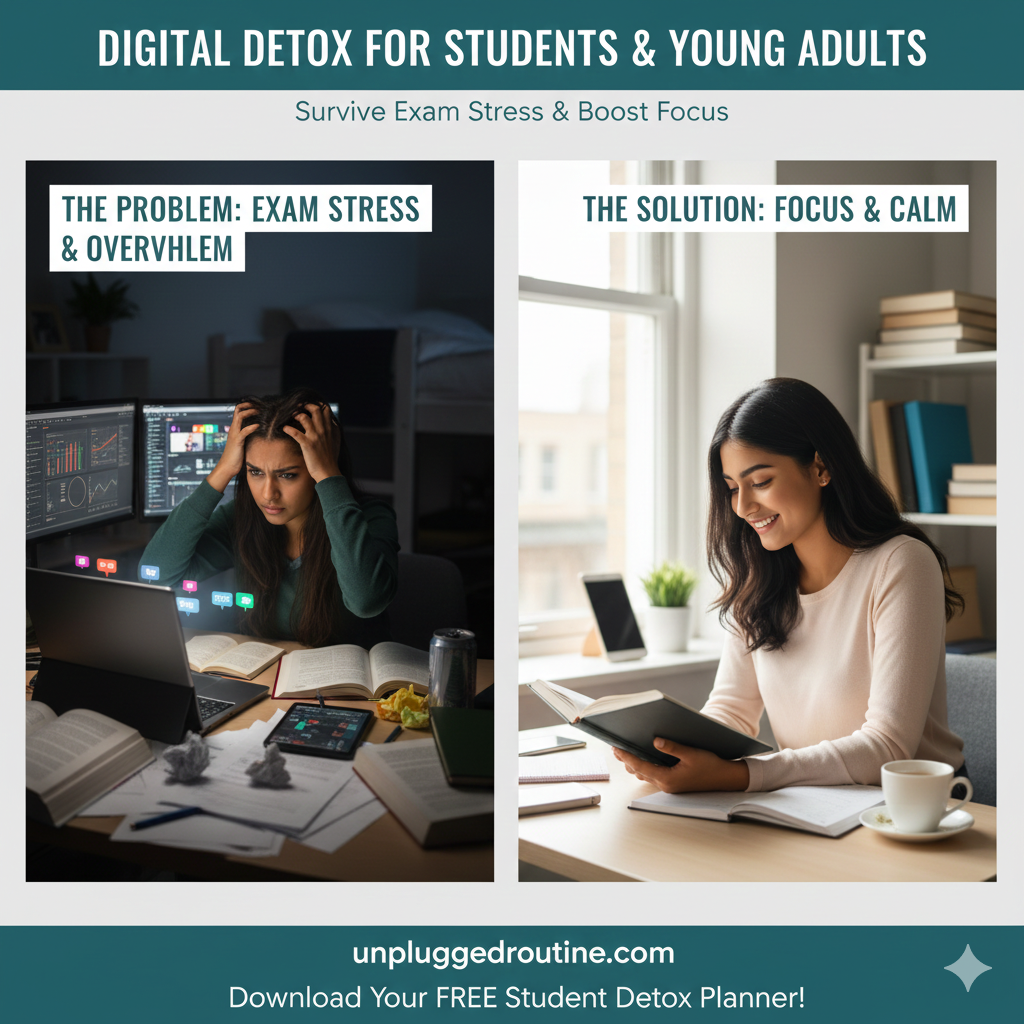
Why a Digital Detox is NOT About Quitting Tech (It’s About Winning!)
Before you freak out, let’s clarify: a digital detox for students and young adults is not about throwing your phone in a lake or deleting all your social media. It’s about intentionality and control. It’s about creating boundaries, reclaiming your time, and optimizing your relationship with technology so you are in charge, not your devices.
Think of it as training for your brain. Just like an athlete needs rest and specific training to perform at their peak, your brain needs strategic breaks from digital overload to process information, consolidate memories, and maintain peak cognitive function.
The Game-Changing Benefits of a Digital Detox for Students & Young Adults
Ready to transform your study habits, reduce stress, and genuinely enjoy your downtime more? Here’s how a strategic digital detox can help you survive exam stress and boost focus:
Benefit 1: Supercharge Your Focus and Concentration
This is perhaps the most immediate and profound benefit for students. Your brain is not designed for constant interruption. Every notification, every quick check of a social feed, fragments your attention and reduces your capacity for deep work.
When you implement a digital detox, even for short, focused periods, you eliminate these pervasive distractions. This allows your brain to settle into a state of sustained attention, improving your ability to absorb complex information, solve problems, and retain what you’ve learned. Imagine tackling a difficult problem set or writing an essay without your mind constantly drifting! That’s the power of uninterrupted focus.
Benefit 2: Significantly Reduce Exam Stress and Anxiety
Exam season is inherently stressful. But constant digital engagement can amplify that stress exponentially. The pressure to present a perfect online persona, the endless comparison to peers, and the relentless news cycle all contribute to a heightened state of anxiety.
A digital detox provides a much-needed mental break. By stepping away from the digital noise, you give your nervous system a chance to calm down. You reduce the triggers for social comparison, ease the pressure to be constantly “on,” and create space for genuine relaxation and stress-reduction techniques (like meditation, exercise, or spending time in nature). Less digital overwhelm equals less overall stress.
Benefit 3: Improve Memory Retention and Learning Efficiency
Have you ever “read” something online only to immediately forget it? This isn’t a coincidence. Our brains learn best through deep engagement and repetition, not fragmented consumption.
When you unplug, you create the conditions for better memory consolidation. You have dedicated time for active recall, concept mapping, and thoughtful review – all proven methods for stronger learning. Plus, by reducing distractions, your brain can more effectively move information from short-term to long-term memory, making those long study sessions actually pay off when it comes to exams.
Benefit 4: Enhance Sleep Quality and Energy Levels
Late-night scrolling, gaming, or binge-watching are notorious for wrecking sleep patterns. The blue light from screens suppresses melatonin production, making it harder to fall asleep, and the stimulating content keeps your mind wired.
A crucial part of any digital detox for students and young adults is setting screen-free boundaries, especially before bed. This allows your natural sleep cycle to regulate, leading to deeper, more restorative sleep. And better sleep means more energy, improved mood, and enhanced cognitive function – all vital for tackling academic challenges.
Benefit 5: Foster Stronger Real-Life Connections
While screens connect us globally, they can ironically disconnect us locally. How many times have you been with friends, only to find everyone silently looking at their phones?
A digital detox encourages you to put down the device and genuinely engage with the people around you. This leads to more meaningful conversations, deeper friendships, and a stronger sense of belonging. These real-life social connections are incredibly important for mental health, reducing feelings of loneliness, and providing a crucial support system during stressful times.
Benefit 6: Boost Creativity and Problem-Solving Skills
When your brain is constantly consuming information, it has less space to generate new ideas. The “default mode network,” the part of your brain responsible for creativity and introspection, thrives on downtime and undirected thought.
By unplugging, you give your brain the quiet space it needs to wander, connect disparate ideas, and come up with innovative solutions. Whether it’s brainstorming for a project, writing a creative essay, or finding a novel approach to a complex problem, stepping away from screens can be your biggest creative catalyst.
Benefit 7: Reclaim Time and Discover New Passions
How many hours do you spend staring at screens each day? Imagine redirecting just a fraction of that time. A digital detox isn’t just about what you stop doing; it’s about what you start doing.
You’ll discover a wealth of “found” time. Use it to explore new hobbies, pursue a passion project, get more exercise, spend time outdoors, or simply relax without digital stimulation. This renewed engagement with the offline world leads to a more balanced, fulfilling life and a stronger sense of self, beyond your online identity.
Your Starter Guide: Actionable Digital Detox Steps for Students & Young Adults
Ready to take control and experience these incredible benefits? Here are three powerful “hook steps” to kickstart your digital detox for students & young adults journey:
- The “Study Mode” Lock-Down: Designate specific study blocks (e.g., 60-90 minutes) where your phone is completely out of sight and on silent (not just vibrate). Use website blockers for distracting sites on your laptop. Treat this time as sacred, uninterrupted focus time. You’ll be amazed at how much more you accomplish.
- The Bedroom Ban (No Screens Past 10 PM): This is non-negotiable for better sleep. Set a strict rule: no phones, tablets, or laptops in bed after a certain time (e.g., 10 PM). Charge your phone outside your bedroom. Use this time to read a physical book, listen to a podcast, or journal. Your sleep (and your grades!) will thank you.
- The “Social Media Sabbath” (Mini-Version): Pick one day a week (or even half a day) where you consciously avoid all non-essential social media and casual browsing. Inform your close friends you’ll be offline. Use this time to catch up on offline activities, pursue a hobby, or simply enjoy some peace and quiet. This helps break the compulsive checking habit.

Conclusion: Empower Your Academic Journey and Beyond
Being a student or young adult today comes with unique challenges, especially in managing the overwhelming presence of digital technology. But you have the power to turn this challenge into an advantage. By embracing a digital detox for students and young adults, you’re not just surviving exam stress; you’re actively building the mental resilience, focus, and clarity needed to excel in your studies and thrive in every aspect of your life.
This isn’t about giving up fun or connection; it’s about making conscious choices that empower you. It’s about learning smarter, living fuller, and being truly present for the moments that matter. Your academic success and mental well-being are too important to leave to chance.
Are you ready to unlock your full potential and achieve a healthier balance?
Call to Action (CTA)
Take the first step towards a calmer, more focused you!
Click here to download our FREE “Student Success Digital Detox Planner!” This interactive guide includes customizable study schedules, screen-time trackers, stress-reduction techniques, and offline activity ideas specifically designed to help students and young adults master their digital habits and conquer exam season. Start your journey to boosted focus and reduced stress today!