Ever feel like your brain is running on fumes, your attention span is shrinking, and deep focus is a distant memory? In our always-on world, it’s easy to blame stress or a busy schedule. But what if a significant culprit is right in your pocket, or staring back at you from your desk? We’re talking about excessive screen time – and the impact it’s having on your most vital organ: your brain.
Welcome back to unpluggedroutine.com, your sanctuary in a digitally saturated world. Today, we’re diving into some fascinating (and frankly, a little concerning) 2025 research that sheds new light on how our digital habits are reshaping our brains. More importantly, we’ll uncover why unplugging isn’t just a trend, but a crucial strategy for brain health, cognitive performance, and overall well-being.
The Digital Brain: A Double-Edged Sword
Let’s be clear: technology isn’t inherently bad. It connects us, educates us, and streamlines countless aspects of our lives. But like any powerful tool, it demands mindful use. The problem arises when interaction becomes incessant, when screen time is no longer a choice but a default state.
The human brain, an incredible organ of adaptability, is constantly being molded by our experiences. For centuries, our brains evolved in environments rich with diverse stimuli – natural light, social interaction, physical movement, and periods of quiet contemplation. Fast forward to today, and a significant portion of our waking hours is spent interacting with glowing rectangles.
This fundamental shift in our daily experience is having profound, measurable effects on our neural pathways, cognitive functions, and even brain structure. New research emerging in 2025 is starting to paint a clearer picture of these changes, confirming what many of us have intuitively felt: our brains are getting rewired.
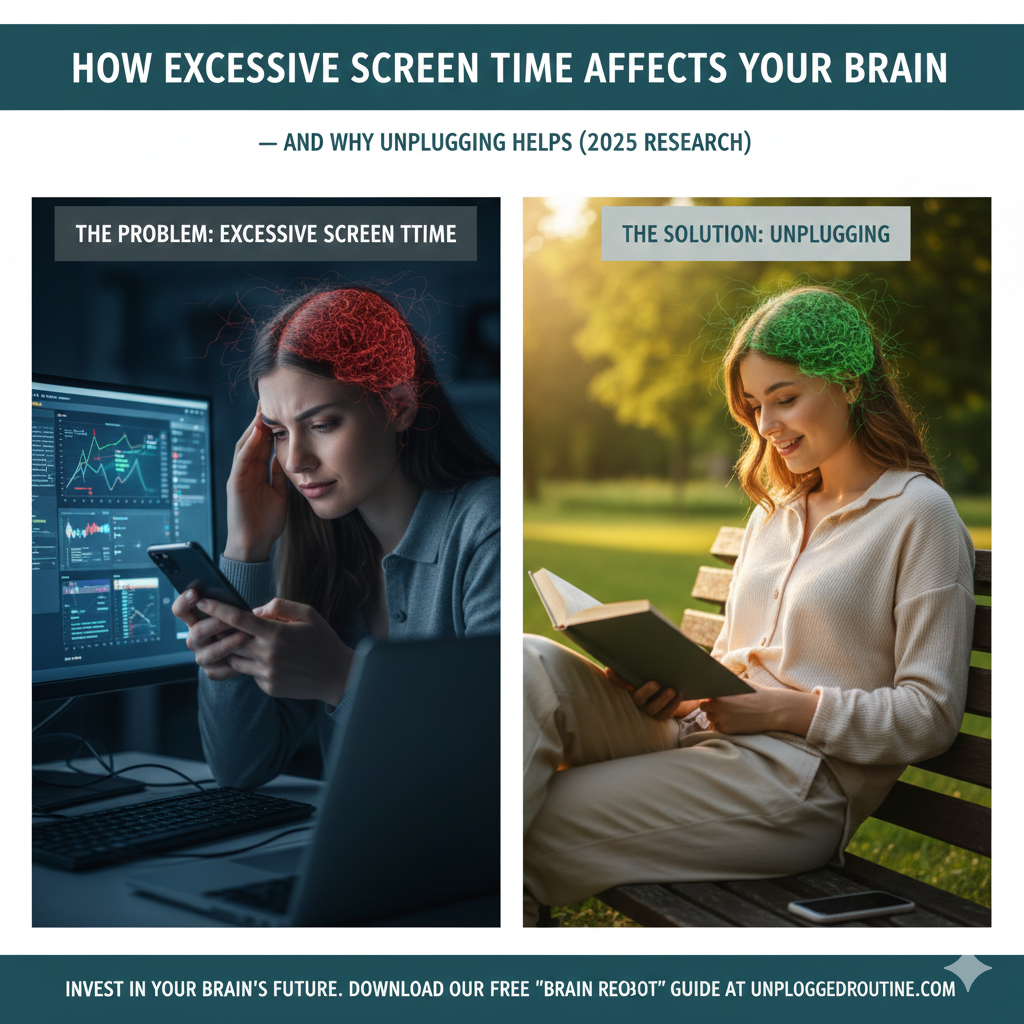
Understanding the “Rewiring”: What 2025 Research Reveals
Recent studies are utilizing advanced neuroimaging techniques (like fMRI and EEG) and sophisticated cognitive assessments to pinpoint precisely how prolonged and excessive screen time affects your brain. Here’s a breakdown of some key findings:
Impact 1: The Shrinking Attention Span – The “TikTok Brain” Phenomenon
You’ve heard the anecdotes: “I can’t even read a book anymore,” or “My mind just jumps from one thing to another.” This isn’t just you; it’s a widespread cognitive shift.
2025 Research Insights: New longitudinal studies track participants’ attention spans over several years, correlating them with daily screen use. Findings indicate a statistically significant decrease in sustained attention and an increase in task-switching behavior among heavy screen users. Neuroimaging shows reduced activity in the prefrontal cortex—the brain’s command center for focus and executive function—during tasks requiring prolonged concentration.
The constant barrage of rapidly changing content (think short-form videos, endless feeds, and multiple open tabs) trains your brain for superficial engagement rather than deep processing. Your brain becomes accustomed to novelty and instant gratification, making it increasingly difficult to engage with anything that requires sustained effort. It’s like constantly feeding your brain sugary snacks instead of nourishing meals; it gets used to quick hits and struggles with anything substantial.
Impact 2: Altered Brain Structure and Connectivity
This is where things get truly fascinating. Our brains are not static; they exhibit neuroplasticity, meaning their structure can change in response to experiences.
2025 Research Insights: Several neuroimaging studies, particularly those focusing on adolescents and young adults, have identified observable changes in brain structure. Heavy screen use, especially involving internet addiction, has been correlated with reduced gray matter volume in regions vital for impulse control, emotion regulation, and decision-making (e.g., the insula and anterior cingulate cortex).
Furthermore, some research points to altered white matter integrity—the “wiring” that connects different brain regions. This can affect the efficiency of communication within the brain, potentially impacting cognitive flexibility and processing speed. The implications are profound, suggesting that prolonged digital immersion could be physically reshaping the very architecture of our minds.
Impact 3: The Dopamine Loop and Addiction Pathways
Our devices are meticulously designed to be engaging, even addictive. They tap into our brain’s reward system.
2025 Research Insights: New studies are refining our understanding of how screen interactions, particularly social media “likes” and gaming achievements, activate the mesolimbic dopamine pathway – the same pathway involved in substance addiction. Consistent activation of this pathway can lead to a desensitization of dopamine receptors, meaning your brain needs more stimulation to get the same “hit.”
This creates a vicious cycle: the more you engage with stimulating content, the higher your tolerance becomes, and the harder it is to feel rewarded by less intense, real-world activities. This constant chase for digital dopamine can manifest as irritability, restlessness, and anxiety when disconnected – classic withdrawal symptoms. This reinforces the idea that excessive screen time can indeed lead to behavioral addictions.
Impact 4: Impaired Emotional Regulation and Social Cognition
Humans are inherently social creatures, and our brains are wired for complex social interaction. However, digital communication often lacks the richness of face-to-face exchanges.
2025 Research Insights: Studies are exploring the link between high screen time and reduced empathy, as well as difficulties in interpreting non-verbal cues. When a significant portion of social interaction occurs through screens, individuals may get less practice in reading subtle facial expressions, body language, and vocal inflections—all crucial for developing robust social intelligence.
Additionally, the curated, often idealized nature of online interactions can contribute to feelings of inadequacy and loneliness, paradoxically increasing anxiety and diminishing true emotional connection. Research is beginning to show subtle shifts in the neural networks associated with empathy and social understanding, suggesting that extensive reliance on digital communication might be hindering the development of these critical human skills.
Impact 5: The Toll on Memory and Learning
Ever feel like you instantly forget something you just read online, or struggle to recall details without a quick search? Your digital habits might be playing a role.
2025 Research Insights: While the internet provides instant access to information, new studies highlight a phenomenon dubbed “digital amnesia” or “Google effect” on memory. The brain, being efficient, may offload the need to remember information when it knows it can easily retrieve it later from a device.
This constant reliance on external memory aids can weaken our internal mnemonic abilities, particularly for factual and semantic memory. Furthermore, the fragmented nature of online content consumption, combined with constant interruptions, makes it difficult to form deep, consolidated memories. Learning is most effective when it involves sustained attention and active processing, both of which are compromised by excessive screen time.
Why Unplugging Is Your Brain’s Best Friend (The Solution)
If reading about these impacts feels a bit overwhelming, take a deep breath. The good news is our brains are incredibly resilient. Thanks to neuroplasticity, the very same mechanism that allows our brains to adapt to screen time also enables them to readapt and heal when we intentionally unplug.
Here’s how stepping away from your devices can reverse these negative effects and boost your brain health:
- Restoring Attention and Focus: When you unplug, you remove the constant interruptions. This allows your prefrontal cortex to “reboot” and strengthen its ability to sustain attention. Dedicated periods of device-free time train your brain to engage in deep work, improving concentration and task completion.
- Rebalancing Brain Chemistry: Taking a break from the constant dopamine hits allows your reward system to reset. This helps your brain become more sensitive to natural, healthy dopamine releases from real-world activities like exercise, social interaction, or achieving a goal. It helps to break the addiction cycle.
- Enhancing Neurogenesis and Cognitive Reserve: When you swap screen time for activities like reading, learning a new skill (offline!), or engaging in mindful practices (meditation, nature walks), you stimulate brain areas that promote neurogenesis (the growth of new brain cells) and build cognitive reserve, making your brain more resilient.
- Strengthening Social and Emotional Intelligence: Unplugging forces you into genuine, face-to-face interactions. This “practice” with real human connection sharpens your ability to read non-verbal cues, fosters empathy, and strengthens the neural networks associated with social cognition.
- Boosting Creativity and Problem-Solving: Remember the “default mode network” (DMN)? When you disconnect, your brain has the space to wander, make novel connections, and engage in divergent thinking. This is where your best ideas often come from, unhindered by external input.
- Improving Memory Consolidation: Giving your brain downtime, especially before sleep, allows it to process and consolidate the day’s information, leading to better long-term memory formation. Reading physical books, for instance, has been shown to improve recall compared to digital text.
Your Brain-Boosting Unplugging Plan (Hook Steps)
Ready to harness the power of unplugging and give your brain the reset it deserves? Here are three actionable steps you can start today, grounded in the latest understanding of brain health:
- The “Mindful Hour” Rule: Implement a daily “Mindful Hour” where all non-essential screens are off. This could be the first hour of your day, the hour before dinner, or the hour before bed. Use this time for reading, journaling, light exercise, or simply quiet reflection. This consistently gives your brain a break from external stimulation.
- Notification Audit & Detox: Go through your phone and aggressively turn off notifications for almost everything. Keep only essential calls/texts. Research suggests each notification creates a micro-distraction, fragmenting your attention. Liberate your brain from this constant tug.
- The “Analog Anchor” Activity: Choose one daily activity that you commit to doing completely screen-free. This could be your morning coffee, your lunch break, or a 15-minute walk. This regular “analog anchor” provides a consistent period of mental calm and presence, helping to rewire your brain for focus.
Conclusion: Invest in Your Brain’s Future, Unplug Today
The rapid evolution of technology has brought incredible advancements, but it has also presented unforeseen challenges to our cognitive well-being. The 2025 research on how excessive screen time affects your brain paints a clear picture: prolonged digital immersion is reshaping our attention, emotions, and even brain structure in ways that demand our attention.
But here’s the empowering truth: you have the power to influence your brain’s health. By intentionally and strategically unplugging, you can mitigate the negative effects, restore your focus, boost your creativity, and fortify your cognitive resilience. This isn’t about rejecting technology; it’s about mastering it, ensuring it serves your brain, not diminishes it.
Isn’t it time to give your brain the break it desperately needs and truly thrive in an increasingly digital world?
Call to Action (CTA)
Want to dive deeper into brain-healthy unplugging strategies?
Download our FREE “Brain Reboot: A 7-Day Unplugging Challenge” guide! This comprehensive kit provides daily exercises, mindful practices, and expert tips designed to help you strengthen your focus, reduce digital fatigue, and cultivate a healthier relationship with technology. Click here to get your guide and start rewiring your brain for brilliance today!