Are you constantly scrolling, comparing, and feeling a tight knot of anxiety in your stomach after an hour on your phone? You’re not alone. The curated, always-on world of social media has become a significant source of stress, comparison, and outright anxiety for millions. It’s a relentless feedback loop that leaves you feeling drained, inadequate, and utterly overwhelmed.
It’s time to find an escape route—a way to step off the digital hamster wheel and reclaim your peace of mind.
While taking a full digital detox is ideal, it’s not always practical. What you need is a sustainable, daily practice that fortifies your mental boundaries and helps you process the overload.
The solution? Journaling.
Often seen as just writing down your day, journaling is actually a powerful therapeutic tool. It acts as a mental filter, helping you sort the noise from the signal, process complex emotions, and build resilience against the pressures of the digital world. It’s the ultimate “unplugged” activity for an anxious mind.
This comprehensive guide will show you exactly how journaling helps reduce anxiety specifically triggered by social media overload. We’ll explore five profound ways this simple habit can restore your calm, shift your perspective, and help you establish a truly mindful routine.
Let’s turn the page on digital stress and start writing a calmer story.
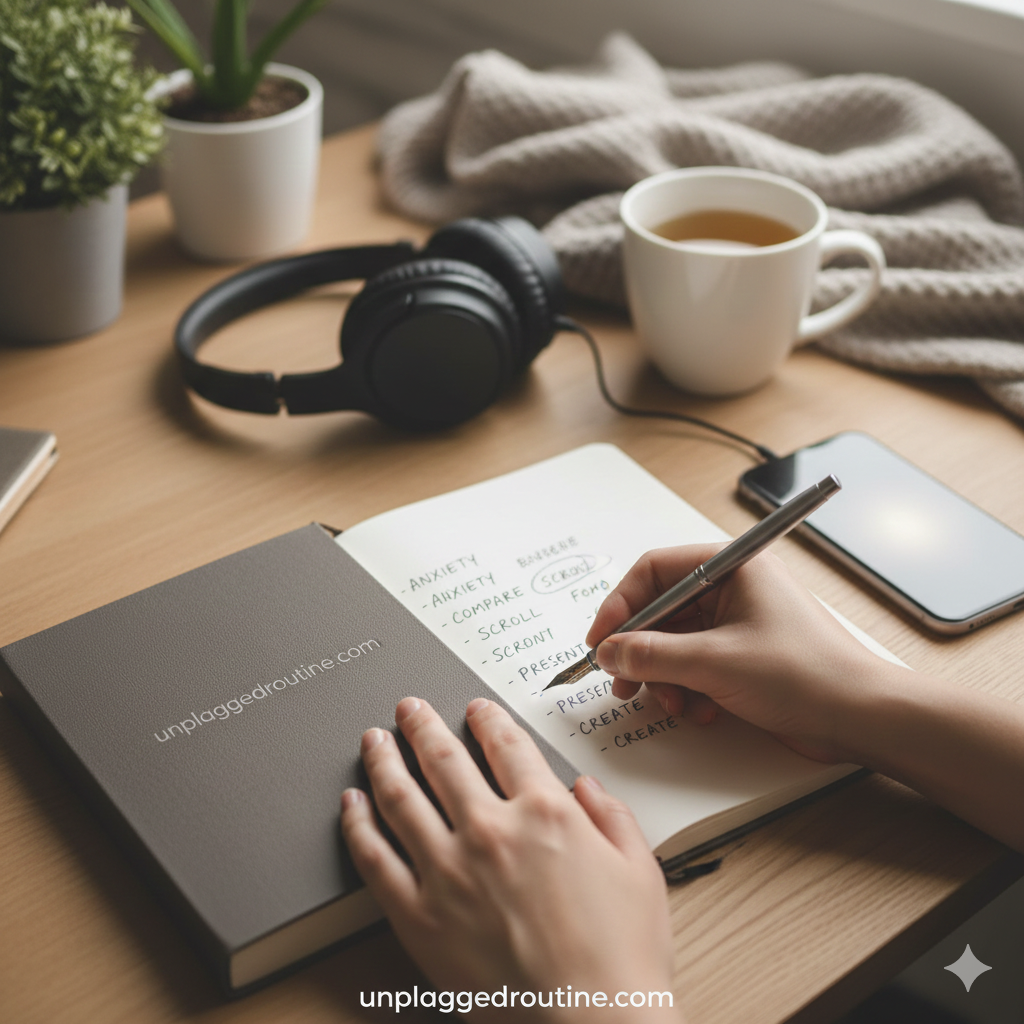
The Social Media Anxiety Epidemic
Before we dive into the solution, let’s clearly define the problem. Why does social media cause so much anxiety?
It boils down to a few key factors:
- The Comparison Trap: We are constantly exposed to highlight reels—perfect vacations, career milestones, flawless bodies, and seemingly effortless lives. This leads to unfavorable social comparison, triggering feelings of jealousy, inadequacy, and low self-worth.
- Fear of Missing Out (FOMO): Seeing others engage in fun activities or important events creates a gnawing fear that your life isn’t as full or exciting, forcing you to keep checking your phone.
- Cognitive Overload: The sheer volume of information, updates, and notifications bombarding your brain hour after hour is exhausting. This constant stimulation overloads your nervous system and contributes to chronic stress.
- The Pursuit of Validation: Likes and comments provide small hits of dopamine. When they don’t arrive, or when posts are poorly received, it can feel like a personal rejection, linking your self-esteem to digital metrics.
The cumulative effect of these pressures is often chronic, low-grade anxiety that makes it hard to focus, sleep, and enjoy the present moment. That’s where the power of the pen comes in.
1. Journaling Disrupts the Comparison Cycle
The core of social media anxiety is comparison. You look at someone else’s filtered reality and immediately measure it against your messy, unfiltered life. Journaling offers a powerful counter-practice to this toxic habit.
How It Works: The “Inside vs. Outside” Prompt
Social media is all “outside”—external validation, external perception. Journaling forces you to go “inside.”
- Prompt Idea: Write about a recent social media post that made you feel inadequate or anxious. Now, use your journal to deconstruct that feeling. Ask yourself: “What is the actual, tangible truth about my life right now that this post doesn’t measure up to?”
- The Shift: By writing about your own authentic journey, challenges, and quiet victories, you validate your reality. Your journal becomes a record of your true self, making the external highlight reel less significant. You start comparing yourself to your past self and your future potential, rather than to strangers online.
- Action Step: Dedicate five minutes to journaling about three things you accomplished today that you would never post online (e.g., finally organized a messy drawer, had a deep conversation with a family member, finished a difficult work task). This reinforces the value of your private, unplugged life.
2. Journaling Creates a Dedicated Mental Detox Space
When your brain is overloaded with digital input, it has no time to process or “file away” the information and emotions. Everything piles up, leading to mental clutter and increased anxiety. Journaling provides the necessary detox time.
How It Works: The “Brain Dump” Technique
The most effective way to clear the anxiety caused by information overload is to get it all out of your head and onto the page.
- Prompt Idea: Start writing anything and everything that comes to mind—worries about work, a frustrating comment you saw, things you need to remember, random song lyrics. Write until your hand aches, without stopping to edit or judge. Don’t worry about grammar or coherence.
- The Shift: This brain dump is a literal transfer of mental load. Seeing your anxieties, to-do lists, and fleeting thoughts laid out on paper diminishes their power over you. They are externalized and manageable, rather than swirling chaotically inside your head. It’s like clearing the temporary files on your mental hard drive.
- Action Step: Use this technique immediately after a prolonged scrolling session. Notice how much lighter your mind feels after this immediate, judgment-free release. This dedicated practice trains your brain to wait for the journal session before giving in to anxiety.
3. Journaling Identifies and Challenges Digital Triggers
Anxiety often feels like an uncontrollable wave, but when it’s caused by social media, it often has specific triggers. Journaling is the perfect tool for detective work, helping you identify what causes the anxiety and why.
How It Works: The “Anxiety Log”
Keep track of the connection between your digital habits and your emotional state.
- Prompt Idea: When you feel anxiety flare up, open your journal and answer these three questions: 1) What platform was I just on? 2) What specific content (or person) did I just see? 3) What emotion did I feel immediately after seeing it (e.g., envy, pressure, fear)?
- The Shift: By logging these triggers, you move from a state of passive reaction to active awareness. You realize that the anxiety isn’t random; it’s a predictable response to specific digital stimuli. This awareness gives you the power to create proactive boundaries, like unfollowing certain accounts or restricting your time on specific apps.
- Action Step: Review your log after a week. If you notice one platform or one type of content (e.g., financial success posts, travel photos) consistently sparks anxiety, immediately mute or unfollow those accounts for a 3-day trial period.
4. Journaling Cultivates Self-Acceptance and Kindness
Social media often forces us into a critical stance toward ourselves. We constantly scrutinize our appearance, intelligence, and achievements. Journaling is a deliberate act of self-care and self-compassion, which directly combats this self-criticism.
How It Works: The “Inner Critic” Dialogue
Write out the harsh words your inner critic uses, often amplified by social media exposure, and then respond to them with kindness.
- Prompt Idea: Write down a self-critical thought (e.g., “I’m not successful enough compared to my peers”). Then, shift perspective and write a response as a kind, supportive friend would: “That is an unfair measure. Success looks different for everyone, and I know you are working hard and making meaningful progress in these three areas…”
- The Shift: This technique, known as cognitive reframing, helps rewire your negative thought patterns. You physically see the irrationality of the self-criticism and consciously replace it with evidence-based, compassionate self-talk. This inner resilience makes the external judgments on social media less impactful.
- Action Step: Make a list of five unique strengths or positive qualities you possess that have absolutely nothing to do with digital validation (e.g., patience, loyalty, sense of humor, ability to bake a great pie). Read this list every time you open your journal.
5. Journaling Reconnects You with the Present Moment
Social media pulls your mind into a future of “what if” (FOMO) or a curated past of “what was.” Anxiety thrives when you are disconnected from the present. Journaling is a simple, effective anchor to the here and now.
How It Works: The Sensory and Mindful Check-in
This practice utilizes your senses to bring your attention back to your immediate environment, grounding you in reality.
- Prompt Idea: Describe the current moment using only your senses. What are the sounds outside the window? What is the texture of the paper beneath your hand? What is the temperature of the air? Focus on simple, tangible details of your present physical reality.
- The Shift: By engaging your senses and focusing on the physical act of writing, you interrupt the mental loop of anxiety. You shift your brain from abstract worry (social media comparison) to concrete reality (the sound of the refrigerator humming). This immediate grounding is a powerful antidote to digital distraction.
- Action Step: Before you start journaling, take three deep, slow breaths. On the first breath, think “I am here.” On the second, think “I am safe.” On the third, think “I am unplugged.” Then, begin writing.
Practical Tips for Making Journaling Stick
To maximize how journaling helps reduce anxiety caused by social media, integrate it seamlessly into your daily life:
- Set a Time Boundary: Commit to journaling before you check social media in the morning or after you put your phone away at night. This gives you a mental filter before or after digital exposure.
- Keep it Simple: Don’t aim for 2,000 words. Even three minutes of focused, honest writing is profoundly beneficial. Consistency beats duration every time.
- Find Your Tool: Some people prefer a beautiful leather journal; others prefer a simple spiral notebook. The medium doesn’t matter; the message does. Find a pen and paper you enjoy using.
- Treat it as a Date: Make your journaling time a non-negotiable appointment with yourself. This signals to your brain that your mental health is a priority.
Conclusion: Write Your Way to Peace
You don’t have to let the endless scroll dictate your emotional state. The anxiety caused by social media overload is real, but your capacity to manage it is even greater.
This simple, powerful practice of journaling offers you a private sanctuary—a space where you are the sole author, judge, and reader. It allows you to process the noise, dismantle toxic comparisons, and, most importantly, reconnect with the authentic, unplugged person beneath the digital surface.
By committing to just a few minutes of reflective writing each day, you build an unshakeable inner wall against the external pressures of the internet. You are actively choosing peace over panic, presence over scrolling.
Ready to stop feeling anxious every time you close an app? Take the next step and commit to 7 days of daily, mindful journaling. Visit unpluggedroutine.com today to download our free starter guide and begin building your anxiety-proof, mindful routine!