Are you ready to truly disconnect and find genuine peace away from the screen? The urge to pick up your phone or check a notification is a powerful habit, but there is an equally powerful counter-force: the humble pen and paper.
Journaling is the cornerstone of any effective unplugging routine. It’s the essential analog tool that helps you process the digital noise, clear mental clutter, and reconnect with your inner voice.
But here’s the problem: The blank page can feel intimidating. Staring at an empty notebook, you might think, “What do I even write about?” and the temptation to switch to a ‘quick’ digital distraction comes flooding back.
The secret isn’t just to journal, but how you journal. Choosing the right structure for your personality and goals makes all the difference between a fleeting attempt and a deeply ingrained, life-changing habit.
This guide breaks down the 3 best types of journals—Guided, Gratitude, and Bullet—to help you find the perfect match for your self-care and digital detox goals. Let’s dive in and choose the journal that will finally make your unplugging routine stick.
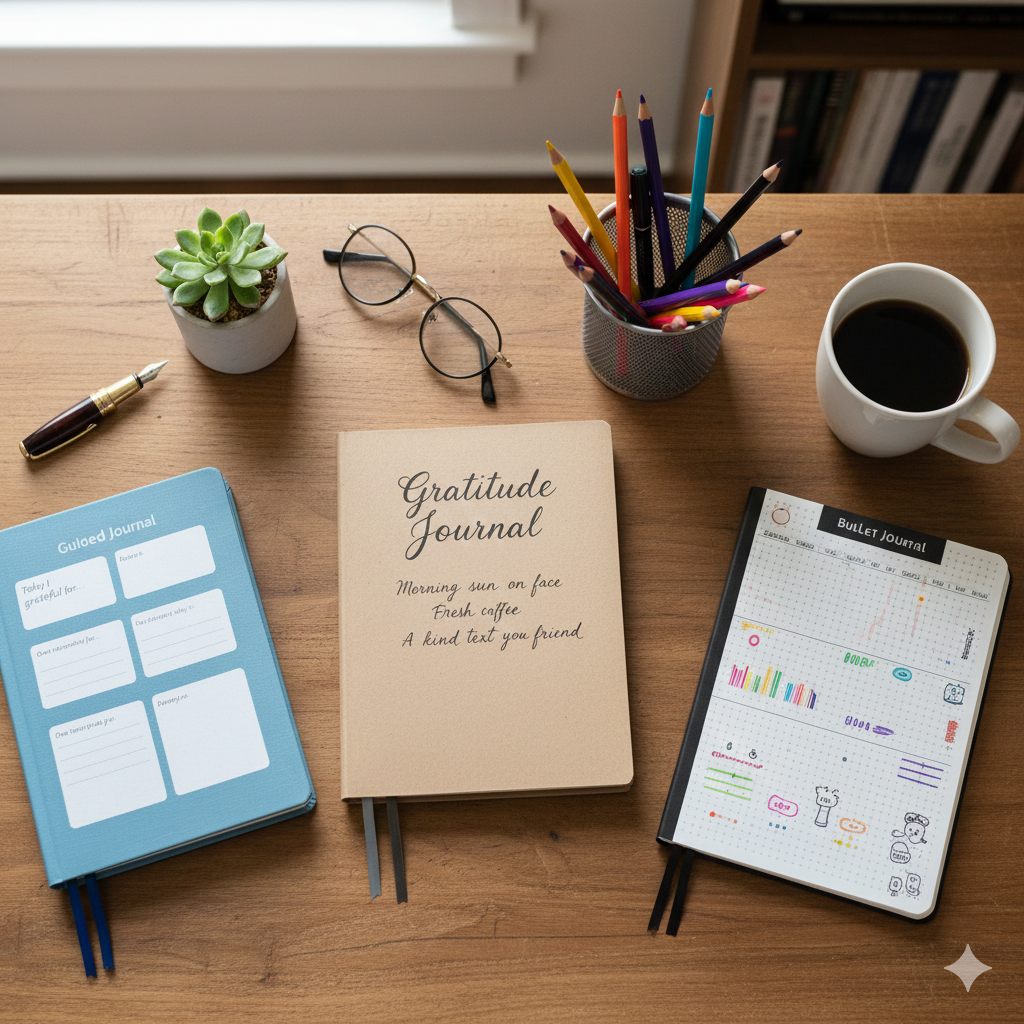
The Hook: Why Journaling is the Ultimate Digital Detox Tool
Before we explore the types, let’s acknowledge the revolutionary power of journaling in a hyper-connected world.
When you spend hours scrolling, you are constantly receiving input—other people’s opinions, news alerts, advertisements. Your mind becomes a passive sponge, constantly reacting to external stimuli.
Journaling reverses this process. It forces you to generate output. It moves you from reacting to reflecting, from consuming to creating.
By setting aside dedicated time for a physical journal, you create a necessary break in the digital feedback loop, allowing your nervous system to calm and your own thoughts to come to the surface. It’s an active practice in self-awareness that screens simply cannot offer.
The goal here is simple: find a journaling style that is so easy, so engaging, and so rewarding that you genuinely prefer it to picking up your phone.
Type 1: ✍️ The Guided Journal—Your Stress-Free Start
If the thought of a blank page gives you anxiety, the Guided Journal is your perfect starting point.
What It Is
A Guided Journal is a pre-structured book filled with questions, prompts, and specific sections for daily or weekly entries. It eliminates the decision-making process—you just open it and answer the question on the page.
Think of it as having a friendly therapist or a kind mentor on speed dial, gently directing your focus to the areas that need attention. Many popular formats, like the “Five Minute Journal,” are excellent examples of this style.
Key Benefits for an Unplugging Routine
- Zero Decision Fatigue: The biggest hurdle to starting an unplugging activity is the choice overload. A guided journal removes this. You have a clear, finite task (answer these three prompts), making consistency incredibly easy.
- Time Efficiency: Most guided journals are designed to be quick, often requiring only 5-10 minutes. This structured brevity is ideal for busy people who want maximum mental clarity with minimum time investment.
- Deep Emotional Work (Specific Focus): Many guided journals are themed, focusing on areas like anxiety, self-compassion, goal-setting, or mindfulness. This concentrated focus allows you to work through specific mental blocks without having to free-write your way through them.
Who It’s Best For
The Guided Journal is perfect for beginners, people with busy schedules, or those who feel overwhelmed by their emotions and need a gentle, structured framework to process them. If you value efficiency and clear direction, this is your journal.
How to Use It for Digital Detox
- Morning Intention: Use the morning prompts (often gratitude and a daily intention) before you check your phone. This sets your brain’s agenda for the day, prioritizing your inner peace over external demands.
- Evening Download: Complete the evening prompts (often a reflection on the day’s wins or lessons learned) right before bed, replacing the destructive habit of late-night scrolling. This “brain dump” helps quiet your mind for better sleep.
Type 2: 🙏 The Gratitude Journal—The Ultimate Mood Booster
The Gratitude Journal is a specific, potent subset of the guided journal, famous for its proven psychological benefits.
What It Is
A gratitude journal is a simple practice where you regularly record the things, big or small, that you are genuinely thankful for. It shifts your mental focus from what you lack or what went wrong to what is good and right in your life.
This is not about faking happiness; it’s about training your brain to notice and savor the positive experiences that are often overlooked in the rush of daily life.
Key Benefits for an Unplugging Routine
- The Negativity Counter-Act: Constant exposure to curated social media feeds and negative news can activate your brain’s negativity bias. Gratitude journaling actively works to counteract this, boosting optimism and improving your overall outlook.
- Simple & Low-Pressure: You don’t need a fancy notebook or lengthy paragraphs. Listing 3-5 things you are grateful for each day is enough. This low-commitment approach makes it extremely easy to maintain consistency.
- Mindfulness in Action: To find something genuine to write down, you have to pause and pay attention to your environment. Was it the perfect temperature of your morning coffee? A kind word from a stranger? This practice grounds you firmly in the present moment, away from digital future-tripping or past regrets.
Who It’s Best For
The Gratitude Journal is excellent for anyone struggling with anxiety or pessimism, those who are prone to social comparison (a side effect of heavy screen use), or those who need a quick, effective mental health boost daily.
How to Use It for Digital Detox
- The Trigger Swap: Identify a moment where you usually reach for your phone out of boredom (e.g., waiting for the kettle to boil, sitting in traffic, waiting for a meeting to start). Use a small pocket gratitude journal to jot down one thing you appreciate instead of scrolling.
- Be Specific: Instead of writing “I am grateful for my house,” write: “I am grateful for the warm, quiet spot of sunlight on my favorite armchair this afternoon.” Specificity enhances the positive emotional impact.
Type 3: 🛠️ The Bullet Journal (BuJo)—The Creative Organizer
The Bullet Journal, or BuJo, is a completely customizable organizational system that combines a planner, diary, task list, and creative outlet—all in one notebook.
What It Is
Invented by Ryder Carroll, the core BuJo method is a streamlined way to log daily tasks, events, and notes using short-form rapid logging (bullets, dashes, and circles).
However, the modern BuJo has evolved into a creative haven, where people use dot-grid notebooks to design custom layouts, habit trackers, mood logs, and elaborate artistic pages. It’s a choose-your-own-adventure journal.
Key Benefits for an Unplugging Routine
- Ultimate Customization: If other journal types feel too rigid, the BuJo is your blank canvas. You design the exact structure you need, making it an incredibly personal and engaging practice. You are the architect of your own focus.
- Creative Outlet: For those who miss the creative, visual side of digital life (like design tools or photo editing), the BuJo offers an analog replacement. Decorating pages, choosing fonts, and using color coding satisfies the urge to create without a screen.
- Organization & Clarity: The rapid logging system is fantastic for minimizing mental clutter. By migrating tasks and noting appointments, you free up mental RAM that would otherwise be dedicated to simply remembering things, giving you more brainpower for deeper reflection.
Who It’s Best For
The Bullet Journal is ideal for creative minds, people who need a high level of personal organization, and those who enjoy a DIY approach to their self-improvement. If you feel most engaged when you are actively designing something, this is the best fit.
How to Use It for Digital Detox
- The Habit Tracker Swap: Instead of using an app to track habits (which requires picking up your phone), create a beautiful analog habit tracker in your BuJo. The act of manually filling in the square is deeply satisfying and keeps you off-screen.
- The “Future Log” Focus: Use your monthly or future logs to plan screen-free activities (e.g., “Reading Night,” “Hike,” “Journaling Session”). By scheduling these analog events, you give them the same priority as your digital appointments.
Comparative Snapshot: Choosing Your Perfect Fit
Still torn between the options? Use this quick table to match your personality to your ideal unplugging routine journal.
| Journal Type | Goal / Key Benefit | Ideal Personality | Time Commitment | Best for Digital Detox |
| Guided | Easy structure, quick results, specific focus (e.g., anxiety) | Beginner, Time-poor, Needs direction | 5-10 Minutes Daily | Consistency & Habit Building |
| Gratitude | Mood boost, re-wiring the brain for positivity, savoring | Prone to anxiety/comparison, Needs mood shift | 2-5 Minutes Daily | Counteracting Social Media Negativity |
| Bullet (BuJo) | Ultimate customization, organization, creative freedom | Creative, Organized, Loves DIY | Variable (15-60 min setup, 5-15 min daily log) | Replacing Digital Planning & Apps |
| Freeform | Deep emotional processing, stream-of-consciousness | Experienced journaler, Needs to vent, Creative writer | Variable (15+ Minutes) | Venting & Emotional Release (No Structure) |
Note: Freeform journaling is the ‘traditional diary’ approach, excellent for expressive writing but often the most intimidating for beginners.
Making Your Journaling Practice Unshakable
Choosing the right journal is only half the battle. Sticking with it is what builds the lasting benefits of your unplugging routine.
Here are three simple, human-friendly steps to guarantee consistency:
1. The Two-Minute Rule
Don’t tell yourself you have to write for 30 minutes. That feels massive. Instead, use the two-minute rule: Commit to just two minutes of writing. If you get into a groove and write for 20 minutes, great! If not, you still won, because you kept your promise and reinforced the habit. Consistency over intensity.
2. Make It Irresistibly Accessible
Your journal should never be in a drawer or on a shelf you don’t frequent. Keep your chosen journal and your favorite pen in your screen-free journaling corner, on your nightstand, or right next to your coffee maker. If it’s the first analog thing you see, you increase the likelihood of picking it up before a device.
3. Anchor It to an Existing Routine
Habits are easier to build when they piggyback on something you already do.
- If you already drink coffee: After I pour my coffee, I will write my gratitude list.
- If you already brush your teeth: After I brush my teeth at night, I will write three lines in my evening reflection.
Making the journal part of a physical, daily chain of events removes the mental friction of starting.
The Final Word: Your Life, Unedited
The world bombards us with digital content designed to keep us scrolling. Your journal is the private space where that noise stops and your own voice can finally be heard.
Whether you choose the structured guidance of a pre-made journal, the powerful positivity of gratitude lists, or the creative freedom of a BuJo, the act of putting pen to paper is a revolutionary step toward reclaiming your time and attention.
It is your life, unedited, on the page. It is the core of your peaceful unplugged routine.
Conclusion: Stop Scrolling, Start Writing (Call to Action)
The greatest freedom in the modern world is the freedom of attention. Your journal is the key to unlocking that freedom.
You’ve learned about the 3 best types of journals and the strategies to make the habit stick. Now, it’s time to choose your weapon against digital distraction.
Your Call to Action:
- Decide: Based on the guide, which type of journal (Guided, Gratitude, or Bullet) is the absolute best fit for your personality and current unplugging goals?
- Acquire: Don’t delay. Order or purchase that specific journal today—physical, analog, and ready to go.
- Commit to Two: Starting tomorrow, commit to the Two-Minute Rule in your new journal.
Ready to transform your routine? Share in the comments below which type of journal you chose and the first screen-free moment you plan to replace with writing! Let’s make this year the year of the unplugged routine!