🤯 Are You Secretly Addicted to Your Screen?
Be honest. How many times today have you picked up your phone without a clear purpose?
How many times has a “quick check” turned into 20 minutes of endless scrolling, leaving you feeling more drained than refreshed?
Most of us live in a state of digital auto-pilot. Our phones are extensions of our hands, notifications are instant commands, and our screen time often spirals out of control without us even realizing it. We know it’s affecting our focus, sleep, and mood, but breaking free feels impossible.
You’ve probably tried apps to track your screen time. They show you the grim numbers, but often leave you feeling guilty, not empowered. Knowing the what isn’t enough to change the why.
✨ Your Secret Weapon: A Pen and Paper
What if the most effective tool for gaining control over your digital life wasn’t another piece of tech, but something profoundly simple, personal, and powerful?
It’s journaling.
This isn’t about shaming yourself; it’s about building conscious awareness. It’s about connecting your digital actions to your true feelings and discovering the hidden triggers that keep you trapped in the scroll cycle. Journaling transforms raw data (like screen time numbers) into personal insights, paving the way for lasting habit change.
In this ultimate guide, we’re going to dive deep into why screen time is so addictive, and then equip you with 7 powerful journaling methods to track your screen time and build healthier digital habits. You’ll learn how to move beyond guilt, understand your unique patterns, and finally reclaim your valuable time and focus.
Ready to swap auto-pilot for intention? Let’s turn the page on digital distraction.
The Screen Time Epidemic: Why We’re Losing Control
Before we dive into the journaling solutions, let’s acknowledge the powerful forces at play. We’re not just lacking willpower; we’re up against sophisticated algorithms designed to keep us hooked.
The Dopamine Loop: Instant Gratification’s Grip
Every notification, every ‘like,’ every new message triggers a tiny hit of dopamine in our brains. This creates a powerful reward loop: check phone -> get dopamine -> feel good (momentarily) -> crave more dopamine -> check phone again.
This constant craving trains our brains to seek instant gratification, making it incredibly hard to resist the pull of our devices, even when we know it’s not serving us.
The Comparison Trap Revisited: Curated Perfection vs. Your Reality
Social media thrives on comparison. We see everyone’s highlight reels—perfect vacations, successful careers, idealized relationships—and unconsciously measure our own lives against them.
This constant, unfair comparison fuels insecurity, self-doubt, and the urge to keep scrolling, hoping to find validation or simply distract ourselves from feeling “less than.” This cycle is a major driver of excess screen time.
The Cost of Constant Connection: Focus, Sleep, Mood
Excessive screen time isn’t just a nuisance; it has tangible costs:
- Fragmented Focus: Our attention spans are shrinking, making deep work and sustained concentration incredibly challenging.
- Disrupted Sleep: The blue light from screens suppresses melatonin, making it harder to fall asleep, while the mental stimulation keeps our brains wired.
- Negative Moods: Studies consistently link high screen time to increased anxiety, depression, and loneliness, despite the platforms’ promise of connection.
Understanding these underlying mechanisms is the first step in using journaling to track screen time effectively. You’re not just fighting a habit; you’re fighting a sophisticated system.
Why Journaling is Your Secret Weapon for Screen Time Control
You might think, “Why journal when there are apps to track screen time?” The answer lies in the fundamental difference between passive data and active self-awareness.
Beyond Apps: The Power of Conscious Awareness
Screen time apps provide numbers: “You spent X hours on Instagram.” But these numbers, on their own, rarely inspire change. They often just create guilt.
Journaling to track screen time goes deeper. It forces you to pause, reflect, and actively record not just the time, but the context and emotions surrounding your digital usage. This transforms passive data into meaningful insight.
Connecting Emotion to Action
When you consciously write down that you picked up your phone out of boredom, or felt frustrated after a social media session, you forge a powerful connection between your actions and your feelings.
This emotional link is far more potent than a numerical statistic. It helps you understand why you reach for your device, which is the key to developing healthier alternatives.
Building Self-Awareness, Not Just Data Collection
Journaling is a practice in self-awareness. By regularly observing your digital habits through writing, you become an active participant in understanding your behavior, rather than a passive victim of it.
This self-awareness is the foundation of genuine empowerment, giving you the agency to make intentional choices about how and when you engage with your devices.
📝 7 Powerful Journaling Methods to Track Your Screen Time & Build Healthier Habits
These methods transform your journal into a powerful tool for behavioral change, helping you map your habits and redesign your routines.
Method 1: The “Moment of Truth” Log
This is the fastest, simplest way to start building awareness of your automated habit loops.
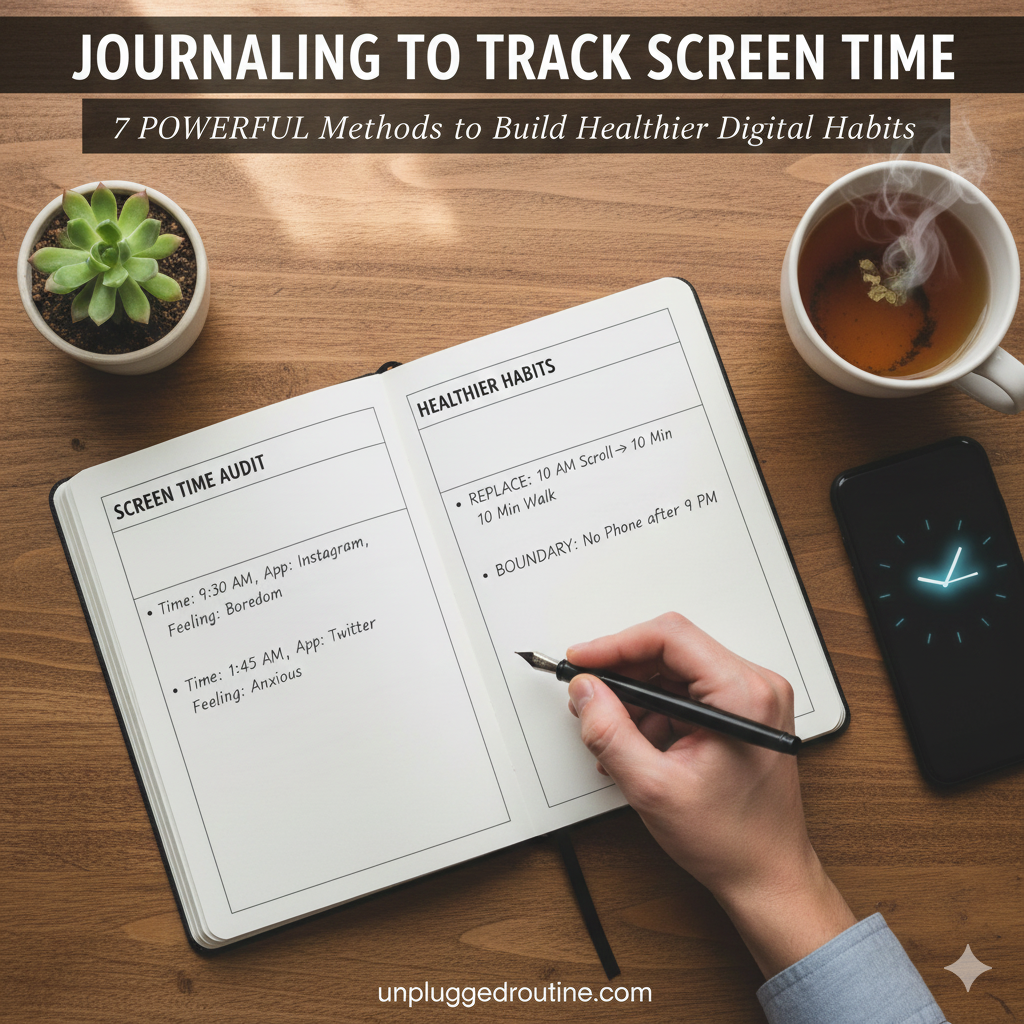
The Prompt: Whenever you catch yourself picking up your phone without a clear, specific goal, jot down three things immediately: Time, App Opened, Feeling before opening.
Example: 2:15 PM, Instagram, Feeling: Vague restlessness.
The Benefit: You interrupt the auto-pilot mode. By forcing yourself to write those three words, you introduce conscious thought into the habit loop, often preventing a long, unintentional scroll.
Method 2: The Emotional Trigger Tracker
This method helps you identify the specific emotional states that drive you to seek digital distraction.
The Prompt: At the end of the day, review your biggest screen time blocks. For each block, ask: What emotion was I avoiding? Boredom? Anxiety? Loneliness?
The Benefit: You realize that the phone is often an emotional avoidance tool. Once you know the true trigger (e.g., loneliness after lunch), you can find a healthier replacement activity (e.g., calling a friend).
Method 3: The “Energy Drain/Gain” Map
Not all screen time is equal. This method helps you separate the content that energizes you from the content that drains you.
The Prompt: List the main apps you used, and next to each, rate your energy level after using it on a scale of -3 (Drained) to +3 (Energized).
Example: Twitter: -2 (Frustrated); YouTube: +1 (Learned new recipe); Facebook: -3 (Comparison).
The Benefit: This is the practical key to curating a healthy digital diet. You eliminate the Energy Drains to reduce screen time and prioritize the Energy Gains to make your digital time intentional.
Method 4: The “Time Warp” Log
We often underestimate how much time we lose digitally. This log forces a reality check.
The Prompt: Before you open a trigger app (like TikTok or a mobile game), jot down the start time. When you close the app, note the end time and the perceived time spent. Then, calculate the actual time.
The Benefit: Seeing the Actual Time spent versus the Perceived Time spent is often a shocking wake-up call. This reality check is highly motivating for anyone journaling to track screen time and set limits.
Method 5: The “Digital Boundary Builder”
Journaling is excellent for setting and reviewing rules. This method turns your abstract desires into concrete boundaries.
The Prompt: Write down one clear, specific digital boundary you want to set this week (e.g., No phone in the bedroom). Write it down as a commitment. At the end of the week, review: Did I keep this boundary? Why or why not? What made it easy/hard?
The Benefit: You move beyond passive tracking and into active behavioral change. Reviewing the challenges helps you troubleshoot your environment and resilience.
Method 6: The “Replacement Activity” Planner
Habits thrive on replacement. If you just take the phone away without offering an alternative, the old habit will resurface.
The Prompt: For each major trigger time (e.g., 10 AM coffee break, 7 PM after dinner), list one clear, pre-planned Non-Digital Activity that you will do instead of reaching for your phone.
Example: Trigger: Post-dinner slump. Replacement: 10 minutes of stretching.
The Benefit: You create a new, positive habit loop. You’re not fighting a habit; you’re replacing it, making it much easier to build healthier habits.
Method 7: The “Unplugged Wins” Celebration Log
Change is hard, and it’s vital to celebrate your progress to maintain motivation.
The Prompt: At the end of each day, list three things you accomplished or enjoyed because you weren’t on your phone. They don’t have to be big!
Example: 1. Finished reading a chapter. 2. Had a focused conversation with my partner. 3. Noticed the sunset.
The Benefit: This shifts the focus from “what I missed online” (FOMO) to “what I gained in real life” (JOMO). This positive reinforcement solidifies your new behaviors.
📈 Beyond Tracking: Translating Insights into Actionable Habits
Tracking alone is data; the true power comes when you use that data to design a smarter digital life. Here’s how to move from journaling insights to concrete action.
1. Identifying Your Personal Triggers
Look back at your Emotional Trigger Trackers (Method 2). Do you notice a pattern?
- Boredom Trigger: Needs a Replacement Activity (Method 6).
- Anxiety Trigger: Needs Breathwork or Journaling (Processing).
- Transition Trigger (e.g., walking between rooms): Needs a Physical Barrier (leaving the phone behind).
Identifying your specific trigger type allows you to choose the right strategy, which is key to effectively using journaling to track screen time.
2. Setting Realistic Goals
Don’t aim to cut screen time by 50% immediately. Your goal should be based on your insights:
- Process Goal: I will not bring my phone into the kitchen this week.
- Time Goal: I will cut my Instagram time by 10 minutes per day.
- Emotional Goal: I will pick up my phone once less today when I feel restless.
Goals based on behavior and emotion are much more sustainable than goals based purely on arbitrary numbers.
3. Implementing the “If-Then” Rule
This is a powerful habit formation technique. Use your journal to write down specific “If-Then” statements based on your triggers.
- IF I finish dinner and feel the urge to scroll, THEN I will immediately put on my walking shoes.
- IF I am waiting in line at the grocery store, THEN I will practice 5 rounds of Box Breathing.
This bypasses decision fatigue and puts your behavior on auto-pilot for healthier choices.
4. Creating Physical Barriers
Journaling helps you identify where you are weakest. Use that knowledge to create physical obstacles to reduce screen time temptation:
- The Drawer Rule: Keep your phone in a drawer when you’re working or socializing.
- The Bedroom Box: Place a physical box outside your bedroom door for all devices at night.
- The Distance Rule: Place your charger across the room, forcing you to move to check the phone.
🛑 Troubleshooting Your Journaling Journey
You are human, and there will be relapses. Don’t let a slip-up become a slide-down.
Dealing with Relapses
If you have a two-hour scrolling session, don’t trash your journal and give up. Instead, use your journal as a tool for recovery:
- Prompt: I messed up today. Why did this happen? Was I tired? Hungry? Avoiding a task?
- Fix: Forgive yourself immediately. Recommit to the Moment of Truth Log (Method 1) for your next session. Relapse is part of the learning process.
Overcoming Resistance/Boredom
If journaling feels like a chore, keep it simple. Remember the 5-Minute Rule. Don’t write pages; just jot down the necessary data points (Time, App, Feeling). The simple act of tracking is what builds awareness.
Celebrating Small Victories
Use the Unplugged Wins Log (Method 7) aggressively. Did you read three pages of a book instead of checking email? Did you leave your phone charging in the kitchen for an hour? Log it! Every small win strengthens the new, desired behavior and makes it easier to build healthier habits.
Conclusion: From Data to Digital Freedom
The journey to a healthier digital life doesn’t start with a complex app or a harsh punishment. It starts with conscious awareness.
By integrating journaling to track screen time into your routine, you move from being a victim of algorithmic compulsion to an intentional designer of your focus and attention. You gain clarity on your triggers, you set sustainable boundaries, and you celebrate the real-life victories that matter most.
You deserve to look up from your phone and feel present, focused, and free. Your journal is the tool that makes that freedom possible.
🚀 Your Call to Action (CTA)
Ready to stop guessing about your screen time and start understanding it?
Start today with Method 1 (The “Moment of Truth” Log). For the next 24 hours, simply jot down the Time, App, and Feeling every time you pick up your phone unintentionally.
Visit unpluggedroutine.com to download our Free Digital Habit Journaling Template—the exact framework to use the 7 powerful methods discussed here.
Reclaim your time and focus today!