It’s that time of year again. The glitter from the New Year’s Eve party has settled, and the “New Year, New Me” energy is at an all-time high. But if you’re like 80% of people, you’ve probably set massive resolutions in the past only to see them fizzle out by Valentine’s Day.
Why does this happen? In 2026, research shows that the biggest barrier to change isn’t a lack of willpower—it’s digital friction. We try to build a better life while being tethered to devices that are literally designed to hijack our focus.
This year, the trend is shifting. We aren’t just setting goals; we are setting Digital Resets. At UnpluggedRoutine.com, we believe that New Year Resolutions & Goal-Setting should prioritize your mental “headspace” over your daily “hustle.”
Ready to make 2026 the year you finally break the cycle? Let’s dive into the seven secrets of a sustainable, human-centered reset.
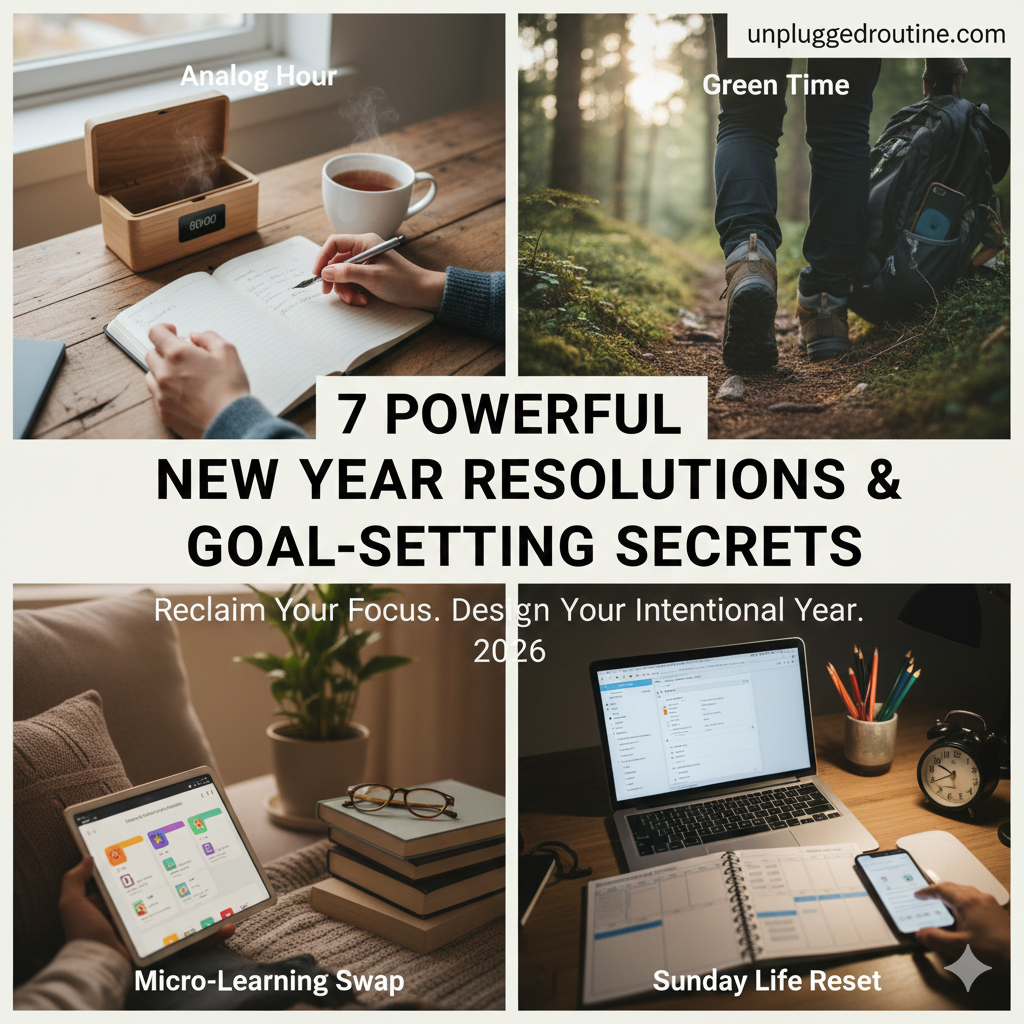
Hook Step #1: The “Digital Ghost” Visualization
Before you grab your planner, try this. Imagine it is December 31, 2026. You are looking back at the last 12 months.
Did you spend those 8,760 hours living your life, or watching others live theirs? Most Americans now spend over 7 hours a day on screens. That’s nearly half of our waking lives.
Ask yourself: If I reclaimed just 15% of that time, what could I build? A new hobby? A deeper connection with my kids? A side business? Hold that vision in your mind. That is your “Why.”
1. Ditch “Grand Results” for “Tiny Rhythms”
The #1 reason New Year resolutions fail is that they are too broad. “I will be more productive” is a wish, not a plan. In 2026, the most successful people are using Micro-Rest practices.
Instead of vowing to “quit social media,” resolve to implement a “10-Minute Buffer.” This means for the first 10 minutes after you finish a work task, you don’t check your phone. You just sit. You breathe.
Why it works: Small wins build dopamine. When you successfully sit for 10 minutes, your brain registers a “win.” This makes the next habit—like a 30-minute walk—feel achievable rather than impossible.
2. The Rise of “Anti-Resolutions”
A major lifestyle trend for 2026 is the Anti-Resolution. Instead of adding more “To-Dos” to your already overflowing life, we are focusing on “To-Don’ts.”
Your 2026 “To-Don’t” List might include:
- Don’t take your phone into the bathroom.
- Don’t check work emails after 7:00 PM.
- Don’t keep more than 5 tabs open on your browser at once.
By removing these small digital drains, you naturally create the “Quiet Life” that 68% of US adults say they are currently craving.
3. Implement the “Keystone Habit” Strategy
A “Keystone Habit” is a single change that creates a ripple effect, making every other goal easier to achieve. In the world of digital wellness, the ultimate keystone habit is “The Analog Hour.”
Commit to one hour a day—any hour—where you are 100% analog. No smartwatches, no tablets, no Kindles. Just you and the physical world.
The Ripple Effect:
- You sleep better because you aren’t staring at blue light.
- You eat more mindfully because you aren’t distracted.
- Your focus improves, making your work goals easier to hit.
4. Swap “Doomscrolling” for “Micro-Learning”
In 2026, we’re seeing a massive shift: people are tired of “junk content.” The trend is now Micro-Learning. We all have that “itch” to check our phones—the secret is to scratch it with something that grows your mind.
If you find yourself reaching for your phone out of boredom, have a “learning fallback” ready. This could be a language app, a masterclass, or even a digital sketchbook.
Pro-Tip: Move your “junk” apps (social media, news) to the very last page of your phone and put your learning apps on the home screen. Make the good habits easy and the bad habits hard.
5. Build a “Sunday Life Reset” Ritual
Goal-setting isn’t a “one-and-done” event on January 1st. It requires a weekly maintenance system. The Sunday Life Reset is a 30-minute routine that US professionals are using to stay sane.
Your Sunday Checklist:
- App Audit: Delete one app that made you feel anxious this week.
- Notification Scrub: Turn off “badges” (those little red numbers) for everything except calls.
- Calendar Shielding: Block out “Unplugged Blocks” for the upcoming week. If it’s not on the calendar, it won’t happen.
6. Prioritize “Green Time” Over “Screen Time”
New research for 2026 confirms that “Nature Immersion” is the fastest way to reset a frazzled nervous system. We call this Biophilic Goal-Setting.
Instead of just saying “I want to exercise,” try “I want to spend 20 minutes in a green space 3 times a week.” The combination of movement and nature acts as a “digital detox” for your brain, lowering cortisol levels far faster than a treadmill in a fluorescent-lit gym.
7. The Power of “Analog Accountability”
Everything is harder alone. In a world of digital “likes,” we are actually lonelier than ever. This year, find an Analog Accountability Partner.
This is someone you meet in person to discuss your goals. No texting your progress; instead, have a monthly “Check-in Coffee.”
The Goal: To have a space where you are seen and heard without a screen between you. This human connection provides the emotional fuel needed to stick to your resolutions when the February “slump” hits.
Frequently Asked Questions
1. Why do most New Year resolutions fail by mid-January? Most resolutions fail because they are too vague or built on “reactive” impulses. People often set massive goals without changing their daily environment. In 2026, the secret to success is focusing on habit stacking—attaching a new, small goal to something you already do every day.+2
2. How can I set “unplugged” goals without hurting my career? Digital wellness isn’t about disappearing; it’s about intentionality. You can set professional goals like “Batch-checking emails” or “Muting non-urgent Slack notifications” during deep-work hours. This actually makes you more valuable at work because your focus is sharper and your output is higher quality.
3. What is a “Digital Sabbath” and how often should I do it? A Digital Sabbath is a dedicated block of time—usually 24 hours—where you step away from all screens. While some do this weekly, starting with one Sunday a month is a great 2026 resolution. It resets your dopamine receptors and helps you reconnect with offline hobbies like reading, hiking, or cooking.
4. Can I use technology to help me stay unplugged? It sounds ironic, but yes! Tools like “Focus Modes” on your phone, distraction blockers, and even minimalist phone apps can help you stay on track with your goals. The key is to use technology as a “shield” to protect your time, rather than a “vacuum” that sucks it away.
5. What is “Biophilic Goal-Setting”? This is a 2026 trend where you align your resolutions with nature. Instead of just “exercising,” a biophilic goal would be “Walking in a park for 20 minutes.” Research shows that being around greenery reduces “mental fatigue” much faster than indoor activities, making it easier to stick to your other resolutions.
Conclusion: Your Best Year is Waiting Offline
Mastering New Year Resolutions & Goal-Setting in 2026 isn’t about being a luddite or hating technology. It’s about being the boss of your own attention. When you control your digital environment, you reclaim the energy you need to build the life you actually want.
This year, don’t just “set a goal.” Design a routine that protects your soul. You have 365 days of potential ahead of you—don’t give them all away to an algorithm.
Ready to start your reset? Join our community at UnpluggedRoutine.com and download our “2026 Intentional Living Planner.” It’s time to turn off the noise and turn up your life. Let’s make this your most present year yet!