Let’s be real for a second. How many times have you sat down to write a single paragraph, only to find yourself forty minutes deep into a “What Your Favorite Drink Says About You” quiz?
It’s not just a lack of willpower. It’s the way your brain is reacting to the glowing rectangle in your pocket.
In 2026, being a student means living on screens. You attend lectures on Zoom, submit essays on Canvas, and “relax” on TikTok. But have you noticed that the more time you spend online, the harder it is to read a single page of a physical textbook without your brain itching for a notification?
The truth is, screen time affects student focus in ways that are scientifically measurable—and frankly, a little bit scary. If your grades are slipping or you feel like your brain is “buffering,” it’s time to look at the data.
In this deep dive, we’re going to look at exactly how those pixels are rewiring your attention span and, more importantly, give you a step-by-step battle plan to take your focus back.
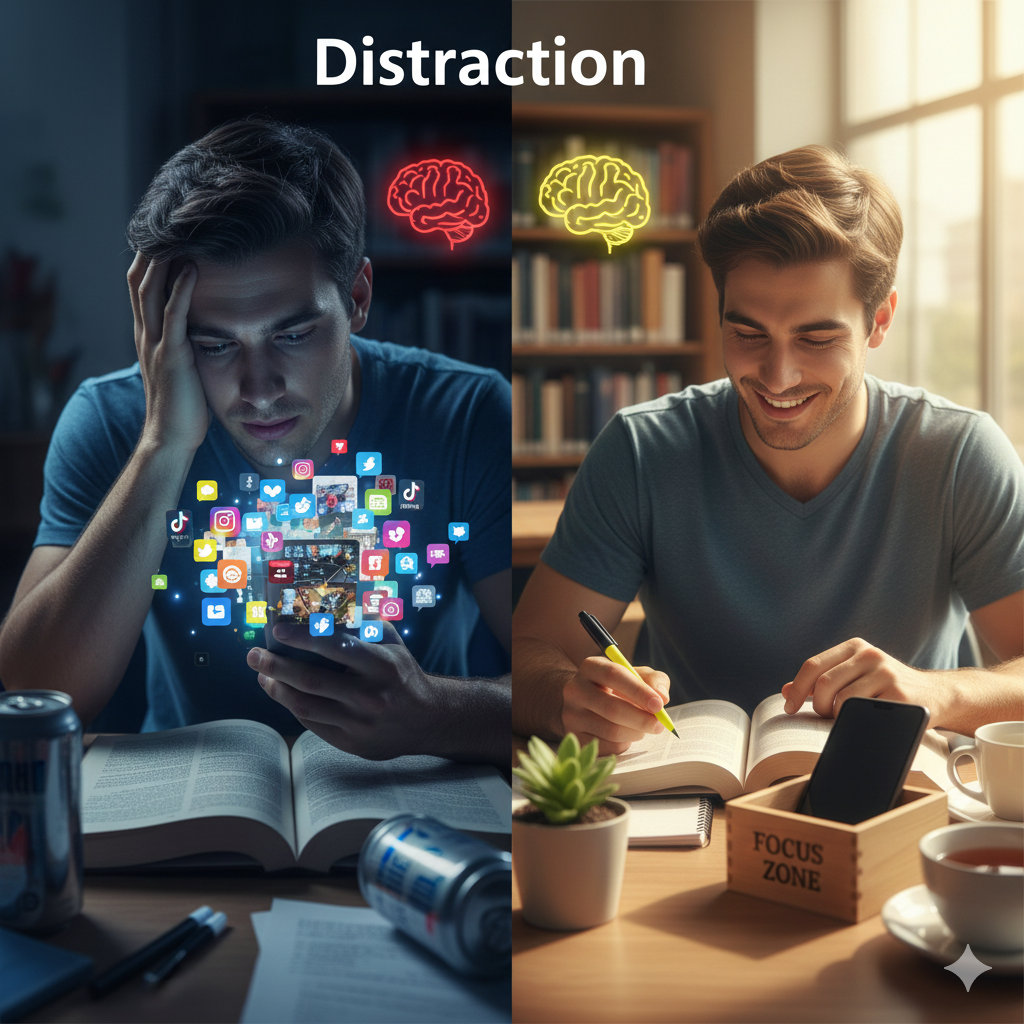
The Invisible Focus Killer: What’s Really Happening?
When we talk about how screen time affects student focus, we aren’t just talking about “being distracted.” We are talking about a fundamental shift in how your brain processes information.
Our brains are highly “plastic.” This means they adapt to the environment we give them. If you spend five hours a day consuming 15-second videos, your brain becomes an expert at processing 15-second bursts of information.
The problem? Most university-level concepts require 15 minutes (or hours) of sustained, deep thought.
The Dopamine Loop
Every time you get a like, a comment, or a “match,” your brain releases dopamine. This is the “feel-good” chemical.
Because screens provide this dopamine so cheaply and quickly, your brain starts to find “low-dopamine” tasks—like studying chemistry or reading history—unbearably boring. You aren’t “bad” at the subject; your brain is just addicted to the fast-paced digital reward system.
1. The “Switching Cost” is Ruining Your Productivity
Have you ever heard of “Task Switching”? Many students call it multitasking, but science says multitasking is a myth.
Your brain doesn’t do two things at once; it switches between them rapidly. Every time you glance at a text while studying, you pay a “switching cost.”
The Hook Step: Try this tomorrow. Time yourself while writing a page of an essay with your phone on your desk. The next day, do the same with your phone in a different room.
Studies show that even having a phone visible reduces your cognitive capacity. It’s like a “brain drain” just by existing in your peripheral vision.
2. Why Digital Reading Isn’t “Real” Reading
Wait, what? Isn’t reading an e-book the same as a physical book? Not exactly.
Research published in the journal Scientific Reports suggests that when we read on screens, we tend to “scan” rather than “deep read.” We look for keywords and headings instead of absorbing the nuance of the argument.
For students, this is a disaster for comprehension. If you find yourself reading the same paragraph four times on your laptop and still not “getting it,” the screen itself might be the problem.
The Unplugged Fix: For your most difficult subjects, print out the core readings. The tactile feel of paper and the lack of clickable links force your brain into a deeper state of focus.
3. The Sleep-Focus Connection (The Blue Light Trap)
You’ve heard it before: blue light ruins sleep. But for students, the stakes are higher.
Sleep is when your brain moves information from “short-term memory” to “long-term memory.” This process is called memory consolidation.
If you are on your phone until 12:00 AM, the blue light suppresses melatonin. You might fall asleep, but you won’t reach the deep REM cycles needed to remember what you studied that afternoon.
If you don’t sleep well, your focus the next day is shot. It’s a vicious cycle that leads directly to lower grades.
4. Social Comparison and Mental “Noise”
Focus isn’t just about concentration; it’s about emotional calm. It’s hard to focus on your Macroeconomics notes when you just saw a classmate on Instagram living their “best life” at a beach club.
This “mental noise” creates a background layer of anxiety. You start wondering if you’re doing enough, if you’re falling behind, or why your life doesn’t look like a filtered photo.
This emotional distraction eats up the mental energy you should be using for your coursework.
5. The “Goldfish Effect”: Shrinking Attention Spans
In the early 2000s, the average human attention span was about 12 seconds. Today? It’s estimated to be around 8 seconds. For context, a goldfish has an attention span of 9 seconds.
While that specific study is often debated, the sentiment resonates with every student. The “infinite scroll” has trained us to expect a new stimulus every few seconds.
Academic success requires the opposite. It requires “boredom tolerance.” You have to be okay with the quiet, slow process of learning.
6. How to Fight Back: The “Focus Protocol”
So, the data is grim. But you aren’t a victim of your devices! You can reclaim your brain. At unpluggedroutine.com, we recommend a three-tier approach:
Tier 1: The Physical Barrier
If you can see your phone, you are losing focus.
- The Drawer Rule: When studying, your phone must be in a drawer, in a bag, or in another room.
- Grayscale Mode: Turn your phone to black and white. It makes the “digital candy” look like “digital broccoli,” making it much less addictive.
Tier 2: The Digital Barrier
Use technology to save you from technology.
- App Blockers: Use apps like Freedom or Cold Turkey to lock yourself out of social media during school hours.
- Browser Hygiene: Close every tab that isn’t related to the specific task you are doing right now.
Tier 3: The Recovery Period
You need “Digital Downtime.”
- The 90-Minute Rule: No screens 90 minutes before bed.
- The First Hour: Don’t check your phone for the first 60 minutes of your day. Own your morning before the world’s notifications own you.
7. The Long-Term Payoff: Beyond the GPA
While we focus on grades, the real benefit of reducing screen time is mental sovereignty.
When you can control your focus, you can control your life. You become the person who can sit down and learn a new language, write a book, or start a business while everyone else is busy scrolling.
Students who master the unplugging routine don’t just get better grades; they have less anxiety, better relationships, and more “real-world” energy.
Conclusion: Take Back Your Brain Today
The evidence is clear: screen time affects student focus by fragmenting our attention, stealing our sleep, and overstimulating our dopamine receptors. But your GPA isn’t destined to suffer. By setting clear boundaries and intentional routines, you can be the exception to the rule.
You don’t have to be perfect. You just have to be intentional.
Are you ready to stop the scroll and start the success?
Join our community at unpluggedroutine.com and download our free “Focus Over Phone” Study Tracker to see how much your grades improve when you finally put the screen away!