The Modern Exhaustion Epidemic
Do you feel it? That low, constant hum of digital exhaustion? You finish a long workday, but instead of resting, you switch from a work screen to a personal screen. Your brain never truly powers down.
This isn’t just “being busy”—it’s burnout, fueled by the endless demands of the digital world. The pressure to be “always on” has left us perpetually depleted, anxious, and disconnected from the simple joys of life.
Your calendar is full. Your inbox is overflowing. Your battery, however, is critically low.
I’m here to tell you that the most powerful antidote to modern burnout isn’t a vacation to a distant island; it’s two days right where you are. It’s a complete, deliberate, and immersive Tech-Free Weekend.
This isn’t about deprivation; it’s about reclamation. It’s about taking back your time, your focus, and your sanity. By creating a temporary oasis from the digital noise, you can achieve a profound mental and emotional reset.
This guide will walk you through 7 transformative steps to plan, execute, and maximize a single tech-free weekend, guaranteed to move you From Burnout to Balance and fundamentally change your relationship with technology.
Let’s hit the power button on the world and boot up your best self.
Phase 1: The Pre-Detox Preparation (The Essential Setup)
A successful Tech-Free Weekend is 90% preparation. You can’t just turn off your phone at 5 PM on Friday; you need a strategy to prevent anxiety and digital FOMO (Fear of Missing Out).
1. The Friday Shutdown Ritual: Announce Your Absence
Your first step is managing expectations—yours and everyone else’s.
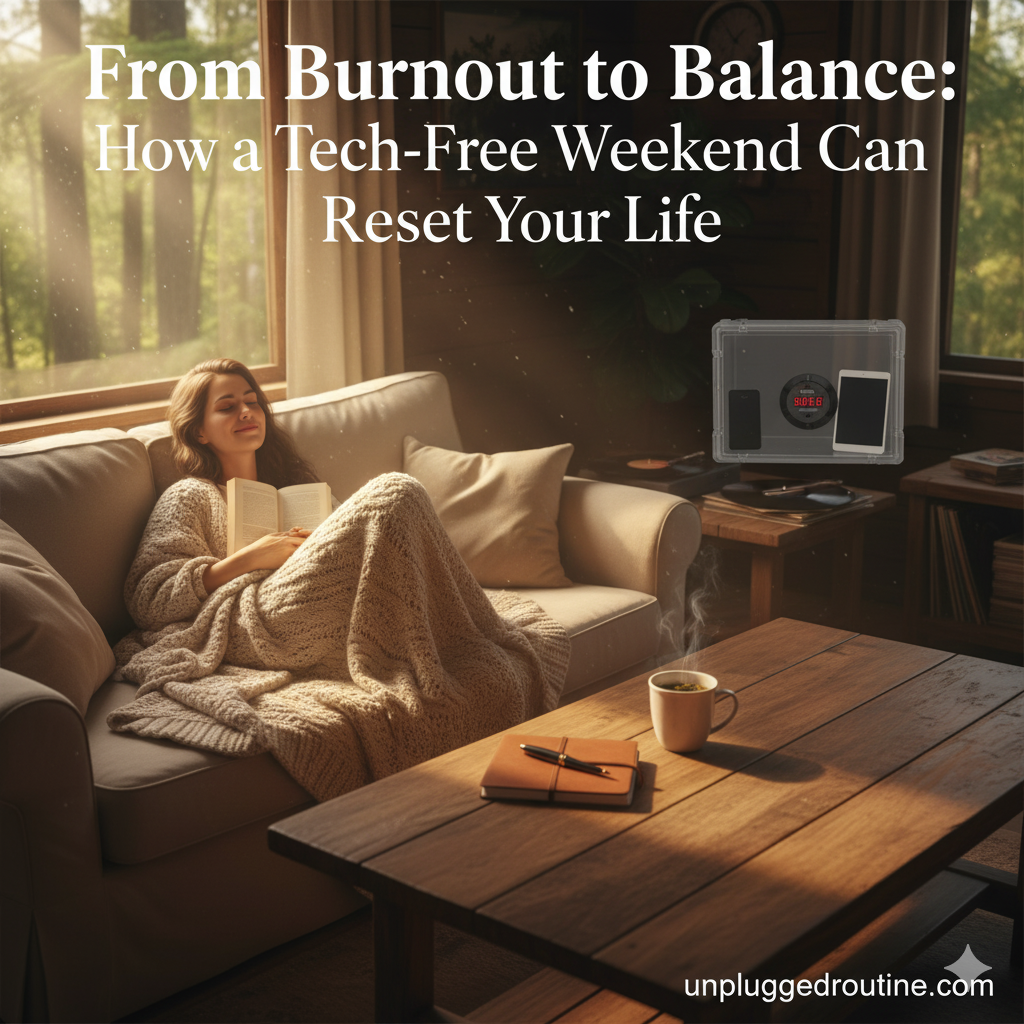
You need a clear, physical ritual to signal the start of the detox. At 5 PM Friday, take your work laptop, tablet, and smartphone. Place them in a designated, secure location. A kitchen cabinet, a bedroom closet, or, ideally, a Timed Lock Box (perfect for preventing impulse grabs).
Crucially, you must communicate your absence:
- Set an Out-of-Office: This is mandatory. Make it clear you will not be checking email until Monday morning.
- Inform Key People: Send a brief text to your partner, a close friend, or family member, saying: “Going fully offline until Monday morning. See you on the flip side!” This prevents emergency calls and ensures a safety net.
- Prepare Your Analog Backup: Charge your devices and make a note of any crucial addresses, phone numbers, or passwords on paper before locking them away.
Why this works: This ritual acts as a psychological seal. Once the phone is locked away, the anxiety of “what if I’m missing something” is replaced by the relief of “I physically can’t check it.”
2. The Analog Arsenal: Replace, Don’t Restrict
The urge to scroll comes from a need for mental stimulation. You must replace that easy digital fix with compelling analog alternatives. Don’t leave a void—fill it!
Stock your home with things that engage your hands and mind:
- A “High-Value” Novel: Not just any book, but one you are genuinely excited to read.
- A Physical Journal and Pen: This is your replacement for social media status updates and late-night ‘digital dumping.’
- A Tactile Hobby: Puzzles, knitting, model building, coloring books—anything that requires your hands to work.
- A Dedicated Music Player: Pull out an old iPod, a CD player, or a record player. The rule: no device that also provides notifications.
Why this works: You are setting yourself up for success. When boredom strikes, your only options are fulfilling, real-world activities, not draining, digital ones.
Phase 2: The Reset Weekend (The Transformative Shift)
With the devices secured, your two-day reset can begin. The goal here is to actively engage in activities that heal your central nervous system, which has been overloaded by blue light and constant noise.
3. Reclaim Your Morning: The 90-Minute Dopamine Fast
The first two hours of your day are the most important. On Saturday, resist the urge to jump out of bed. Instead of a phone, the first thing your hand touches should be your book or journal.
The Ritual:
- Wake Up Analog: Use a physical alarm clock (no phone in the bedroom!).
- No Media for 90 Minutes: Do not turn on the TV, radio, or computer.
- Go Outside: Spend 15 minutes drinking coffee or tea outside. Feel the sunlight, listen to the ambient noise. This simple act recalibrates your circadian rhythm, preparing you for better sleep.
- Journal Your Thoughts: Brain dump all your worries and to-dos onto paper. Get them out of your head and onto a physical page.
Why this works: This initial “dopamine fast” breaks the Pavlovian response of grabbing your phone. You start your day with intention and control, rather than reacting to a flood of notifications.
4. Practice Deep Listening: Reconnect with Your People (and Yourself)
One of the greatest casualties of constant connectivity is the quality of our attention.
Use the silence of your Tech-Free Weekend to practice Deep Listening.
- With Your Partner/Family: Declare a “no interrupting” rule during meals. Look into their eyes, put your full mental focus on their words, and ask follow-up questions. You will be amazed at the conversations that emerge when the digital distraction is removed.
- With Yourself (The Body Scan): Sit or lie down for 20 minutes. Don’t try to clear your mind—just observe. Where is your body holding tension? Are you clenching your jaw? Does your stomach feel tight? Acknowledge these physical signs of burnout. This awareness is the first step toward balance.
Why this works: When the phone isn’t vibrating, your brain’s attention circuit can finally relax. Deep listening heals relationships and allows you to process the stress signals your body has been sending you.
5. Embrace Analog Creation: The Satisfaction of Finished Work
Burnout often stems from a feeling of being stuck in perpetual, unfinished work (endless emails, ongoing projects). Analog creation provides the satisfying opposite: a clear, finite finish line.
Dedicate your Saturday afternoon to an activity that results in a tangible product:
- Cook a Complex Meal: One that requires time, chopping, and patience (like homemade pasta or bread).
- Build Something: Assemble flat-pack furniture, hang shelves, or work on a carpentry project.
- Deep Clean a Space: Completely clear out a cluttered drawer, cabinet, or closet.
Why this works: The human brain is wired to feel satisfaction from completing tasks. Holding a physical object you created or seeing a clean, organized space provides a dopamine hit that lasts far longer than a social media notification.
6. The Nature Immersion Cure: Grounding Your Nervous System
Nature is the ultimate digital detox tool. The sights, sounds, and smells of the outdoors are proven to lower cortisol (the stress hormone) and restore attention capacity.
The Task: Spend at least two hours of your weekend actively immersed in nature.
- Take a Slow Walk: Leave your headphones at home. Listen to the birds, the wind, the sound of your own footsteps.
- Sit and Observe: Find a park bench or a spot in your yard. Simply watch the clouds, the trees, or the traffic. Don’t read; just exist.
- Work in the Dirt: Tend to a garden, repot a houseplant, or just feel the soil between your fingers.
Why this works: This is a direct act of “grounding.” It shifts your brain’s focus from the tiny, fast-paced world of the screen to the vast, slow-paced reality of the natural world, instantly reducing anxiety.
Phase 3: The Re-Entry Strategy (Sustaining the Balance)
The goal of the Tech-Free Weekend isn’t just to survive two days—it’s to leverage the clarity you gain into a better routine for your whole life.
7. Design Your Digital Boundaries: The Rules of Re-Entry
Before you unlock your devices on Monday morning, sit down with your journal and establish the non-negotiable rules for your week ahead. You are setting the terms of engagement, not the other way around.
New Non-Negotiables (Sample Rules):
- The Bedroom Ban: Phones charge outside the bedroom, every night. An analog clock handles the alarm.
- The Power Hour: No email, social media, or news until 9 AM. Use this time for focused work, exercise, or journaling.
- Notification Control: Turn off all non-essential notifications (social media, most news apps). Allow only calls, texts, and maybe one or two essential apps.
- Scheduled Checks: Only check email at three specific times during the day (e.g., 9 AM, 1 PM, 4 PM).
Why this works: You are translating the emotional relief you felt during your detox into concrete, maintainable habits. This is the difference between a temporary break and a lasting lifestyle reset.
Conclusion: Your Life Starts When the Screens Shut Off
The power of a Tech-Free Weekend lies in its ability to give you perspective. When the noise stops, you finally hear your own thoughts, identify the true sources of your burnout, and recognize the activities that genuinely bring you peace.
You will find that the world did not stop spinning without your constant presence. Your life, however, just started spinning in a much healthier direction.
Don’t wait until you hit rock bottom to press the reset button. Take control of your well-being, shift From Burnout to Balance, and discover the incredible freedom that comes from being present.
Ready to reclaim your life?
→ Download our free “Tech-Free Weekend Checklist” at unpluggedroutine.com and start planning your transformative 48 hours of peace this Friday!