👋 Hey, Digital Native! Are You Really Working?
Stop right there for a second. Before you scroll past this paragraph, I want you to look around. How many screens are within arm’s reach? Two? Three? More?
If you’re anything like the typical high-achieving American, you’re probably juggling a laptop, a smartphone, a tablet, and maybe a smartwatch—all buzzing, blinking, and vying for your precious, limited attention. We’ve been trained to believe that being busy equals being productive. We wear our “always-on” status like a badge of honor. But let me tell you a secret: that constant connection is actually sabotaging your best work.
The Honest Hook: The Productivity Paradox
You open your laptop to crush your to-do list. An email notification pops up. You check it. Then you see a quick headline. You click it. Three minutes later, you’re scrolling through a social media feed, wondering what you were supposed to be doing in the first place. Sound familiar?
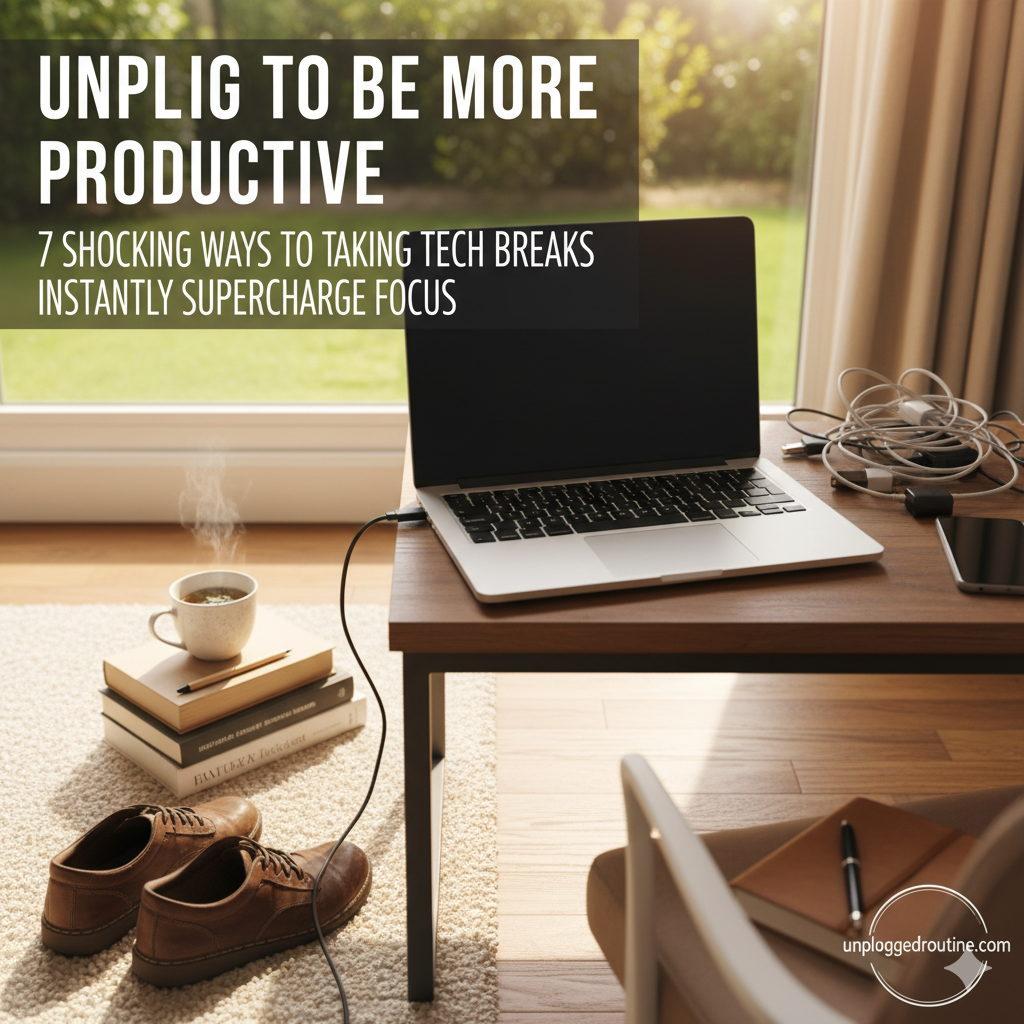
The truth is, technology is a magnificent tool, but it’s a terrible master. If you want to move from busy to truly productive, the answer isn’t a new app or a faster computer. The answer is counter-intuitive, radical, and incredibly simple: you need to unplug to be more productive.
This isn’t just about guilt-free scrolling; this is a scientifically proven strategy to supercharge your focus, unleash your creativity, and get more done in less time. Over the next, we’re going to dive into the 7 shocking ways intentional tech breaks will instantly transform your work and your life. Ready to reclaim your attention span? Let’s dive in.
Part I: The Invisible Drain—How Constant Connection Destroys Focus
The Myth of Multitasking
Let’s be brutally honest: multitasking is a myth. When you think you’re efficiently writing an email while listening to a podcast and checking a text, your brain isn’t doing three things at once. It’s rapidly switching between tasks.
Every switch comes with a “switching cost”—a fraction of a second where your brain has to re-orient itself. Dozens of switches per hour add up to a massive loss in efficiency and an even bigger drain on your cognitive energy.
The Cognitive Overload Crisis
Your brain is a supercomputer, but even supercomputers crash when overloaded. Constant pings, notifications, and streams of information fill your working memory to capacity.
When your memory is full, there’s no room left for deep work—the kind of focused, high-value work that moves the needle in your career or business. Taking a real break from your tech allows your brain’s “cache” to clear out, giving you fresh, clean mental space for complex problem-solving.
The Dopamine Hit Cycle
Notifications are designed to be addictive. Every time your phone lights up, your brain releases a tiny squirt of dopamine—the pleasure and reward chemical. This creates a cycle where you subconsciously crave the next “hit.”
This endless loop trains your brain for distraction, making it physically harder to sit quietly and focus on a single, long-term task. Unplug to be more productive by breaking this habit and allowing your brain to seek reward in meaningful, challenging work instead of fleeting digital pings.
Part II: The 7 Shocking Ways Taking Tech Breaks Instantly Supercharges Your Focus
1. 🚀 Boost Your Concentration with the “Brain Reset” Effect
Your prefrontal cortex, the part of your brain responsible for focus and decision-making, actually gets fatigued, just like a muscle. When you push through the fog, you’re trying to lift a heavy weight with exhausted arms.
The Science of Deactivation
Research from the University of Illinois has shown that simply deactivating and reactivating a goal—in this case, your work—by taking a brief, non-tech break helps you maintain concentration over time.
Instead of fighting the fatigue with another cup of coffee, step away. Look out the window, stretch, or walk to the kitchen. This brief period of downtime acts like a system reboot, allowing you to return to your work with a refreshed and sharper mind. It’s the ultimate productivity hack that feels like laziness!
2. 💡 Unlock Breakthrough Ideas Through “Default Mode”
Have you ever noticed that your best ideas—the “aha!” moments—don’t happen when you’re staring intensely at your screen? They happen in the shower, on a walk, or right before you fall asleep.
The Power of Productive Daydreaming
This is the Default Mode Network (DMN) in action. When you engage in low-level, non-focused activities (like walking or washing dishes), your DMN lights up. This is the brain’s powerhouse for self-reflection, memory consolidation, and, most importantly, creative problem-solving.
When you’re constantly engaged with technology, you never give your DMN a chance to turn on. An intentional tech break is an invitation for your subconscious to connect the dots on that tricky project, making your moments of insight more frequent and profound. This is how you truly unplug to be more productive in a creative sense.
3. ⚖️ Master Your Time with the “Sunk Cost” Killer
One of the biggest time-wasters is the feeling that you must finish a task just because you’ve started it—the “sunk cost fallacy.” This is amplified by technology that makes it easy to keep checking, tweaking, and scrolling.
Introducing the Break-Point Rule
Taking a scheduled tech break forces you to pause and objectively evaluate your work. When you come back, you’re less emotionally invested in the last few minutes of effort and more likely to see:
- A better, more efficient path forward.
- The point of diminishing returns.
- A critical mistake you missed.
This intentional pause gives you back control, making you the master of your task, not its slave. It allows you to strategically pivot and apply your focus where it truly matters.
4. 🧘 Drastically Reduce Stress and Anxiety
Our “always-on” culture is inherently stressful. The expectation of immediate response, the fear of missing out (FOMO), and the constant input create a low-grade, persistent state of anxiety.
Hormones and the “Fight or Flight” Response
Every time a notification goes off, your body releases a shot of cortisol, the stress hormone, preparing you for a “fight or flight” scenario. While a quick email check isn’t life-threatening, your body treats it like it is. Over time, high cortisol levels lead to chronic stress, burnout, and reduced immunity.
A tech break isn’t just a mental break; it’s a physiological break that allows your nervous system to calm down. Stepping away for 10-15 minutes and engaging in a non-tech activity (like deep breathing or listening to nature sounds) lowers your cortisol and allows you to return to work from a place of calm focus, not panic-driven reaction.
5. 😴 Improve Sleep Quality for True Recovery
We’ve all heard it, but it bears repeating because it’s that important: your tech habits at night are ruining your sleep, and poor sleep is the ultimate productivity killer.
The Melatonin Suppression Factor
The blue light emitted by screens suppresses the production of melatonin, the hormone that tells your body it’s time to sleep. Using your phone or tablet right before bed tricks your brain into thinking it’s still daytime, pushing your sleep cycle back.
A tech-free wind-down routine—at least 60 minutes before bed—is non-negotiable for anyone who wants to be truly productive the next day. Better sleep means:
- Superior Memory Consolidation: Your brain solidifies what you learned during the day.
- Enhanced Cognitive Function: You wake up with better problem-solving skills and mental clarity.
- Regulated Mood: A good night’s rest makes you more resilient to stress and distraction.
6. 🤸♀️ Boost Physical Energy and Reduce Aches
Productivity isn’t just mental; it’s physical. Sitting hunched over a screen for hours on end is terrible for your body, leading to back pain, neck strain, and headaches, all of which are massive focus detractors.
The Simple Break as a Health Strategy
A tech break encourages movement. Every time you step away from your desk, you naturally stretch, walk, or change your posture. Even a five-minute walk around the office or house can:
- Increase Blood Flow: More oxygen reaches your brain, literally waking you up.
- Reduce Eye Strain: Following the 20-20-20 Rule (every 20 minutes, look at something 20 feet away for at least 20 seconds) is a simple, effective break.
- Trigger Endorphins: Movement releases feel-good chemicals that boost your mood and motivation.
You’re not just taking a break from work; you’re taking a break for your body, which in turn fuels your mind to perform at a higher level.
7. 🤝 Deepen Real-World Connections and Resilience
Humans are fundamentally social creatures, and genuine connection is a crucial part of mental well-being and long-term productivity. When you are engrossed in your tech, you are often missing out on the enriching, simple interactions happening right around you.
The Value of Face-to-Face
Research consistently shows that even having a phone present—even if turned face-down—can make people feel less connected and listened to in a conversation.
Tech breaks force you to engage in real life: a chat with a colleague, a meaningful dinner with family, or simply paying attention to your pet. These genuine human interactions build emotional resilience, give you perspective on work-related stress, and recharge your emotional battery far better than any social media scroll ever could.
Part III: Your Action Plan—How to Master the Art of the Productive Unplug
It’s one thing to agree with the concept; it’s another to actually implement it. Your digital habits are deeply ingrained, so you need a strategic, step-by-step plan to truly unplug to be more productive.
The “Unplugged Routine” Framework: Daily Habits
🎯 Step 1: Schedule Your Breaks (Don’t Wait for Burnout)
Think of your breaks as essential appointments, not optional time-outs. Don’t wait until your brain is fried. Schedule them like you would a meeting.
- The Pomodoro Method: Work for 25 minutes, then take a 5-minute break. After four cycles, take a longer, 20-30 minute break. Crucially, your breaks must be non-tech.
- The 50/10 Rule: 50 minutes of deep focus, followed by a 10-minute non-tech break. Find the interval that works for your personal energy cycle.
📱 Step 2: Create a Dedicated Tech-Free Zone
Designate a space or a time where no devices are allowed. This is about setting clear, physical boundaries for your brain.
- The Dinner Table: A classic, powerful rule. No phones at the table to foster genuine connection.
- The Bedroom: Use an old-fashioned alarm clock and leave your phone to charge outside the bedroom. This is your sacred space for rest.
🚫 Step 3: Deactivate the Distraction Drivers
The biggest obstacle to deep focus is the endless stream of notifications. You need to be in control of your tech, not the other way around.
- Turn Off Non-Essential Notifications: Do you really need a buzz for every social media like, game alert, or news headline? Go into your settings and turn off everything except critical calls or texts.
- Use “Do Not Disturb” (DND) Mode: Use DND for your scheduled focus blocks. Let colleagues/family know that if the world isn’t ending, you’ll respond after your block is finished.
The “Unplugged Routine” Framework: What to Do on Your Breaks
A tech break doesn’t mean sitting staring at the wall. It means engaging in activities that genuinely rest and reset your brain. Here are a few expert-approved, focus-boosting activities for your 5- to 30-minute breaks:
| Break Duration | Recommended Activity | Productivity Benefit |
| 5 Minutes | Staring out a window (20-20-20 Rule), light stretching, deep breathing exercise, glass of water. | Instantly resets eye strain and mental focus, calms cortisol levels. |
| 10-15 Minutes | Walking around the block, tidying your workspace, listening to a short non-lyrical music track, light physical activity (e.g., bodyweight squats). | Boosts blood flow, clears mental “cache” for DMN activation, reduces physical stiffness. |
| 20-30 Minutes | Reading a physical book, preparing a healthy meal, meditating, drawing/doodling, calling a friend/loved one. | Fosters creativity, provides emotional connection, deepens cognitive rest for high-quality return. |
A Note on Social Media during Breaks
A word of caution: if your break consists of jumping from your work screen to your social media screen, you have defeated the purpose. You are simply exchanging one form of low-quality cognitive load for another. A true tech break must be a screen-free break.

The Ultimate Unplug: The Weekend Digital Detox
For the most profound effects on your long-term focus and overall well-being, you need to incorporate a longer unplug period.
- The Saturday Morning Rule: Keep your phone in airplane mode until noon on Saturday. Use this time for family, hobbies, exercise, or pure silence.
- The Sunday Prep: Use Sunday afternoon to plan your week on paper. This creates a mental map for the week ahead, reducing the reactive need to check devices on Monday morning.
The feeling of stepping back into your digital life after a genuine detox is often one of clarity, control, and calm—a true state of supercharged focus.
Final Thoughts: The Choice is Yours
We’ve covered the overwhelming evidence: the constant digital stream is an invisible drain on your most valuable resource—your focused attention. From the myth of multitasking and the dopamine addiction cycle to the scientific necessity of the Default Mode Network, the path to superior productivity is clear: unplug to be more productive.
By implementing the simple, actionable steps in the “Unplugged Routine” framework—scheduling your breaks, creating tech-free zones, and truly resting your mind and body—you stop being a passive recipient of digital distraction and become the intentional architect of your focus.
This isn’t about Luddite living; it’s about mindful, powerful living. It’s about using technology as a lever to amplify your work, not as a leash that pulls you around.
The Call to Action: Start Your New Routine Today
Are you ready to stop feeling busy and start being truly productive? The switch is literally in your hand.
Your challenge this week: Pick just one of the 7 ways to supercharge your focus—maybe it’s implementing a non-tech 10-minute break every two hours, or perhaps it’s charging your phone outside your bedroom tonight.
Tell us about your choice! Share your plan in the comments below, or better yet, share this article with a friend or colleague who needs to hear this and challenge them to take the pledge with you.
👉 To help you get started right now, click here to download our FREE 7-Day Digital Detox Planner! It includes printable sheets for scheduling your focused work blocks and fun, screen-free break ideas. Let’s start your Unplugged Routine!