Feeling constantly tethered to your devices? Are endless notifications hijacking your attention, leaving you feeling drained and unfocused? You’re not alone. In our hyper-connected world, the line between helpful technology and overwhelming distraction has blurred. We all know we should unplug more, but actually doing it? That’s the real challenge.
At UnpluggedRoutine.com, we believe that taking control of your digital life doesn’t have to be a daunting task. It’s about building sustainable habits, and the best way to do that is with a clear roadmap. This comprehensive guide will equip you with unplugging challenges, checklists & tools designed to make disconnecting manageable, fun, and incredibly rewarding. Get ready to shift from “always-on” to “always present,” boosting your productivity, creativity, and overall well-being.
Let’s transform your digital overwhelm into digital mastery, starting today!
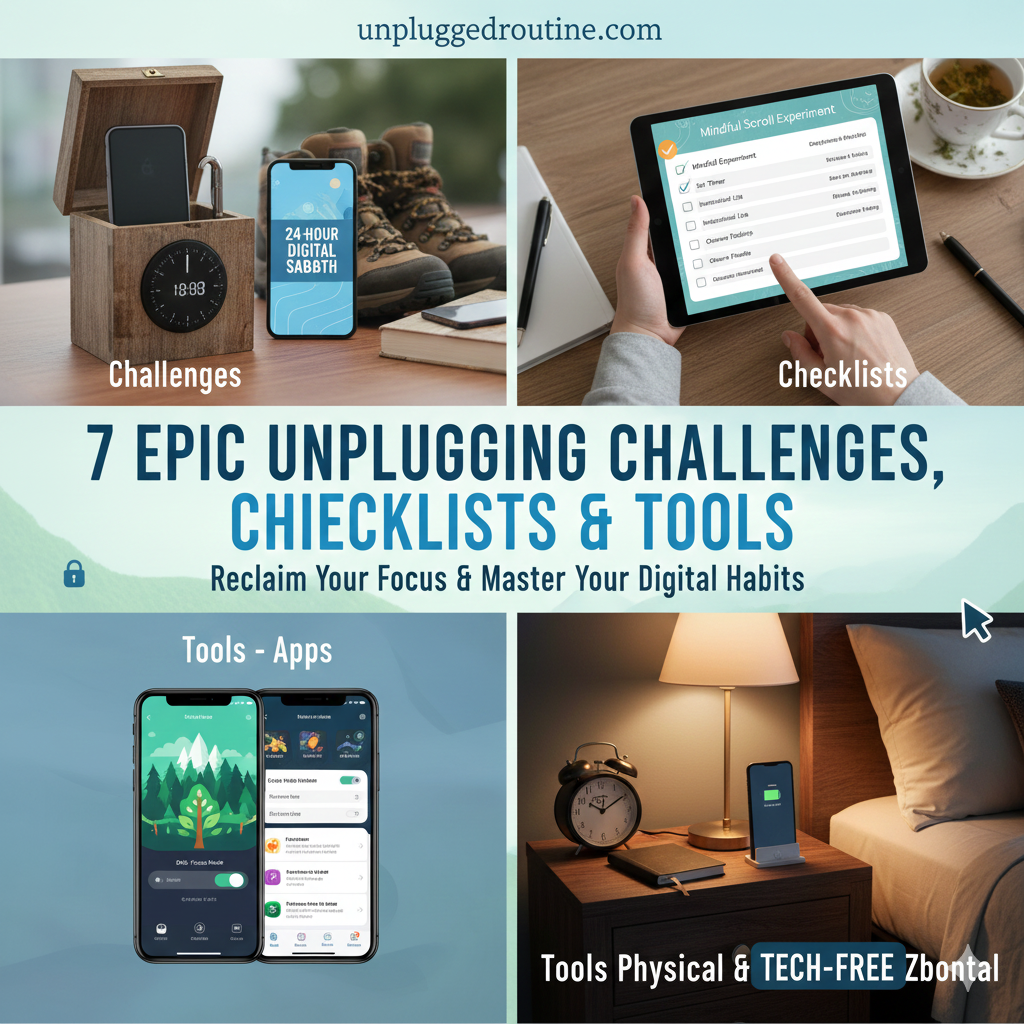
Hook Step #1: The “Digital Drain” Self-Assessment
Before we dive into solutions, let’s pinpoint where your biggest digital drains are. Grab a pen and paper or open a simple note app (ironic, right?). For the next 2 minutes, quickly jot down answers to these questions:
- What is the first app you open in the morning?
- What is the last app you close at night?
- Which app causes you the most anxiety or comparison?
- When you feel bored or stressed, what’s your go-to digital distraction?
This quick exercise isn’t about judgment; it’s about awareness. Identifying your personal digital “hot spots” is the first step towards targeted unplugging.
Why “Challenges, Checklists & Tools” Are Your Secret Weapon
We’re all wired for quick wins and clear instructions. That’s why vague advice like “just use your phone less” rarely works. What does work?
- Challenges: They provide a clear goal, a sense of accountability, and often a fun, gamified approach to habit change.
- Checklists: They break down big goals into manageable steps, reducing overwhelm and giving you a sense of accomplishment as you tick things off.
- Tools: These can be apps, physical gadgets, or environmental changes that make it easier to stick to your unplugging goals.
Together, these three elements create a powerful system for anyone looking to genuinely reset their relationship with technology.
Challenge #1: The “24-Hour Digital Sabbath”
This is the gold standard of unplugging and a powerful reset button for your brain.
- The Challenge: Pick a 24-hour period (e.g., Saturday morning to Sunday morning) and commit to absolutely no non-essential digital devices. That means no smartphone, no social media, no streaming, no recreational internet use, and ideally, no TV.
- Checklist for Success:
- Inform your circle: Let friends and family know you’ll be off-grid (for emergencies, you might leave a landline number or use a “dumb phone”).
- Plan analog activities: Have books, puzzles, craft supplies, outdoor gear, or board games ready.
- Charge your camera (if you still have one!): Take photos without the instant gratification of sharing.
- Prep meals: Avoid using recipes on your phone.
- Print directions: If you’re going somewhere new.
- Tools: An actual alarm clock (not your phone), a physical journal, a good old-fashioned map.
- Why it works: It breaks the addiction cycle. A full 24 hours gives your mind a chance to truly decompress and remember what it’s like to live fully in the present.
Challenge #2: The “Phone-Free First Hour”
How you start your day sets the tone. Most people grab their phone within minutes of waking.
- The Challenge: For 7 days, commit to not touching your phone (or any screen) for the first 60 minutes after waking up.
- Checklist for Success:
- Move your phone: Put it in another room or far enough away that you can’t reach it from bed.
- Replace the habit: Plan what you will do instead (e.g., hydrate, stretch, meditate, journal, make breakfast, read a physical book).
- Use an alarm clock: A dedicated alarm clock is crucial here.
- Tools: A traditional alarm clock, a water bottle by your bed, a journal and pen.
- Why it works: It allows you to be proactive, not reactive. You create your own agenda before the digital world throws its agenda at you.
Challenge #3: The “Notification Lockdown” Blitz
Notifications are attention vampires. They constantly pull you out of focus.
- The Challenge: Over the next 3 days, audit and drastically reduce your notifications. The goal is to only receive alerts for truly urgent or essential communications.
- Checklist for Success:
- Go into your phone’s settings: Review every single app’s notification permissions.
- Ask for each app: “Does this need to alert me immediately, or can I check it on my own terms?” If not immediate, turn off banners, sounds, and badges.
- Prioritize: Keep calls/texts from important contacts, calendar reminders. Everything else? Silent or off.
- Enable “Do Not Disturb” or “Focus Mode” for specific work/study times.
- Tools: Your phone’s settings menu, Focus Mode (iOS) or Digital Wellbeing (Android).
- Why it works: You regain control over your attention. Fewer pings mean fewer interruptions and more sustained focus.
Challenge #4: The “Mindful Scroll” Experiment
It’s unrealistic for many to completely avoid social media. This challenge teaches intentionality.
- The Challenge: For one week, before opening any social media app (or even YouTube, Reddit, etc.), pause and ask yourself two questions: “What is my intention here?” and “How long will I spend?”
- Checklist for Success:
- Set a timer: If your intention is “check Aunt Carol’s photos for 5 minutes,” set a 5-minute timer.
- Stick to your intention: If you opened it to check one thing, do that and then close it. Avoid the endless scroll.
- Observe your feelings: Does mindful scrolling feel different? Do you get more out of it?
- Tools: Your phone’s built-in timer, app timers (like Forest, Freedom, or your phone’s screen time limits).
- Why it works: It breaks the mindless habit loop. You move from passive consumption to active, intentional engagement, making your screen time more meaningful.
Challenge #5: The “Analog Adventure” A Week
Inject some real-world magic back into your life!
- The Challenge: For 7 days, plan and execute one activity each day that is completely tech-free and takes you out of your digital environment.
- Checklist for Success:
- Brainstorm activities: Hiking, gardening, cooking a new recipe (from a cookbook!), playing a board game, drawing, visiting a museum, calling a friend on a landline (if you have one!), going for a bike ride.
- Schedule it: Put these analog adventures on your calendar like important appointments.
- Leave your phone at home (or in the car/bag): Fully immerse yourself.
- Tools: Physical activity gear (running shoes, art supplies), board games, cookbooks, your local park.
- Why it works: It reminds you of the richness of life beyond the screen, boosting creativity, physical activity, and real-world connections.
Tool #1: Focus Apps & Website Blockers
Sometimes, willpower isn’t enough. External tools can be incredibly effective.
- Freedom: Blocks distracting websites and apps across all your devices for a set period. Perfect for deep work sessions.
- Forest: A gamified app where you plant a virtual tree. If you leave the app or use your phone, the tree dies. Great for staying off your phone.
- StayFocusd (Chrome Extension): Limits the time you can spend on time-wasting websites.
- Your Phone’s Built-in Features: Don’t underestimate “Screen Time” (iOS) or “Digital Wellbeing” (Android) for setting app limits and scheduling downtime.
Tool #2: Physical Unplugging Devices
Sometimes, the best digital tool is no digital tool at all.
- Alarm Clock: A dedicated alarm clock prevents your phone from being the first thing you interact with in the morning (and lets you keep it out of the bedroom).
- Phone Lock Box / “Phone Jail”: A timed box where you can literally lock away your phone for a set period. Perfect for family dinners or study blocks.
- “Dumb Phone” / Feature Phone: For true emergencies or minimalist connectivity, a basic phone that only calls and texts can be a game-changer.
- Paper Planners & Journals: The act of writing by hand engages different cognitive processes and helps with memory and planning without screen glare.
Tool #3: Environmental Design
Your physical space heavily influences your habits.
- “Charging Station” Outside the Bedroom: Designate a spot in the living room or kitchen for all devices to charge overnight. Your bedroom should be a sanctuary for sleep.
- Tech-Free Zones: Establish areas in your home (e.g., dining table, certain armchair) where devices are explicitly forbidden.
- Physical Books & Magazines: Keep engaging analog materials readily available in common areas to make them an easy alternative to grabbing your phone.
Building Your Personalized Unplugging Routine
You don’t have to tackle all these challenges and tools at once. The key is to:
- Start Small: Pick one challenge that feels achievable.
- Be Consistent: Stick with it for a few days or a week.
- Observe: How do you feel? More focused? Less anxious?
- Iterate: Adjust as needed. What works for one person might not work for another.
- Celebrate Wins: Acknowledge your progress, no matter how small!
Remember, unplugging isn’t about deprivation; it’s about liberation. It’s about taking back your time, your focus, and your peace of mind from the endless demands of the digital world.
Conclusion: Your Digital Freedom Awaits
The journey to a more balanced digital life is ongoing, but with the right unplugging challenges, checklists & tools, it becomes an exciting adventure rather than a frustrating struggle. You have the power to curate your digital experience, to choose when and how technology serves you, rather than the other way around.
Don’t let the algorithms dictate your well-being. Take the first step today and experience the profound benefits of reclaiming your focus, boosting your creativity, and truly being present in your life.
Ready to start your first challenge? Visit UnpluggedRoutine.com for more resources, a downloadable “Digital Detox Starter Kit,” and join our community in building a more intentional relationship with technology. Your unplugged life is waiting!