Happy 2026, everyone! We’ve officially survived the first week of the New Year. How are those resolutions holding up? If you’re like most students I talk to, your “New Year, New Me” energy might be clashing with a very old, very sticky habit: the digital scroll.
Let’s be honest—it’s 2026, and our lives are more integrated with tech than ever. Between AI-driven study tools and virtual hangouts, “unplugging” can feel less like a choice and more like a sacrifice. But here’s the truth: the most successful students this year won’t be the ones with the fastest Wi-Fi; they’ll be the ones who know exactly when to turn it off.
Setting an unplugging routine isn’t about moving into a cave. It’s about setting intentional, effective goals so you can reclaim your brainpower. Today, I’m walking you through exactly how to set goals that actually stick, and I’ve even designed a custom printable planner to help you track your wins.
Ready to stop the mindless scroll and start your best academic year yet? Let’s dive in!
The Hook: Why Your “Resolution” Failed Last Year (And How to Fix It)
Most students fail their digital detox because their goals are too vague. Have you ever said, “I’m going to spend less time on my phone this year”? That’s not a goal; it’s a wish.
Without a clear “how,” your brain will always default to the easiest path—which is usually checking TikTok for “just five minutes” that turns into two hours. To win in 2026, you need a strategy. You need to move from “vague wishes” to SMART Unplugging Goals.
1. Audit Your Digital Life (The “Reality Check” Step)
Before you can set a goal, you need to know where you’re starting. In 2026, most of us have AI-powered screen time trackers built right into our devices. Use them!
Spend ten minutes looking at your “Weekly Report.” Which apps are your biggest “time-vampires”? Is it social media? Mobile games? Or maybe it’s just “work-related” stress from checking your school portal at 11 PM?
Knowing your triggers is the first step toward an effective unplugging routine. If you don’t know where the time is going, you can’t get it back.
2. Use the SMART Framework for Unplugging
If you want your New Year goals to last past February, they need to be SMART. This is the gold standard for goal setting, and it works wonders for digital wellness.
- Specific: Instead of “less phone time,” try “No phone in the bedroom after 9 PM.”
- Measurable: Use your screen time app to aim for a 20% reduction in “Entertainment” apps by week two.
- Achievable: Don’t go from 8 hours to 1 hour overnight. Try cutting 30 minutes every few days.
- Relevant: Why do you want to unplug? Better sleep? Higher GPA? Keep that “why” front and center.
- Time-bound: Set a 30-day challenge (like the one we discussed in our last post!) to give yourself a deadline.
3. Replace, Don’t Just Erase
This is where most students stumble. If you take away your phone but don’t have an “analog” replacement, you’ll feel bored and restless. That “digital itch” is real!
Your unplugging routine needs a “replacement list.” When you aren’t scrolling, what are you doing?
- Reading a physical book (yes, the paper kind!)
- Journaling about your day.
- Engaging in a 2026 Somatic Reset like a quick walk or stretching.
- Practicing a hobby like sketching or playing an instrument.
Have your replacement activity ready before you put the phone down.
4. Create “Friction” for Your Worst Habits
Our phones are designed to be “frictionless”—one tap and you’re in. To set effective goals, you need to add a little friction back in.
Try these 2026 “Friction Hacks”:
- Delete the “Infinite Scroll” apps: If you have to log in via a browser, you’re less likely to do it mindlessly.
- Move your charger: Don’t charge your phone next to your bed. Put it in the kitchen or a hallway.
- Greyscale Mode: Make your screen black and white. It’s amazing how much less addictive Instagram looks when it’s grey and boring.
5. Build a “Digital Sunset” into Your Routine
In the student world of 2026, your brain is constantly “on.” A digital sunset is a specific time when you start powering down.
Set a goal to start your “sunset” one hour before bed. This isn’t just about discipline; it’s about biology. Blue light kills your melatonin, and as a student, your brain needs that deep sleep to process everything you learned in class that day.
6. The Power of “Micro-Unplugs”
Not every goal has to be a 24-hour detox. In fact, micro-unplugs are often more effective for busy students.
Try setting a goal for “Unit-Tasking.” This means when you are studying, you are only studying. No music videos in the background, no phone on the desk. Just you and your work for 45 minutes, followed by a 10-minute “analog” break.
These small wins build the “focus muscle” you need for exams.
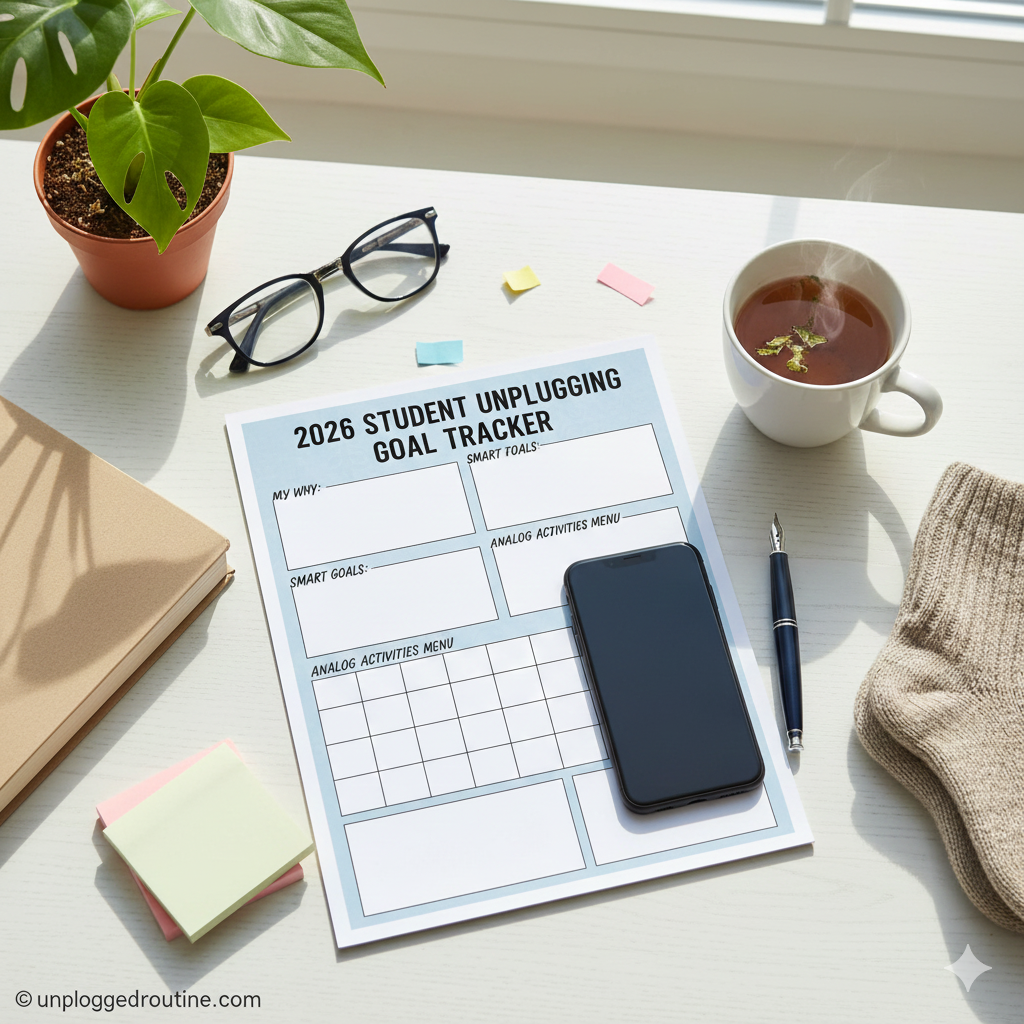
7. Track Your Progress (Your Free Printable Planner!)
Writing your goals down makes you 42% more likely to achieve them. That’s why I’ve created the “2026 Student Unplugging Goal Tracker.”
What’s inside the planner:
- Daily Screen-Free Blocks: Shaded areas for your “Digital Sunset” and “Deep Work” sessions.
- The “Why” Section: A place to write down your motivation so you don’t forget it during a FOMO moment.
- The Analog Activity Menu: A checklist of offline things you actually enjoy doing.
- Weekly Reflection: A space to note how your focus and mood improved.
Conclusion: Your Most Focused Year Starts Now
Setting effective unplugging goals isn’t about being perfect; it’s about being better than you were yesterday. As a student in 2026, the ability to disconnect is your greatest competitive advantage. It’s how you’ll out-study, out-create, and out-live the burnout that stops so many others.
Use the SMART framework, download your planner, and remember to be kind to yourself. If you slip up and scroll for an hour, don’t throw away the whole day. Just put the phone down, take a deep breath, and start your unplugging routine again.
You’ve got this!
I want to hear from you! What is ONE specific unplugging goal you’re setting for yourself this month? Share it in the comments below—let’s hold each other accountable!
Want more tips on staying focused? Check out our previous post on 2026 Digital Detox Trends Students Should Follow to stay ahead of the curve!