🤯 Are You Confusing Distraction with Rest?
We all know the feeling. You’re stressed from work, so you take a “break.” You put down your laptop, pick up your phone, and spend twenty frantic minutes scrolling social media or watching a fast-paced video.
Do you feel rested afterward?
Probably not. You’ve simply traded one type of mental activity (work stress) for another (digital overwhelm). That wasn’t a reset; it was just a distraction detour.
The constant digital noise means our minds rarely get a chance to truly shut down, leading to chronic fatigue, shallow breathing, and that nagging sense that you’re always missing something.
You deserve real rest. You deserve genuine, deep clarity.
✨ The Holy Trinity of Wellness
What if you could combine three simple, powerful, and scientifically-backed practices into one seamless unplugging routine that guarantees a mind-body reset every time?
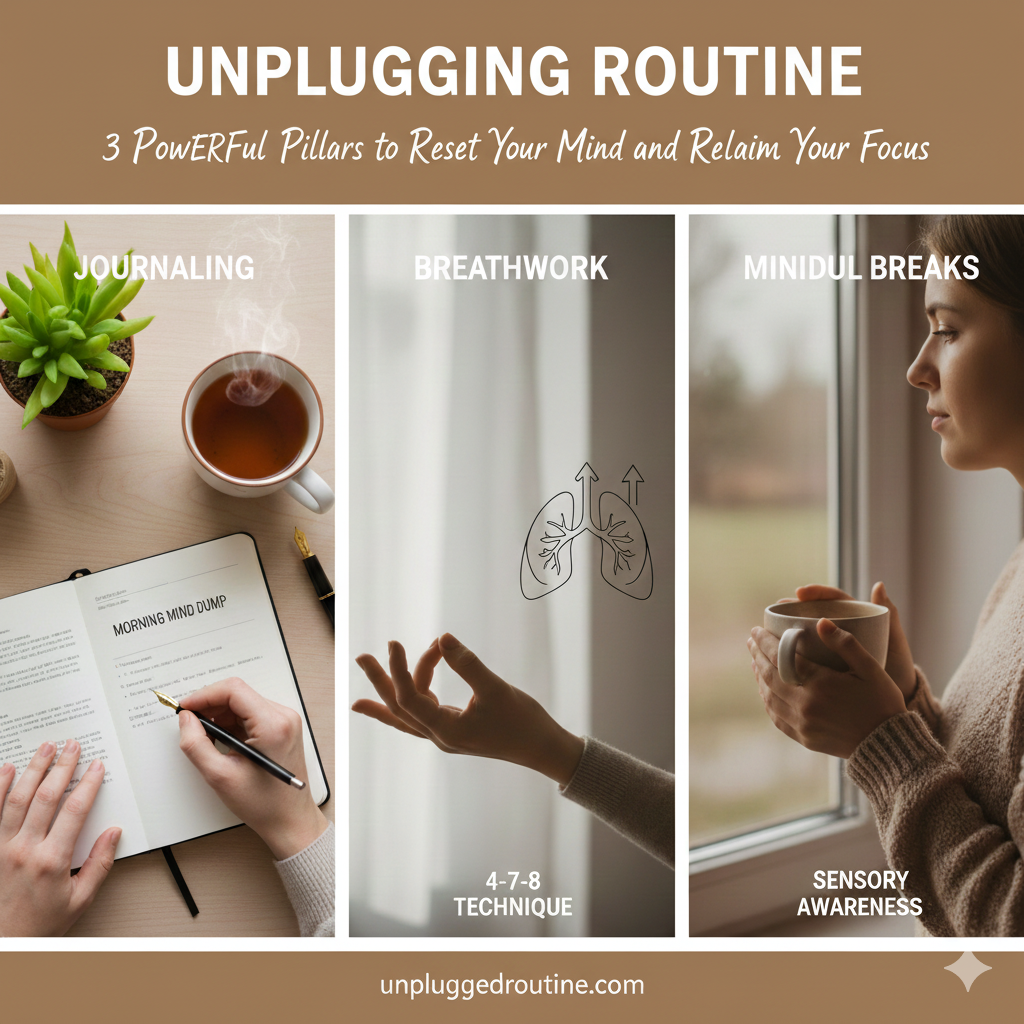
You can. The solution isn’t another app or a costly retreat; it’s a strategic combination of:
- Journaling: To process mental chaos.
- Breathwork: To physically reset your nervous system.
- Mindful Breaks: To anchor you firmly in the present moment.
These three pillars work in synergy, treating the mind, body, and spirit simultaneously. They are the keys to building a robust defense against digital fatigue.
In this ultimate guide, we’re going to dive deep into each pillar, explain why they work together, and give you the exact framework for structuring your own Unplugging Routine that finally brings peace back into your everyday life.
Ready to trade frantic scrolling for genuine calm? Let’s start building your new routine.
The Crisis of Constant Connection
To appreciate the solution, we must first understand the problem we’re fighting: the physical and mental fallout of being constantly plugged in.
The Mind-Body Disconnect
Digital overload doesn’t just make you mentally tired; it affects your physical state.
Constant low-level stress—from email alerts to endless news cycles—keeps your nervous system in a state of chronic sympathetic activation (fight or flight).
Your breath becomes shallow, your heart rate remains elevated, and your muscles stay tense. A mental reset requires a physical reset, which is why simply thinking “I need to calm down” rarely works.
The Focus Fragmentation Trap
The constant stream of notifications and switching between digital tasks trains our brains for distraction, not depth.
We become experts at shallow focus but struggle when we need to concentrate deeply for long periods. This leads to a low-grade, constant frustration because we feel busy but rarely productive or truly present.
To counter this, your Unplugging Routine must address both the turbulent mental landscape (Journaling) and the hyper-vigilant physical body (Breathwork), while strengthening your ability to remain anchored (Mindful Breaks).
🧱 Pillar 1: Journaling (The Mind Dump for Clarity)
Journaling is the strategic tool for transforming abstract emotional chaos into concrete, manageable information.
Role: Processing and Gaining Perspective
Your mind is a terrible filing cabinet. Thoughts tumble around, gaining power simply because they are stuck in a loop.
Journaling forces you to take those looping, stressful thoughts out of your head and deposit them onto the page. This simple act immediately creates emotional distance and frees up crucial working memory.
When you can see the thought (e.g., “I’m worried about that comment on my post”), you can deal with it logically, instead of just feeling the anxiety it causes.
Core Tactics for Your Unplugging Routine
- The Brain Dump: The most essential journaling tactic. Set a timer for five minutes and write down every single thought, worry, task, or feeling that pops into your head. Write without censoring or stopping. This clears the slate for the deeper work.
- Boundary Setting Log: Use your journal to establish and affirm your digital limits. Write down when you will put your phone away and what you will do instead (e.g., “Phone off at 8 PM. Read a physical book until 9 PM.”). Writing it makes the commitment more concrete and effective.
When to Use It:
- First thing in the morning: To clear the mental slate before the day’s demands hit.
- After a stressful digital interaction: To vent the emotion instead of carrying it.
- Before bed: To process the day’s thoughts and worries for better sleep.
🌬️ Pillar 2: Breathwork (The Nervous System Reset)
If journaling addresses the mind, Breathwork addresses the body’s reaction to stress. This is the fastest, most effective way to shift your physical state from stress to calm.
Role: Physiology and Immediate Calm
Your breath is the only system directly controlled by both your conscious and unconscious mind. When you are stressed, your breath is shallow and fast (sympathetic mode). By deliberately slowing and deepening your breath, you send a direct signal to your brain that you are safe.
This quickly engages your parasympathetic nervous system, lowering your heart rate, relaxing your muscles, and flooding your system with a sense of peace.
Core Tactics for Your Unplugging Routine
- Box Breathing (4-4-4-4):
- Inhale slowly for a count of 4.
- Hold for a count of 4.
- Exhale slowly for a count of 4.
- Hold for a count of 4.
- Repeat 5–10 times. This technique is used by the military and first responders to rapidly restore focus and calm under pressure.
- 4-7-8 Technique (Relaxation Breath):
- Exhale completely through your mouth.
- Inhale quietly through your nose for a count of 4.
- Hold your breath for a count of 7.
- Exhale completely through your mouth for a count of 8.
- Repeat only three times to start. This technique is excellent for calming anxiety and preparing for sleep.
When to Use It:
- Immediately after checking social media or email and feeling a surge of anxiety.
- Before switching tasks: To cleanse your focus and signal a reset.
- Anytime you feel the urge to “doomscroll”: Use it as a mental circuit breaker.
🌳 Pillar 3: Mindful Breaks (The Present Moment Anchor)
Once your mind is clearer from journaling and your body is calmer from breathwork, you’re ready to fully engage in the present. Mindful breaks are about intentionally stepping away from digital devices and immersing yourself in your immediate, non-digital reality.
Role: Sensory Focus and Presence
In our digital world, we spend so much time in our heads, consuming information that isn’t physically present. Mindful breaks pull you out of the abstract digital realm and ground you in the concrete reality of your senses.
This practice strengthens your attention muscle, making you less susceptible to digital distraction and more aware of the richness of everyday life. It’s about savoring the small moments we often rush past.
Core Tactics for Your Unplugging Routine
- Sensory Awareness Break (5 Minutes):
- Find a quiet spot. Put your phone away.
- Consciously notice 5 things you can see (colors, shapes, textures).
- Notice 4 things you can feel (the chair beneath you, the temperature of the air, your clothes).
- Notice 3 things you can hear (background sounds, your own breath).
- Notice 2 things you can smell (coffee, fresh air, your lotion).
- Notice 1 thing you can taste (even if it’s just your breath).
- This brings you fully into your physical body and environment.
- Single-Task Focus Break (10-15 Minutes):
- Choose one simple, non-digital activity and devote your full, undivided attention to it.
- Examples: Drinking a cup of tea, watering a plant, listening to one song, washing one dish, taking a short walk without a phone.
- The key is to avoid multitasking and truly immerse yourself in that single action, noticing all its details.
When to Use It:
- Mid-morning or mid-afternoon: To break up long stretches of screen time and prevent fatigue.
- During meal times: To actually taste your food and connect with those around you, rather than scrolling.
- Transitioning between activities: To create a clear boundary between your digital and real-world tasks.
🤝 The Synergy: Structuring Your Ultimate Unplugging Routine
The true magic happens when you weave these three powerful practices together. Each pillar supports and enhances the others, creating a holistic system that is far greater than the sum of its parts. This is your Unplugging Routine blueprint.
The Morning Launch: Clarity & Calm to Start Your Day
This morning sequence sets an intentional tone, preventing you from immediately diving into the digital chaos.
- Journaling (5-10 Minutes):
- Brain Dump: Get all those overnight thoughts and the day’s tasks out of your head and onto the page.
- Intention Setting: What’s one feeling you want to cultivate today? What’s one digital boundary you want to hold?
- Breathwork (3-5 Minutes):
- Immediately after journaling, practice Box Breathing or the 4-7-8 Technique.
- This calms your nervous system, solidifying the mental clarity you just gained from journaling and preparing your brain for focused work, not distraction.
The Midday Micro-Reset: Combatting Fatigue & Reclaiming Focus
This short, powerful break prevents the afternoon slump and the urge to “check out” digitally.
- Breathwork (2-3 Minutes):
- Take a quick Box Breath break. Close your eyes and take 5–10 deep, conscious breaths. This acts as an immediate physiological reset.
- Mindful Break (5-7 Minutes):
- Combine this with a Sensory Awareness Break. Step outside, even if for just two minutes, or take a Single-Task Focus Break by slowly savoring a glass of water.
The Evening Wind-Down: Processing & Deep Rest
This evening routine prepares your mind and body for restorative sleep, free from digital residue.
- Journaling (5-10 Minutes):
- Reflective Questions: How did your digital boundaries hold up? What are you genuinely grateful for today?
- Digital Detox Dream: Write about how you want to feel tomorrow after a night of true rest.
- Mindful Break (10-15 Minutes):
- Engage in a Single-Task Focus Break like reading a physical book or listening to calming music. Avoid any screens during this time to create a peaceful transition to sleep.
🛠️ Troubleshooting Your Unplugging Routine
Starting any new routine can have its challenges, especially when it involves breaking digital habits. Here’s how to make your Unplugging Routine stick:
Start Small: The 5-Minute Rule is Your Best Friend
Don’t aim for perfection. Commit to the 5-Minute Rule for each pillar. Five minutes of journaling, two minutes of breathwork, five minutes of mindful break. Consistency with small wins is what truly counts.
Be Flexible, Not Rigid
If you miss a morning routine, don’t throw in the towel for the whole day. Pick it up at midday. The goal is consistency over perfection. This is about being kind to yourself, not adding another source of stress.
Handle Digital Urges with Awareness
When the urge to grab your phone strikes, pause. Acknowledge the urge. Then, consciously choose to do 1-2 minutes of Breathwork instead. This pause is usually enough to engage your rational brain and interrupt the unconscious habit.
Make It an Environment: Design Your Space
Create physical cues. Keep your journal and pen visible. Designate a “no-phone zone” in your home. These environmental nudges make it easier to default to your Unplugging Routine rather than reaching for a screen.
Conclusion: Your Path to Lasting Digital Peace
In a world that constantly demands your attention, creating intentional moments to unplug and reset your mind isn’t just a good idea—it’s essential for your well-being, focus, and joy.
You now have the ultimate blueprint: Journaling for mental clarity, Breathwork for physical calm, and Mindful Breaks for present moment awareness. These three pillars, combined thoughtfully, empower you to navigate the digital age with grace, resilience, and genuine peace.
Stop letting your devices dictate your mood. Start dictating your own peace.
Are you ready to truly unplug and reclaim your focus?
Commit to one small step today: Choose one pillar (Journaling, Breathwork, or Mindful Break) and dedicate just 5 minutes to it right now. Feel the shift.
Visit unpluggedroutine.com to download our exclusive “3-Day Unplugging Routine Starter Kit,” featuring guided prompts and audio breathwork exercises to help you implement this powerful synergy.
Start your unplugged routine today—your calmer, more focused self is waiting!