Good morning (or good evening!) to all our fellow unpluggers. Let’s talk about timing.
You know that stepping away from screens is vital for your peace and happiness. But here’s the million-dollar question we hear all the time: When is the best time to disconnect? Should you start your day with a screen-free sunrise, or should you cap off your evening with a calm, digital-free wind-down?
The truth is, there’s no single, one-size-fits-all answer. Both Morning vs. Evening Unplugging offer profound, distinct benefits to your brain, your mood, and your productivity. Choosing the right time for you depends entirely on your daily routine, your biggest stress points, and your personal goals.
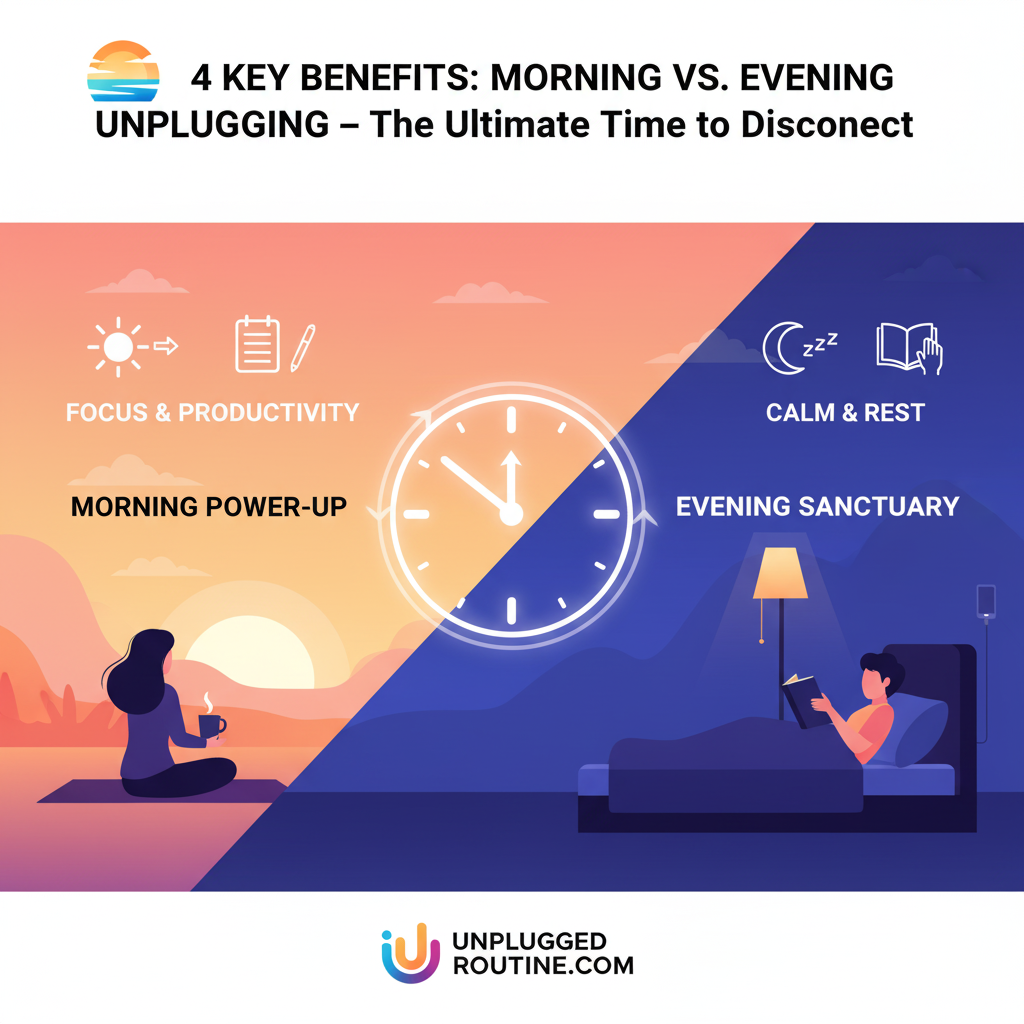
The Big Hook: Why Timing Your Detox Matters More Than You Think
Imagine trying to go for a run right after eating a massive meal—your body just isn’t ready for peak performance. The same principle applies to your digital breaks.
The human body operates on a powerful internal clock called the circadian rhythm. This rhythm governs everything from when you feel alert to when you feel sleepy, and it profoundly influences how your brain reacts to stimuli—including screens—at different times of the day.
Your digital habits can either support or sabotage this natural rhythm. An intentional unplugging period, timed correctly, can act like a powerful reset button, optimizing your brain’s chemistry for focus and calm.
Ready to understand the distinct superpowers of disconnecting in the A.M. versus the P.M.? Let’s explore the 4 Key Benefits of the great Morning vs. Evening Unplugging debate and help you find your perfect rhythm.
The Morning Unplugging Power-Up (A.M. Focus)
When you wake up, your brain is in a powerful, impressionable state. The first hour of your day sets the tone for your energy, focus, and mood. Starting it with a screen-free ritual offers immediate and profound cognitive benefits.
Benefit 1: 🛡️ Protect Your Dopamine and Focus
The Challenge: The moment you check your phone in the morning (emails, social media, news), you flood your brain with a chaotic rush of information and dopamine hits. This immediately puts your brain in a reactive, anxious state. You start the day playing defense against everyone else’s priorities.
The Power of A.M. Unplugging: By delaying that first digital hit, you protect your brain’s precious dopamine supply. Instead of wasting it on low-value scrolling, you reserve it for tasks that require true focus and creative thinking. This allows you to set your own agenda and goals before the world intervenes.
The Science: Your prefrontal cortex is strongest in the morning. A screen-free start allows this area—responsible for planning and decision-making—to prioritize, rather than be hijacked by urgent but non-important notifications.
Hook Step 1: The “Hour of Power” Rule
Commit to one hour after waking up before looking at any screens (phone, TV, computer). Use this time for high-value activities: journaling, meditation, exercise, or planning your three most important tasks for the day. You’ll notice a massive shift in your sense of control.
Benefit 2: ⚖️ Reduce Morning Stress and Anxiety
The Challenge: News feeds are designed to highlight conflict and urgency. Checking them first thing injects a dose of anxiety and negativity directly into your nervous system, before you’ve even had a chance to regulate your mood.
The Power of A.M. Unplugging: A screen-free morning acts as a buffer. It gives you time to transition from sleep to wakefulness gently. You can consciously choose peace, rather than have panic thrust upon you. This reduces the morning surge of stress hormones like cortisol that can be triggered by digital alerts.
The Benefit: By the time you do check your device, your mind is calmer, more grounded, and better equipped to process information without spiraling into worry or distraction.
Hook Step 2: The “Sunrise Stretch” Swap
Instead of reaching for your phone, reach for a yoga mat or simply stretch for five minutes. Tune into your body, not your device. Connect with your physical self first—it’s an incredible grounding technique that overrides the urge to immediately connect digitally.
The Evening Unplugging Sanctuary (P.M. Calm)
As the sun sets, your body’s goal shifts from productivity to preparation for rest. Evening unplugging is less about optimizing work and more about optimizing recovery and deep sleep.
Benefit 3: 🛌 Optimize Your Sleep Quality
The Challenge: Screens emit blue light, which is incredibly effective at suppressing melatonin, the hormone that regulates your sleep-wake cycle. Scrolling through stimulating content (like work emails or dramatic social media posts) right before bed keeps your mind whirring.
The Power of P.M. Unplugging: Implementing a digital curfew is the single most powerful tool for improving sleep quality. By putting screens away 60-90 minutes before bed, you allow your body to naturally ramp up melatonin production. This signals to your brain that it’s time to wind down.
The Science: Restoring your natural circadian rhythm through reduced blue light exposure ensures you fall asleep faster and achieve more deep, restorative REM sleep. Better sleep means better mood, focus, and stress management the next day.
Hook Step 3: The “9 PM Blackout” Rule
Commit to a hard “blackout” time every night (e.g., 9:00 PM). After this time, all non-essential screens (phone, tablet, computer) are powered down or banished from the common areas. Replace screen time with a calming, offline ritual like reading a physical book, listening to soft music, or taking a bath.
Benefit 4: 👨👩👧👦 Deepen Real-Life Relationships
The Challenge: The evening is prime time for family, friends, or simply connecting with a partner. However, constant phone checking creates “phubbing” (phone snubbing) and dramatically reduces the quality of in-person interactions. Even if the phone is quiet, its mere presence distracts from true intimacy.
The Power of P.M. Unplugging: By disconnecting in the evening, you create dedicated, distraction-free time for meaningful connection. This allows for deep listening, shared experiences, and authentic conversation, which are fundamental drivers of happiness and well-being.
The Benefit: When you put your phone away, you activate mirror neurons in your brain that allow for true empathy and connection. You’re fully present, which makes your time with loved ones feel more valuable and memorable.
Hook Step 4: The “Conversation Catalyst” Jar
Place all phones in a basket as you enter the evening hours. Keep a jar filled with fun, open-ended “Conversation Catalyst” questions (e.g., “What was the most surprising thing you learned today?” or “If you could instantly gain one talent, what would it be?”) to encourage genuine, screen-free interaction.
Morning vs. Evening Unplugging: Which is Best for You?
Ultimately, the best time to unplug is the time that addresses your biggest pain point.
| If Your Goal Is… | The Best Time to Unplug Is… | Why? (The Core Benefit) |
| Maximizing Daily Productivity | Morning (A.M.) | Protects dopamine, sets priorities, and ensures you work on your goals first. |
| Achieving Deep, Restful Sleep | Evening (P.M.) | Eliminates blue light, allowing natural melatonin production and calming the mind. |
| Reducing General Anxiety | Both A.M. and P.M. | A.M. prevents the initial stress trigger; P.M. allows the nervous system to relax and recover. |
| Improving Relationships/Family Time | Evening (P.M.) | Ensures you are fully present during crucial social and relaxing hours. |
The Hybrid Solution: Embrace Both
The most powerful routine often involves a combination: the “Bookends Approach.”
- The Morning Boundary: Commit to a screen-free start (30-60 minutes) to establish control and focus.
- The Evening Cutoff: Commit to a fixed digital curfew (60-90 minutes before bed) to ensure restorative sleep.
This two-pronged approach tackles the root causes of both daytime distraction and nighttime anxiety, giving you maximum control over your well-being.
Take Control of Your Time, Not Just Your Technology
The debate between Morning vs. Evening Unplugging teaches us that technology is a neutral tool, and the impact it has on our lives is entirely dependent on when and how we choose to engage with it.
By strategically placing unplugged periods into your day, you are no longer passively allowing technology to dictate your mood or your attention. You are taking back control of your brain chemistry, your focus, your sleep, and your relationships. Whether you choose to prioritize the power of the morning or the peace of the evening, intentional disconnection is the key to a calmer, happier, and more productive life.
Set Your Unplugging Time Today!
Ready to start timing your way to a calmer life?
We challenge you to choose the unplugging period that addresses your biggest struggle right now—Morning (A.M.) or Evening (P.M.)—and commit to the relevant Hook Step for three days.
Which will you choose? Are you a Morning Power-Up person, or an Evening Sanctuary seeker? Share your choice and why in the comments below!
For personalized plans and guides on mastering your digital downtime, be sure to subscribe to our newsletter at unpluggedroutine.com.